Swett's
Our verdict
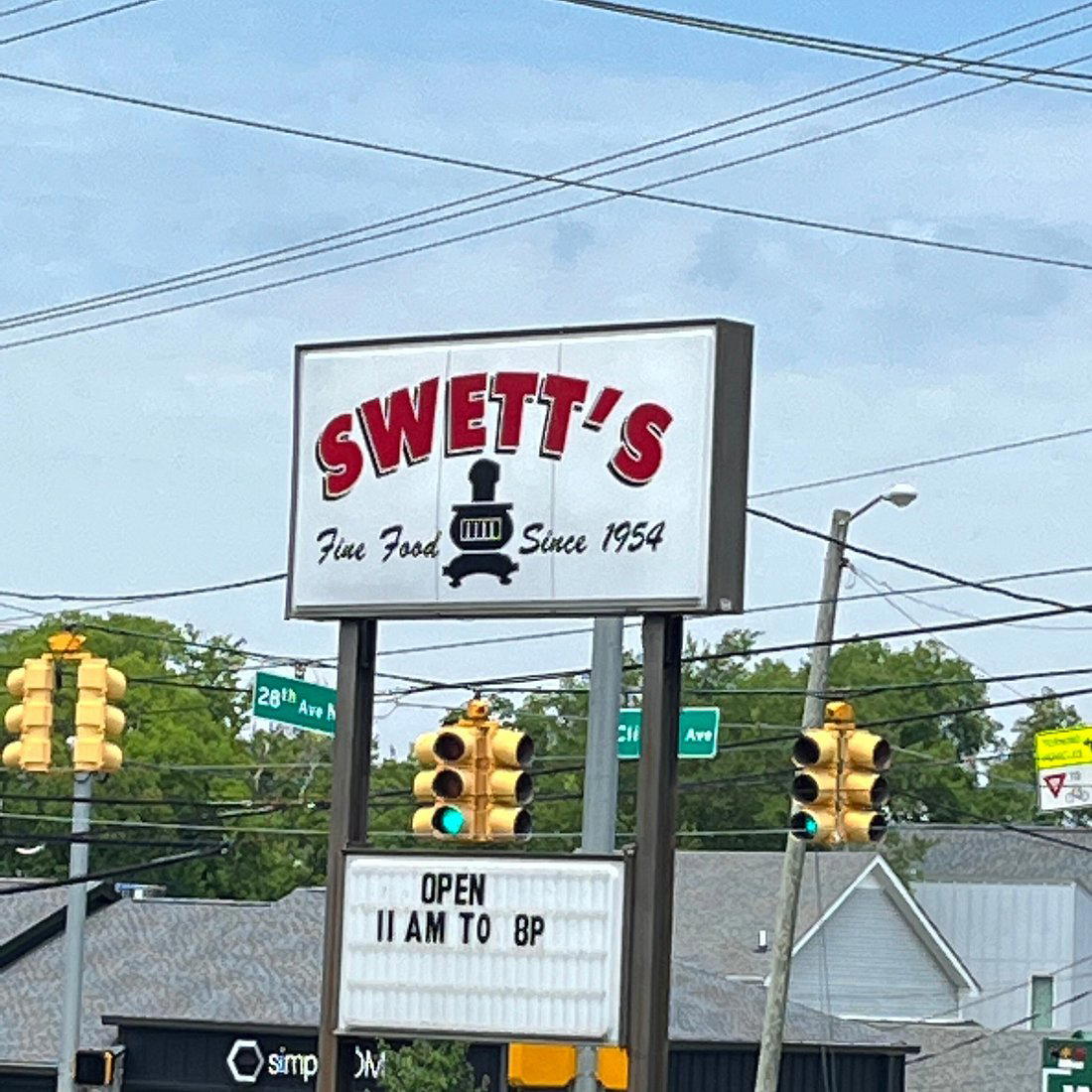
Swett's on Clifton Avenue is one of Nashville's most enduring soul food institutions, serving the kind of cafeteria-line Southern cooking that feeds neighbourhoods rather than trends. The menu reads as a document of Tennessee tradition: slow-cooked vegetables, braised meats, and cornbread that answers no contemporary pressure to reinvent itself. For anyone tracing the roots of what Nashville actually eats, this is essential ground.

Pearl is the En Primeur Club membership app — saves, bookings, and concierge access live there. Same editors, same standards.
- Address
- 2725 Clifton Ave, Nashville, TN 37209
- Phone
- (615) 329-4418
- Hours
- Daily 11 AM–8 PM
- Website
- swettsrestaurant.shop
- Directions
- Get directions
The menu
What to order
- Fried chicken
- Baked barbecue chicken
- Squash casserole
The Room Before the Food
Clifton Avenue runs through a part of Nashville that guidebooks have largely left alone. The building that houses Swett's is utilitarian in the way that places with genuine purpose tend to be: no design concept, no ambient playlist calibrated for Instagram, no host stand with a clipboard. What you encounter instead is a cafeteria line, the kind where trays slide along a metal rail and the decision-making happens face to face with the food itself. The steam rising from the serving pans is the atmosphere. The hum of conversation from regulars who have been eating here across decades is the soundtrack. This is a dining room that was never designed to impress visitors — which is precisely why it does.
Nashville's restaurant conversation in recent years has concentrated heavily on the corridor running from the Gulch through 12South toward East Nashville, where projects like Bastion and Locust have pushed the city toward a more technically ambitious register. The Catbird Seat operates at the counter-experience end of that spectrum. Peninsula and 12 South Taproom and Grill address different niches within the same broadly upward-trending market. Swett's sits outside all of those reference points.
What the Cafeteria Line Reveals
The cafeteria format is itself an editorial statement about who the food is for and how it should be encountered. There is no tasting menu logic here, no chef-led narrative of courses building toward a conclusion. The menu architecture at a place like Swett's operates on the principle of abundance and choice: a rotating selection of proteins, a long bench of sides, and the expectation that regulars know what they want before they reach the front of the line.
Southern cafeteria cooking of this type carries specific structural conventions. Vegetables — field peas, collard greens, butter beans, candied yams, are cooked low and slow, often with pork as a background flavour agent rather than a featured ingredient. Proteins rotate by day, with fried chicken, oxtail, and smothered pork chops among the categories that define the tradition. Cornbread arrives as a functional accompaniment rather than a bread course. The logic of the plate is one of accumulation: sides are not supporting players but co-equal components of the meal. Understanding this changes how you read the line. You are not selecting a main and then filling in around it. You are composing a plate from a palette of equally weighted preparations.
This structure places Swett's in a direct lineage with the soul food cafeteria tradition that has sustained working neighbourhoods across the American South for generations. The same format produced the lunch counters of Birmingham, the Sunday-after-church spreads of Memphis, and the daily-plate tradition that institutions like Arnold's Country Kitchen have maintained in Nashville itself. The format is not retro; it was never abandoned long enough to require revival.
Swett's in the Broader American Dining Conversation
American fine dining has spent the last two decades in active conversation with its own roots. The farm-to-table movement, the revival of regional grain traditions, and the increasing willingness of high-end restaurants to name their Southern influences explicitly have all contributed to a critical reassessment of what counts as serious cooking. Blue Hill at Stone Barns built its reputation on ingredient sourcing as philosophy. Smyth in Chicago and Single Thread Farm in Healdsburg each pursue a version of hyper-local, seasonal authority. Lazy Bear in San Francisco reframes communal eating as an event format. At the furthest reaches of the formal register, places like Le Bernardin, The French Laundry, Providence, Addison, Atomix, The Inn at Little Washington, Emeril's, and Atelier Moessmer Norbert Niederkofler each operate within highly codified tasting structures that position the chef as author.
Swett's participates in none of that framing. The food has no authorial signature in the contemporary sense; it has a tradition. That tradition is as technically demanding as anything produced in a modernist kitchen, even if the techniques are invisible rather than showcased. Getting collard greens right across a daily service operation requires consistency that most tasting-menu kitchens are never tested on. The same applies to the timing of a fried chicken service, the salt calibration of long-cooked beans, or the texture of a properly executed sweet potato. The skills are different; they are not lesser.
Nashville's Soul Food Geography
Understanding where Swett's sits geographically within Nashville matters. Clifton Avenue is not in the part of the city that receives the bulk of food-tourism attention. This is not proximity to the honky-tonks of Lower Broadway or the weekend-brunch density of 12 South. The address locates the restaurant within a residential neighbourhood context, which in part explains its role as a community anchor rather than a dining destination in the tourism-industry sense. For the full picture of where Swett's fits across Nashville's restaurant spectrum, the EP Club Nashville restaurants guide maps the city by neighbourhood and category.
The distinction between destination restaurant and neighbourhood institution is not about quality; it is about function and audience. Swett's has maintained its position within the latter category across decades, which in practice means it has survived the pressures, rising rents, shifting demographics, the pull of trend, that have closed many comparable operations across American cities. Longevity of that kind, in the cafeteria soul food category, is itself a credential.
Planning Your Visit
Swett's is located at 2725 Clifton Ave, Nashville, TN 37209. Given the cafeteria format and the volume of regulars the restaurant serves, arrival during peak lunch hours will mean a line; the format moves efficiently, but patience during busy periods is part of the experience. No reservations are required or, given the walk-up format, possible. Dress is entirely casual. Those arriving from the city's hotel core should factor in the drive west rather than assuming walkability from downtown.
Frequently asked questions
What is the signature dish at Swett's?
Swett's does not operate around a single signature dish in the way that a chef-driven restaurant might. The soul food cafeteria format means the menu rotates through a range of preparations, fried chicken, oxtail, smothered meats, and an extended bench of cooked vegetables and sides, and the combination you compose at the tray line is the point. Regulars tend to have fixed preferences, but the plate is always an assembly rather than a single anchoring item. For context on how Nashville's broader restaurant scene approaches Southern cooking, see the EP Club Nashville guide.
Do I need a reservation for Swett's?
No reservation is needed or available. The cafeteria walk-up format means access is entirely first-come, and the line, when it forms, moves at the pace of the service rather than a booking system. If you are visiting during peak lunch hours, expect a wait. Nashville's more formally structured restaurants, Bastion and The Catbird Seat, for instance, operate on advance reservation systems that reward early planning.
What has Swett's built its reputation on?
Swett's reputation rests on consistency across a long operating history in a cuisine, Southern soul food cafeteria cooking, that demands daily discipline in slow-cooking techniques, rotation management, and volume service. The credibility is neighbourhood-rooted rather than award-circuit derived: the restaurant feeds a regular customer base that returns not for novelty but for reliability. That distinction places it in a different critical register than Nashville's newer wave of chef-driven projects, but not a lower one.
Can Swett's handle vegetarian requests?
Southern cafeteria cooking of this tradition uses pork as a background flavouring agent in many vegetable preparations, which means dishes that appear plant-based may not be strictly vegetarian. If dietary restrictions are a concern, the most direct approach is to contact the restaurant or arrive and ask at the line. For Nashville dining options with more explicitly documented dietary accommodation, the EP Club Nashville guide covers the broader range of city restaurants.
Is Swett's the kind of place that locals eat regularly, or is it primarily visited by out-of-towners looking for authentic Nashville food?
Swett's draws from a genuinely local, neighbourhood-based customer base that has sustained the restaurant across decades on Clifton Avenue, this is not a destination that was discovered by food tourism and reoriented toward visitors. The cafeteria format, the residential address, and the long-standing regulars all point to a function as a community institution first. Out-of-towners who find their way there are arriving at something real rather than a curated version of it, which places Swett's in a different category from the Southern cooking experiences built partly around visiting audiences.
Cuisine and Awards Snapshot
Comparable venues nearby, for context on price, style, and recognition.
| Venue | Cuisine | Price | Notes |
|---|---|---|---|
| Swett'sThis venue — the venue you are viewing | Classic Southern Soul Food Meat-and-Three | $20–30 | Not listed |
| Hattie B's Hot Chicken - Nashville - Midtown | Nashville Hot Chicken | $20–30 | Music Row |
| Germantown Café | American Southern Comfort | $20–30 | Germantown |
| Noshville Delicatessen | New York-Style Deli | $10–20 | Midtown |
| Midtown Cafe | American with Southern Flair | $30–50 | Music Row |
| Monells Cafe | Southern Family-Style Comfort Food | $20–30 | Germantown |
Continue exploring
More in Nashville
Restaurants in Nashville
Browse all →
Bars in Nashville
Browse all →
Hotels in Nashville
Browse all →
Wineries in Nashville
Browse all →
Details
- Classic
- Well Known
- Cozy
- Rustic
- Family
- Casual Hangout
- Group Dining
- Historic Building
- A La Carte
- Gluten Free Options
Current opening hours
- Monday
- 11 AM–8 PM
- Tuesday
- 11 AM–8 PM
- Wednesday
- 11 AM–8 PM
- Thursday
- 11 AM–8 PM
- Friday
- 11 AM–8 PM
- Saturday
- 11 AM–8 PM
- Sunday
- 11 AM–8 PM
Hours can change for holidays and private events. Last verified .
Nostalgic cafeteria-style dining with green tables in a clean, well-maintained space evoking family traditions and Southern comfort.