
Tabelog 100 #34
Our verdict
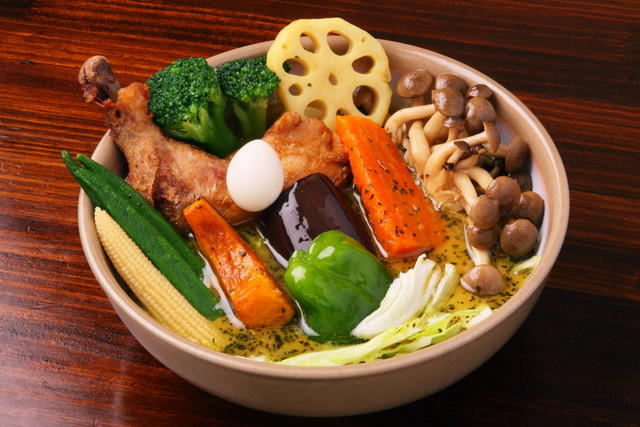
Sapporo’s soup curry ritual is casual, highly personal, and more structured than it first appears: broth choice, spice level, rice, toppings, then the slow alternation between spoon and plate. SOUP CURRY KING Sentoraru sits in that tradition with Tabelog Curry EAST “Tabelog 100” selections in 2020, 2023, and 2024, placing a basement Tanukikoji counter in the city’s serious curry conversation.

Pearl is the En Primeur Club membership app, where members save venues, book tables and use the concierge.
The menu
What to order
- Chicken curry
- Seafood curry
- Pork kakuni curry
- Lamb vegetable curry
Sapporo’s casual dining rooms have their own rhythm: quick decisions at the entrance, clear preferences at ordering, and meals built for diners who know exactly how they want their lunch to move. In Sapporo, soup curry is not treated as a novelty bowl but as a local eating system, closer to ramen in its ritual than to a conventional curry plate. The diner chooses heat, rice, add-ons, and pacing; the meal works through broth and spoon rather than sauce and fork.
That distinction matters. Japanese curry elsewhere often leans toward thickness, sweetness, and rice-first comfort. Sapporo soup curry is looser, more aromatic, and designed around customization. The form is strongly associated with the city and has become one of Hokkaido’s defining casual dishes, helped by cold winters, vegetable culture, and a local appetite for food that can feel both restorative and forceful. SOUP CURRY KING Sentoraru belongs to that lineage, listed for Soup Curry and Curry and recognized in Tabelog’s 2024 Hyakumeiten selection. In a city crowded with curry specialists, that inclusion gives the room a clearer signal than social-media noise.
Sapporo soup curry is a ritual of broth, rice, and heat
The pleasure of soup curry lies in sequence. Rice is not buried under sauce; it is managed alongside broth. Vegetables are not garnish; they give the bowl its architecture. Spice is not a single burn; it is adjusted to match appetite, weather, and tolerance. The format rewards diners who slow down enough to work between elements rather than treating the bowl as a race.
That is why Sapporo’s curry map divides into useful subcultures. There are other curry rooms, specialist counters, and spice-led casual stops across the city. Soup curry sits apart from all of them. It has the informality of a weekday meal, but the decision tree of a more technical format.
The setting reinforces that tempo. A focused curry stop suited to solo dining and quick-turn meals is part of the genre’s appeal. Soup curry is not a ceremony in the kaiseki sense; it is a repeatable urban habit. The serious versions are judged on balance, depth, and how well the bowl holds attention after the first hit of spice.
Recognition matters in a city where curry has depth
Sapporo’s dining reputation travels easily through seafood, ramen, dairy, and winter markets, but curry deserves a firmer place in that hierarchy. Tabelog’s Hyakumeiten lists are useful here because they separate broad popularity from category-specific strength. A category selection places a restaurant against closer peers rather than against every casual dining room in Japan. For travelers, that frame is more helpful than a general score alone.
SOUP CURRY KING Sentoraru’s Tabelog score is 3.68, with a listed budget of JPY 1,000 to JPY 1,999 for lunch and dinner. Those figures position it in an unusually accessible bracket for a recognized Sapporo specialist. The editorial point is not luxury; it is precision within a democratic format. The city’s dining range can run from compact curry counters to serious reservations at places such as ç°ä¹ é®, メリメロ, Yakiniku Gurumans Ito, 月下翁, and はなれ味重, but soup curry occupies a different lane: high local relevance without formal-dining expense.
For a wider Sapporo eating plan, pair this category with other casual stops, then to map the city by area rather than by isolated reservations.
How to read this stop in a Japan itinerary
The reason to place a soup curry meal in a Sapporo schedule is contrast. Tokyo and Osaka can overwhelm visitors with breadth; Sapporo is more legible when approached through its recurring local forms. A bowl here explains something about the city’s climate, lunch culture, and tolerance for spice-led comfort. It is also a useful counterweight to sushi, yakiniku, and izakaya meals that often dominate first-time planning.
Outside Hokkaido, Japanese casual dining can express similar discipline in many different formats, from grilled meat and seafood to café cooking, contemporary dining, and regional Japanese rooms. Abroad, Japanese food culture keeps evolving through casual counters, bars, and specialist kitchens. Sapporo soup curry belongs in that larger conversation because it proves that casual food can have strict internal logic.
The practical verdict is simple: treat this as a focused curry stop, not a lingering special-occasion meal. The appeal is a recognized local format, a Sapporo setting, and a price band that leaves room in the day for a second Sapporo specialty. For travelers who understand Japan through regional eating habits rather than trophy reservations alone, this is a useful marker.
Frequently asked questions
What's the price range at SOUP CURRY KING Sentoraru?
SOUP CURRY KING Sentoraru is listed at JPY 1,000–1,999 for both lunch and dinner.
What part of town is SOUP CURRY KING Sentoraru in?
Sapporo.
How far ahead should I plan for SOUP CURRY KING Sentoraru?
SOUP CURRY KING Sentoraru is a recognized Sapporo curry stop, so planning a little buffer around peak meal times is sensible. Its 2024 Tabelog Hyakumeiten recognition adds another reason to avoid treating lunch as an afterthought.
What's the defining dish or idea at SOUP CURRY KING Sentoraru?
The defining idea is soup curry served in the Sapporo style, with broth treated as the main event rather than a sauce. The restaurant sits in the JPY 1,000–1,999 range and is listed for Soup Curry and Curry.
Is SOUP CURRY KING Sentoraru good for vegetarians?
Vegetarian diners should confirm broth and topping choices before ordering, since the venue is built around soup curry. The practical appeal is the Sapporo setting and a price range of JPY 1,000–1,999.
Cuisine Lens
Comparable venues for orientation by cuisine and category.
| Venue | Cuisine | Price | Awards | Notes |
|---|---|---|---|---|
| SOUP CURRY KING SentoraruThis venue (the venue you are viewing) | Sapporo soup curry | $10–20 | Tabelog 100 #34 | Not listed |
| Keyaki (けやき) | Sapporo miso ramen shop | $10–20 | Tabelog 100 #85 | Susukino |
| Hana Maru | Japanese Ramen | $10–20 | Tabelog 100 #60 | Kiyota |
| Soup Curry & Dining Suage+ (suage+ 本店) | Sapporo soup curry specialty shop | $10–20 | Tabelog 100 #83 | Susukino, Chuo Ward |
| Tezukuri Hamburger Steak Kobo Toshi | Handmade Japanese hamburger steak (yōshoku) | $20–30 | Tabelog 100 #84 | Chūō |
| PULU2 | Sapporo soup curry house | $10–20 | Tabelog 100 #4 | Chūō |
Recognition history
Dated appearances from independent guides and award organizations, with the underlying list record or original source where available.
Tabelog 100 #34 · No. 34
Tabelog · Tabelog 100 - Curry - EAST - 2024
Continue exploring
More in Sapporo
Restaurants in Sapporo
All restaurants in Sapporo →
Bars in Sapporo
All bars in Sapporo →

Details
- Cozy
- Lively
- Solo
- Casual Hangout
- Group Dining
- After Work
- Family
- Standalone
- A La Carte
Casual basement soup curry shop near Tanukikoji with warm, cozy interiors and a lively, often busy atmosphere where guests queue at peak times.