
Tabelog 100 #46
Our verdict
Soba Tamaya puts Iwakuni into Japan’s serious okonomiyaki conversation without the luxury choreography attached to many destination restaurants. The draw is regional comfort food treated with enough consistency to earn selection for Tabelog 100 Okonomiyaki 2025, at a price tier that remains firmly everyday rather than occasion-only.

Pearl is the En Primeur Club membership app, where members save venues, book tables and use the concierge.
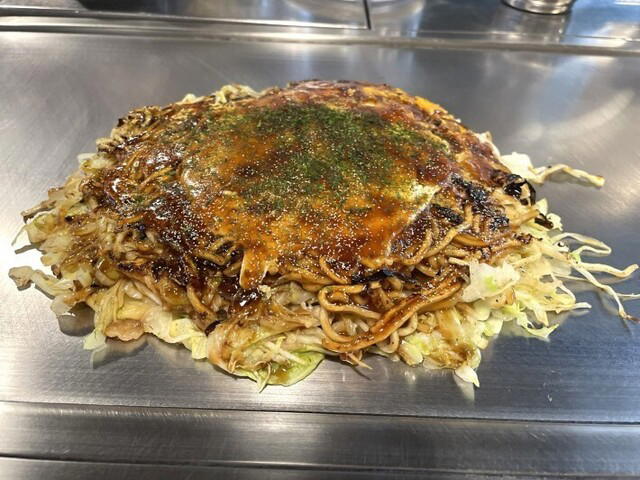
The menu
What to order
- Hiroshima-style okonomiyaki
- Yakisoba
- Wakemori champon
Approaching a local okonomiyaki room in Iwakuni is unlike entering a metropolitan tasting counter. The cues are practical: griddle heat, everyday pacing, and a social rhythm built for solo diners, families, and small groups rather than ceremony. Soba Tamaya fits that model, but its selection for Tabelog 100 Okonomiyaki 2025 moves it from local address to national conversation about how regional griddle cooking is judged.
Okonomiyaki is often framed through city identity, with Hiroshima and Osaka as reference points. Iwakuni is close enough to Hiroshima for that influence to matter, yet this is not mimicry. The area’s everyday dining culture favors food that serves lunch, dinner, and family use without performance. That matters because okonomiyaki depends less on luxury ingredients than control: batter or layers, cabbage, noodles where used, heat, timing, sauce, and the final texture that separates a careful griddle from a generic one.
Okonomiyaki judged by griddle discipline, not luxury signals
Japan’s premium dining conversation can overvalue scarcity, counter intimacy, and chef biography. Okonomiyaki resists that framing. Its credibility comes from repetition and sourcing decisions not always visible on a menu: cabbage condition, wheat-based structure, noodle handling, and how pork, seafood, egg, sauce, and garnish are integrated rather than piled on. Small flaws are amplified by the griddle. Watery cabbage dulls the pancake. Poor noodle texture turns heavy. Too much sauce erases the work underneath.
Soba Tamaya’s category listing, okonomiyaki and teppanyaki, places it in a broader Japanese tradition where the cooking surface is central. Teppanyaki here is not the luxury steakhouse theater familiar overseas; it is a working technique for heat transfer, browning, compression, and timing. The format signals use: not a hushed anniversary room, but a local restaurant where the griddle remains central and the customer mix suits everyday meals.
The Tabelog 100 Okonomiyaki 2025 selection is the relevant trust signal because the category is crowded and regionally competitive. A Tabelog score of 3.58 also needs local context: Japanese user-rating culture is conservative, and mid-3 scores can indicate serious traction, especially outside the largest dining markets. The award does not make the restaurant a luxury destination. It more usefully identifies a modestly priced Iwakuni address whose cooking is strong enough to be noticed beyond the neighborhood.
Iwakuni's case for everyday food with national relevance
Iwakuni is often treated as a side trip rather than a dining base, so its restaurants are easy to misread. The city’s food culture is less about spectacle than utility, repetition, and regional proximity. Hiroshima is close by rail, naturally shaping how visitors think about okonomiyaki in Yamaguchi. But dining only by famous-city categories misses the appeal of smaller places: they show how regional dishes survive as normal meals, not museum pieces.
That is where Soba Tamaya becomes useful editorially. It lets travelers understand Iwakuni through a dish driven by local demand rather than international branding. The price bracket, JPY 1,000 to JPY 1,999 for both lunch and dinner, reinforces the point. This is award-recognized food at a daily-use tariff, more revealing than another expensive counter meal. For readers mapping the city before arrival, Our full Iwakuni restaurants guide is the natural companion; those building a full itinerary can also cross-check Our full Iwakuni hotels guide, Our full Iwakuni bars guide, Our full Iwakuni wineries guide, and Our full Iwakuni experiences guide.
Compared with other Iwakuni-area names such as Cafe & Restaurant SIMOSE, TP dining & cafe tino, Sekitei, Momiji Do Honten, and Momiji Do Niban Ya, the appeal is narrower and clearer. Those addresses serve different travel needs within a broader itinerary. Soba Tamaya is the griddle-meal lane: low ceremony, high repetition, and a dish category with enough national scrutiny to make recognition meaningful.
How to read the room before choosing it
This restaurant rewards the right expectation. Choose it for a grounded okonomiyaki meal in Iwakuni, not a chef-led narrative or long-form tasting structure. Its appeal is casual and direct, built around the cooking surface rather than a secluded or theatrical dining format.
The price details show the tier. With lunch and dinner both listed at JPY 1,000 to JPY 1,999, the restaurant sits closer to Japan’s neighborhood dining economy than hotel-driven tourism infrastructure. For visitors from Hiroshima or using Iwakuni as a Chugoku itinerary stop, treat the meal as a compact regional anchor rather than a night-consuming event.
For broader Japanese dining context, contrast this everyday-griddle logic with formats elsewhere: beef-centered regional dining, izakaya-style seafood and charcoal, cafe dining, contemporary regional cooking, Vietnamese cooking in an urban Japanese setting, curry specialization, Kyoto minimalism, beef-focused dining, burger culture, Yokohama casual dining, mountain-hut dining, sake-bar culture, and rice-ball specialization.
The editorial verdict is restrained but clear: Soba Tamaya is strongest for travelers who want Iwakuni’s everyday food culture with a credible national marker attached. It is not trying to be a grand dining event, and that is the value. In a country where serious food often appears in modest rooms, an okonomiyaki restaurant with Tabelog 100 recognition and everyday pricing can teach more about place than a polished dining room built for visitors.
Frequently asked questions
Can I bring kids to Soba Tamaya?
Soba Tamaya reads as a casual Iwakuni dining choice rather than a formal occasion restaurant. Its listed lunch and dinner budget of JPY 1,000 - JPY 1,999 keeps it accessible for an everyday group meal.
Is Soba Tamaya better for a quiet night or a lively one?
It reads as a grounded, low-key dining room rather than a high-energy spot. The appeal is a relaxed okonomiyaki and teppanyaki meal in Iwakuni, not a late-night scene.
Is Soba Tamaya expensive?
Pricing at Soba Tamaya is listed as JPY 1,000 - JPY 1,999 JPY 1,000 - JPY 1,999 View spending breakdown.
What's the address for Soba Tamaya?
Iwakuni.
Is Soba Tamaya reservation-only?
The provided venue details do not establish Soba Tamaya as reservation-only. Plan for a casual Iwakuni okonomiyaki and teppanyaki meal rather than a formal booking-driven format.
What is Soba Tamaya known for?
Soba Tamaya is known for okonomiyaki and teppanyaki, and it was selected for Tabelog 100 - Okonomiyaki - 2025. Its location in Iwakuni places it firmly in the city's everyday dining circuit.
A Quick Peer Check
Comparable venues by cuisine and price in the same metro.
| Venue | Cuisine | Price | Awards | Notes |
|---|---|---|---|---|
| Soba TamayaThis venue (the venue you are viewing) | Okonomiyaki & Teppanyaki | $10–20 | Tabelog 100 #46 | Not listed |
| Cafe Salon Nakaoku | Japanese Comfort Cafe | $20–30 | Not listed | Honmura |
| 餃子歩兵 | Kyoto-style Gyoza | $10–20 | Not listed | Ginza |
| 創作とんかつ ケ晴レ | 創作とんかつ | Not listed | Not listed | 高松駅周辺 |
| 麺屋 あごすけ | Japanese Ramen | $10–20 | Tabelog 100 #82 | 上越市 |
| Fukutaro (福太郎) | Osaka Okonomiyaki & Negiyaki | $10–20 | Tabelog 100 #90 | Sennichimae |
Recognition history
Dated appearances from independent guides and award organizations, with the underlying list record or original source where available.
Tabelog 100 #46 · No. 46
Tabelog · Tabelog 100 - Okonomiyaki - 2025
Continue exploring
More in Iwakuni
Restaurants in Iwakuni
All restaurants in Iwakuni →
Bars in Iwakuni
Browse all →
Details
- Lively
- Cozy
- Classic
- Casual Hangout
- Family
- Solo
- Group Dining
- After Work
- Late Night
- Open Kitchen
- Standalone
- A La Carte
- Counter Dining
Casual, lively neighborhood okonomiyaki shop with counter seats and a small tatami area, non-smoking and welcoming to both families and solo diners.