Star Wine List
Our verdict
Housed in a heritage sandstone building at The Rocks, Saké Restaurant & Bar brings Japanese dining into one of Sydney's most architecturally charged settings. The split-level space pairs original colonial stonework with sake barrel installations and large-format Japanese artwork, earning a 3-Star World of Fine Wine accreditation and a White Star recognition on Star Wine List. It sits at the intersection of serious beverage programming and crowd-pleasing Japanese cuisine.

Pearl is the En Primeur Club membership app — saves, bookings, and concierge access live there. Same editors, same standards.
The menu
What to order
- Sashimi tower
- Dragon egg
- Rib eye steak
Stone Walls, Sake Barrels, and Sydney's Colonial Bones
The Rocks is one of Sydney's most architecturally loaded precincts, where convict-cut sandstone meets harbourside real estate that most cities would have demolished three times over. The buildings here carry visible history in their walls, and the restaurants that occupy them either lean into that context or fight it. Saké Restaurant & Bar, positioned within the Argyle Stores complex on Argyle Street, belongs firmly to the first camp. The physical space does more work than most interiors in this city.
Sydney's Japanese dining scene has broadened considerably over the past decade. What was once concentrated in CBD basement counters and strip-mall sushi has expanded into a range of formats: omakase rooms, robata bars, izakaya-style sharing venues, and modern Japanese restaurants with serious beverage programs. Saké sits in that last category, where the dining experience is as much about the architecture of the room and the depth of the drinks list as it is about the food itself. That positioning places it alongside venues like Rockpool and Bennelong in terms of spatial ambition, even if the cuisine traditions differ.
The Room as Primary Argument
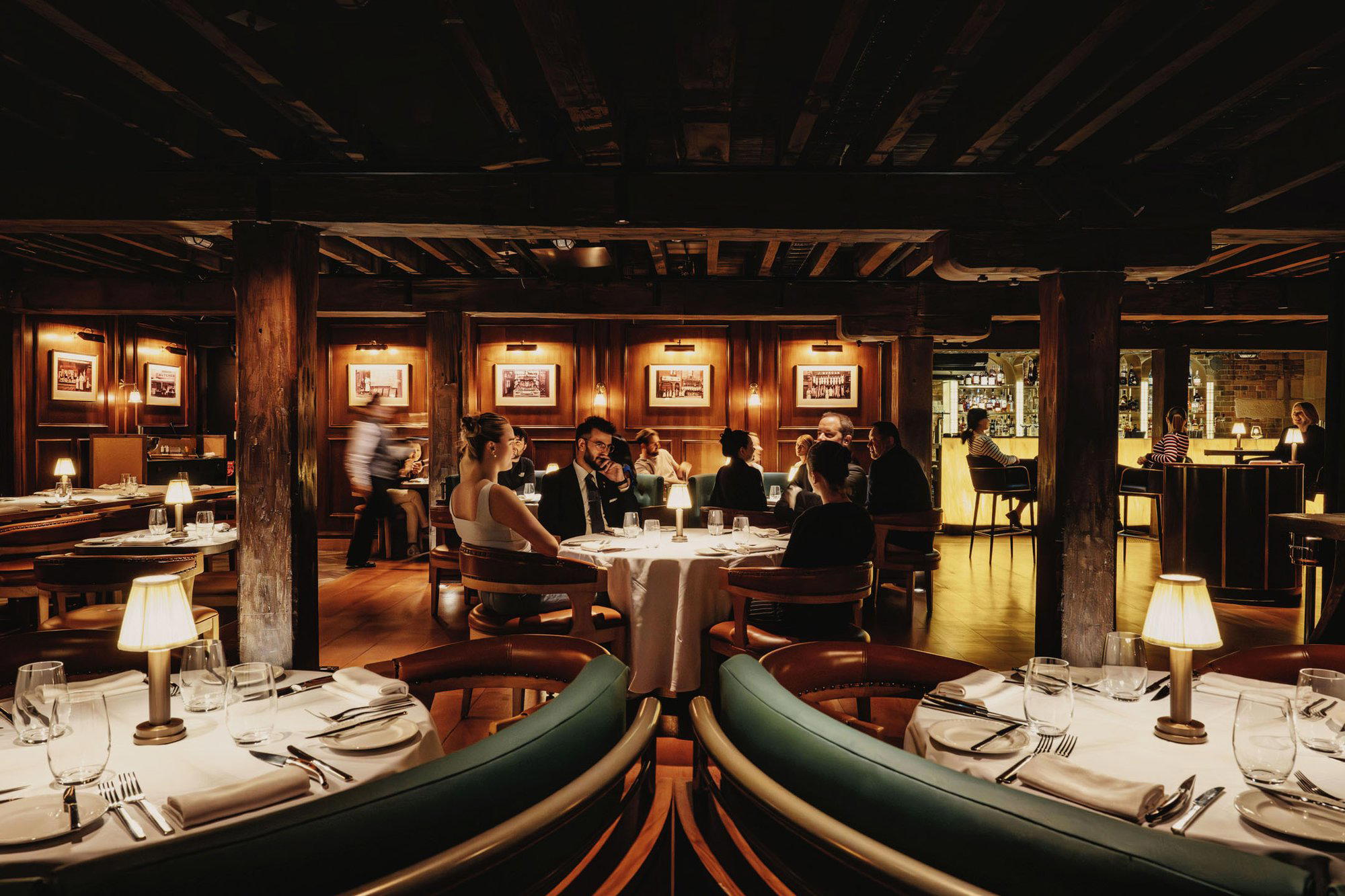
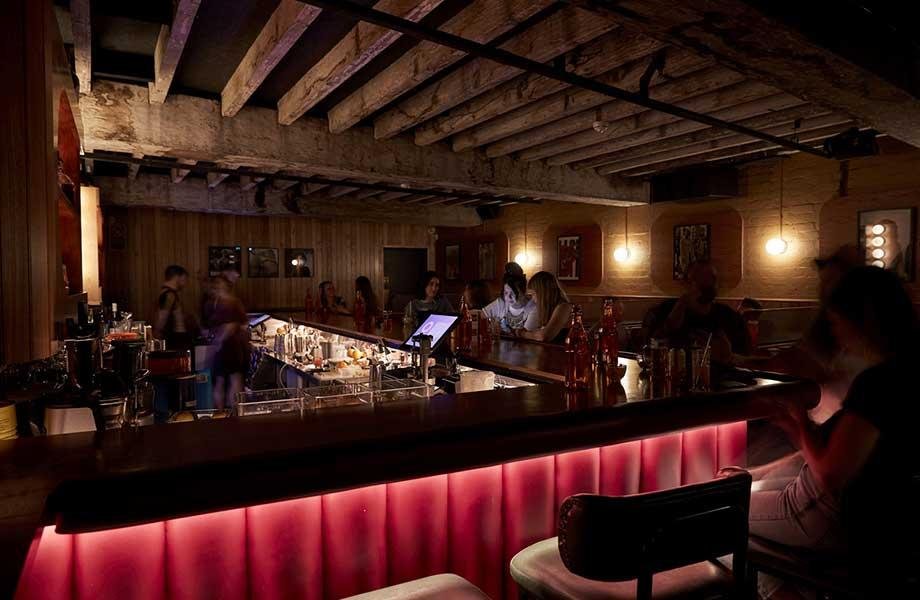
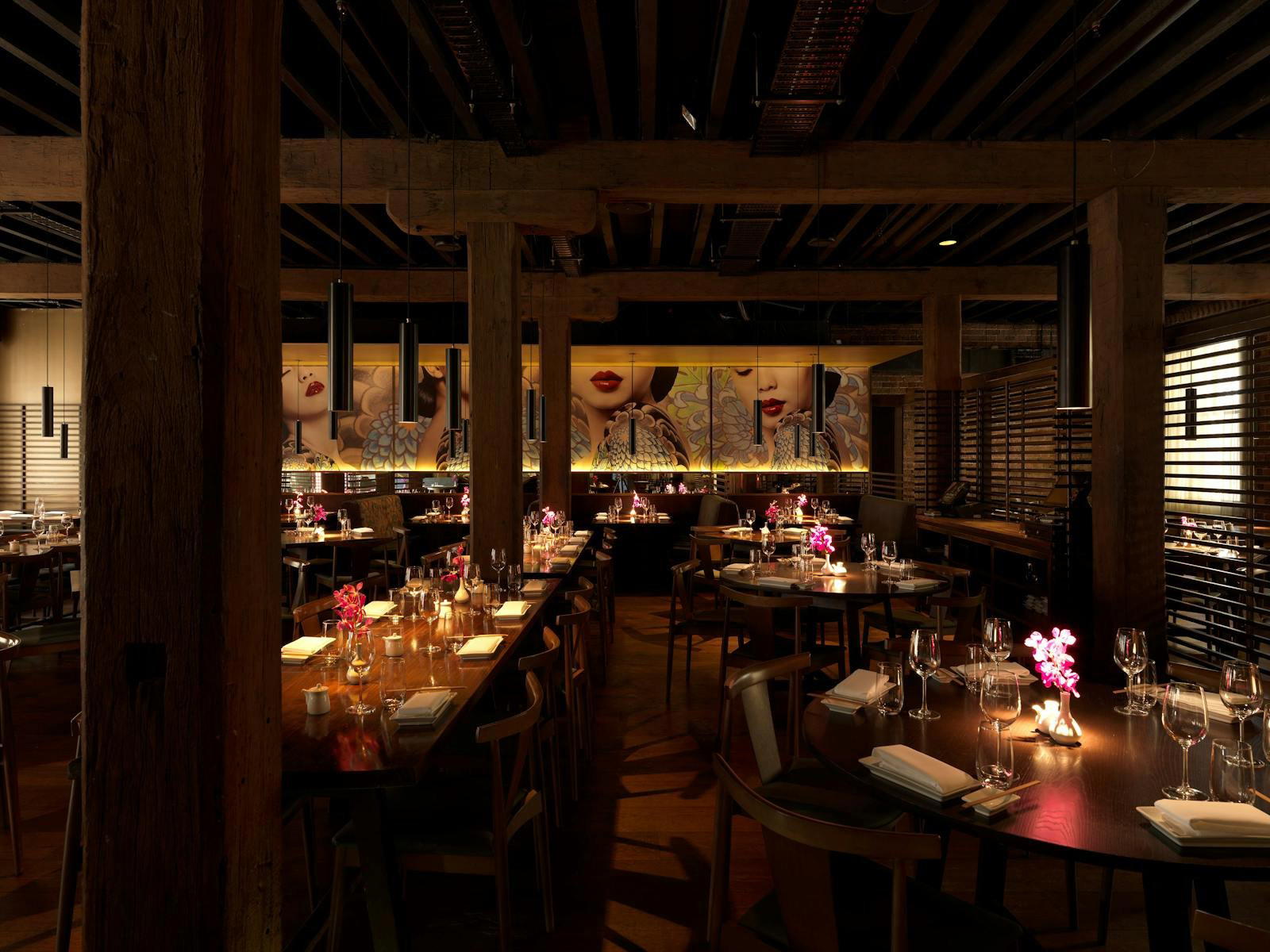
Heritage conversions in Sydney tend toward one of two outcomes: spaces where the original fabric is preserved so carefully the dining room feels like a museum, or spaces where renovation has erased the building's character in favour of a neutral contemporary shell. The Argyle Stores building at Saké avoids both. The split-level layout traces the natural geometry of the heritage structure, with original sandstone walls forming the dominant textural note throughout. That material registers differently depending on the light and the hour, shifting from warm ochre at midday to something closer to dark amber as the evening progresses.
Against this colonial foundation, the interior layers Japanese visual references without treating them as decoration applied over the surface. A wall of brightly coloured sake barrels acts as both a divider and a display, readable as functional object and aesthetic statement simultaneously. Elsewhere, a large-format artwork depicting a tattooed Japanese woman occupies one of the walls in the manner of a permanent installation rather than a rotating gallery piece. These elements create a dialogue between two distinct visual traditions, the Australian colonial and the contemporary Japanese, that the architecture holds in productive tension rather than resolving too neatly.
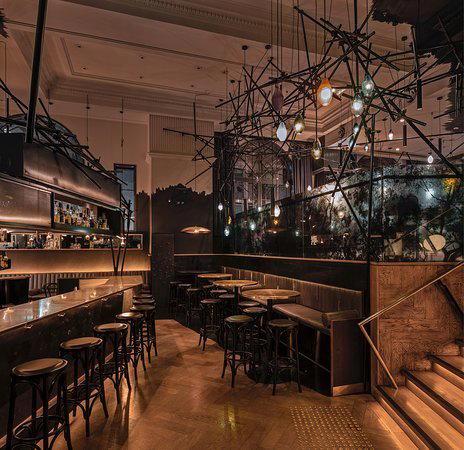
Split-level dining rooms are logistically demanding for operators, but they create something important for the guest: a sense that the space has zones, that moving through the room is a minor event rather than a flat traverse from door to table. The variation in ceiling height, the shift in sightlines as the levels step, and the different acoustic quality between sections all contribute to a room that feels inhabited rather than merely occupied. For those comparing across Sydney's dining stock, that quality of spatial depth is not automatic. Saint Peter achieves it through deliberate restraint in a smaller room; Saké achieves it through the layered complexity of a heritage building extended by considered fit-out.
Wine and Sake: A Beverage Program With Documented Recognition
The drinks program here carries weight in its own right. Saké Restaurant & Bar holds a White Star recognition from Star Wine List, a credential that signals a list with genuine depth and curation rather than a functional by-the-glass selection appended to a food menu. More significantly, the venue carries a 3-Star accreditation from the World of Fine Wine Awards, a London-based publication with a documented track record of rigorous assessment. In Sydney's restaurant beverage landscape, where wine lists often function as revenue instruments rather than editorial statements, that kind of external validation is a specific claim, not ambient positioning.
Within modern Japanese dining internationally, the relationship between sake and wine has become one of the more interesting structural questions. Venues with serious sake programs have historically struggled to attract the same diner attention as those with strong conventional wine lists, partly because sake literacy among non-specialist diners remains limited. The venues that resolve this tension most effectively tend to build lists that treat sake and wine as parallel columns rather than ranking one above the other. That approach, when executed consistently, produces a beverage program that rewards both the informed drinker and the curious one. The Star Wine List recognition suggests that framework is in operation here.
The difference is format: Saké operates as a full restaurant rather than a wine-bar-with-food hybrid, which means the beverage program supports a complete dining arc rather than anchoring it.
The Rocks as Context
Location contributes materially to how a dining experience lands. The Rocks precinct sits at the northwestern edge of Circular Quay, walkable from the harbour and from the CBD, but with a pace and a built character distinct from either. The sandstone warehouses and early colonial streets create an environment where the hospitality offering feels embedded rather than transplanted. That sense of physical rootedness is not universal across Sydney's dining precincts. In Surry Hills or Potts Point, restaurants occupy terrace houses or converted retail spaces that signal change and flux; in The Rocks, the buildings themselves imply continuity.
That continuity works in a restaurant's favour when the interior design engages with the building rather than ignoring it. The Argyle Stores complex has hosted hospitality in various forms for decades, and Saké's long-term presence there has generated what its own documentation describes as a loyal following and a deep-rooted reputation. For the visitor arriving without local knowledge, the surroundings do some of the orientation work that would otherwise require context from staff or a guidebook.
For those building a broader Sydney itinerary around dining and experience, the EP Club guides to Sydney restaurants, Sydney bars, Sydney hotels, Sydney wineries, and Sydney experiences provide mapped coverage of how the precinct sits within the wider city. Internationally, the same editorial framework applies at venues like Le Bernardin in New York City and Emeril's in New Orleans, where heritage of a different kind shapes spatial identity.
Planning a Visit
Saké Restaurant & Bar is located at 12 Argyle Street within the Argyle Stores complex in The Rocks, placing it within easy walking distance of Circular Quay's train and ferry connections. The venue operates as a multi-format space, meaning it functions for both casual bar visits and full dining sittings. Given the heritage setting and the documented following, booking in advance for dinner sittings is the sensible approach, particularly on weekends when The Rocks draws additional foot traffic from the waterfront. For those building a comparative itinerary of Sydney's Japanese dining offer, venues like 6HEAD occupy adjacent territory in the harbourside precinct, while further afield Brae in Birregurra, Flower Drum in Melbourne, and Agrarian Kitchen in Hobart represent comparable investment in space, produce, and beverage programming in their respective markets. Within Sydney itself, Amaru in Armadale, Bacchus in Brisbane, and 400 Gradi in Brunswick East round out a picture of how premium dining at the heritage end of the market operates across Australian cities.
Frequently asked questions
What kind of recognition has Saké Restaurant & Bar received?
Saké Restaurant & Bar has received recognition including: Saké Restaurant & Bar is a wine bar venue.without_translation_and restaurant in Sydney, Australia. It was published on Star Wine List on December 2, 2021 and is a White Star.; The iconic flagship of the Saké Restaurant & Bar fleet is housed….
What's the address for Saké Restaurant & Bar?
Saké Restaurant & Bar is located at Argyle Stores, 12 Argyle St, The Rocks NSW 2000, Australia, Sydney.
What's the must-try dish at Saké Restaurant & Bar?
Given the venue's Japanese positioning and the scale of its sake program — recognised with a White Star by Star Wine List — the drinks pairing is as central to a visit as the food itself. Ask the floor team what's current when you arrive.
Can I walk in to Saké Restaurant & Bar?
Walk-in availability is not documented. Saké The Rocks has a well-established reputation in the Argyle Stores complex and draws a consistent crowd, particularly on weekend evenings. A reservation ahead of peak times is the more reliable approach.
What's Saké Restaurant & Bar best at?
Its drinks program has earned independent recognition: a White Star from Star Wine List and a 3-Star Accreditation from the World of Fine Wine awards. The room itself — split-level heritage sandstone inside the Argyle Stores — gives the venue a physicality that most Sydney Japanese restaurants cannot replicate.
Can Saké Restaurant & Bar handle vegetarian requests?
Japanese restaurant kitchens generally accommodate vegetarian requests across categories like edamame, vegetable tempura, and maki, but specific dietary options should be confirmed directly with the venue at 12 Argyle Street, The Rocks.
Accolades, Compared
A quick peer check to anchor this venue’s price and recognition.
| Venue | Cuisine | Price | Awards | Notes |
|---|---|---|---|---|
| Saké Restaurant & BarThis venue (the venue you are viewing) | Modern Japanese | $100–150 | Star Wine List | Not listed |
| Saint Peter | Modern Australian Seafood | $150–200 | World's 50 Best #66 · La Liste Top Restaurants | Australian Seafood |
| Rockpool | Modern Australian Steakhouse | $150–200 | World's 50 Best #49 · La Liste Top Restaurants | Australian Cuisine |
| BENTLEY Restaurant & Bar | Modern Australian Fine Dining | $150–200 | La Liste Top Restaurants · Star Wine List | Australian Modern |
| Bennelong | Modern Australian Fine Dining | $200–300 | La Liste Top Restaurants · Star Wine List | Australian Cuisine |
| 20 Chapel | Modern Australian Wood-Fired Grill | $100–150 | Not listed | Not listed |
Recognition history
Dated appearances from independent guides and award organizations, with the underlying list record or original source where available.
Star Wine List
Star Wine List
World's Best Wine Lists Awards WBWL Category Winner
World's Best Wine Lists Awards
Full recognition history (3 entries)
World's Best Wine Lists Awards WBWL 3-Star
World's Best Wine Lists Awards