Quaker Kitchen @ UPenn
Our verdict
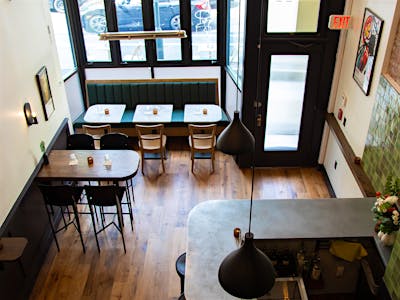
Quaker Kitchen @ UPenn serves American comfort food at 201 S 40th St, with local sourcing and a casual, open-kitchen format that suits a conversational dinner.

Pearl is the En Primeur Club membership app — saves, bookings, and concierge access live there. Same editors, same standards.
- Address
- 201 S 40th St, Philadelphia, PA 19104
- Phone
- (215) 898-3547
- Hours
- Mon 5–8 PMTue–Sun Closed
- Directions
- Get directions
- Booking
- Book on OpenTable
A West Philadelphia Institution in the University City Dining Scene
The stretch of 40th Street that runs through West Philadelphia's University City district operates on a different logic than Center City. The density here is academic rather than corporate, the foot traffic driven by semester schedules rather than happy hours, and the dining options calibrated to a community that values consistency and access over spectacle. Quaker Kitchen, operating at 201 S 40th St within the University of Pennsylvania's orbit, sits inside that context: a campus-adjacent operation shaped by the rhythms of an Ivy League institution and the practical demands of a large, transient population.
University dining in the United States has undergone a significant structural shift over the past two decades. What was once an afterthought — a dining hall serving functional calories — has evolved at many research universities into a genuine hospitality operation, with attention paid to dietary accommodation, sourcing transparency, and menu range. Penn's position as one of the wealthiest universities in the country gives its dining programs resources that community or regional institutions rarely match. Quaker Kitchen operates within that well-resourced framework.
How the Menu Is Structured, and What That Reveals
The editorial angle worth applying to any campus dining operation is menu architecture: what the menu includes, what it excludes, and what those choices say about who the kitchen is actually serving. At a venue like Quaker Kitchen, the menu is not built around a chef's personal vision or a singular culinary tradition. It is built around a population: undergraduates, graduate students, faculty, and staff who eat there repeatedly, often daily, across multiple years. That constraint produces a different kind of menu discipline than you find at a tasting counter or a neighborhood bistro.
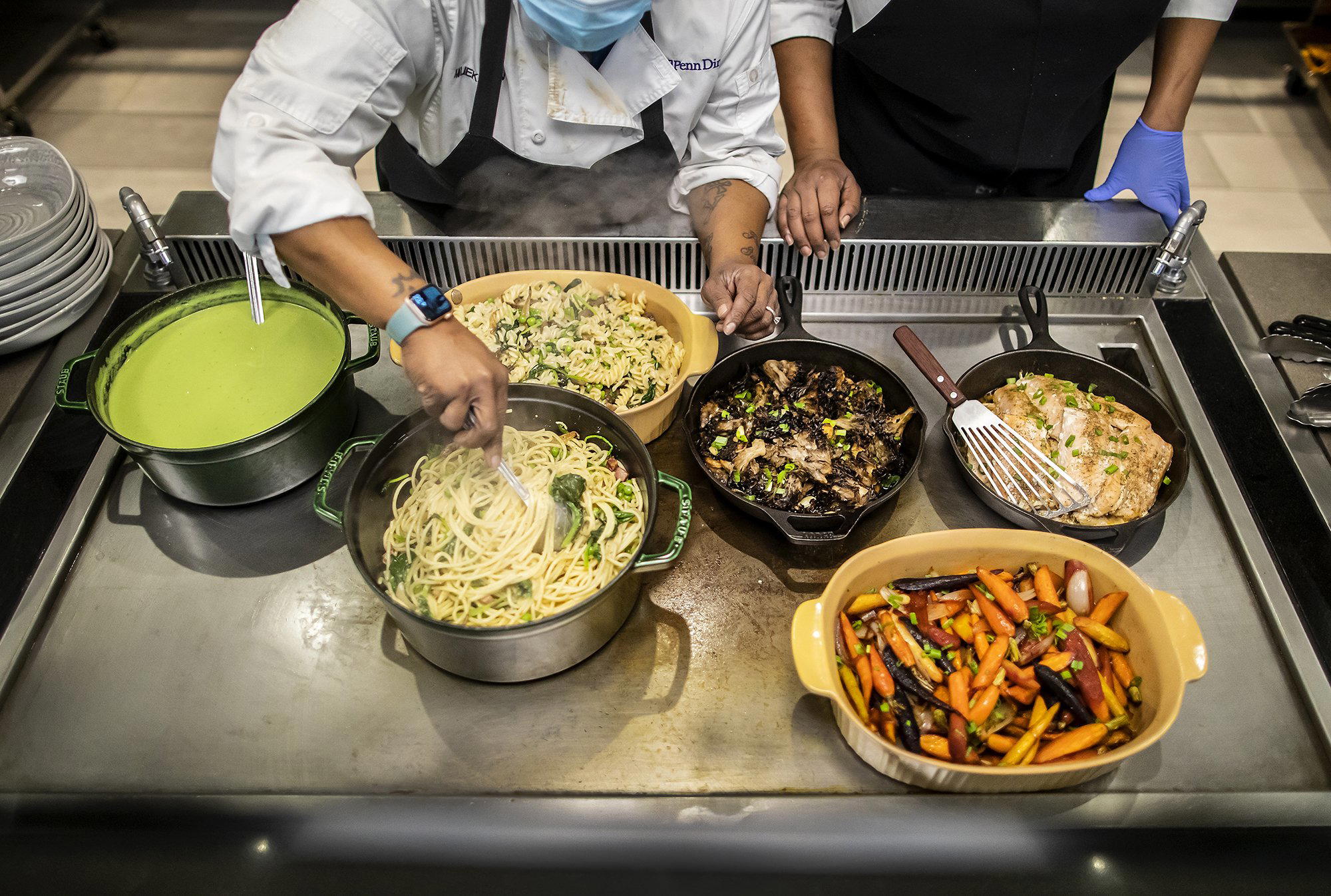
Campus dining menus at institutions like Penn tend to operate as rotating, station-based formats rather than fixed a-la-carte lists. The logic is utilitarian: variety across a week matters more than depth on any single day. This structure tends to prioritize breadth, multiple protein options, a carving station or grain bar alongside lighter fare, over the kind of focused, ingredient-driven menu you encounter at, say, Fork or Friday Saturday Sunday in Center City. The comparison is not a criticism; it is a recognition that different operational goals produce different menus.
What campus dining menus do reveal, when done well, is an institution's commitment to dietary inclusion. Allergen labeling, halal and kosher options, and strong plant-based programming are now baseline expectations at top-tier university dining operations. A venue like Quaker Kitchen, serving a student body with the demographic diversity typical of a major research university, has structural incentives to address vegetarian, vegan, and allergen-sensitive diners in ways that a small independent restaurant may not. This is not a philosophical stance so much as an operational necessity at scale.
For comparison, the kind of tight, produce-driven focus you find at Kalaya or the considered sourcing at My Loup reflects the luxury of serving a self-selected audience that arrives with specific expectations. Campus dining serves whoever shows up, which demands a different architecture entirely.
University City's Place in Philadelphia's Dining Geography
Philadelphia's restaurant scene has consolidated its critical reputation in a handful of neighborhoods: Fishtown, Old City, East Passyunk, and the Center City corridor. University City operates as a parallel food ecosystem, one that functions largely on its own terms. The presence of Penn, Drexel, and associated research institutions has created a neighborhood where international cuisines cluster around student demand, Ethiopian, Korean, Vietnamese, and South Asian options appear alongside American formats, and where price sensitivity shapes the competitive set more than it does in wealthier zip codes.
Quaker Kitchen sits within that University City ecosystem but operates at a remove from the independent restaurant market. It is an institutional dining operation rather than a public restaurant in the conventional sense, which affects everything from access to pricing structure. Visitors to Philadelphia looking for the city's most critically recognized dining should look to the broader scene: venues like Mawn represent the kind of neighborhood-specific, chef-driven work that has earned Philadelphia increasing national attention. For a fuller view, our full Philadelphia restaurants guide maps the city's dining character across neighborhoods and price tiers.
At the national level, the distance between institutional dining and the country's most recognized restaurant programs is considerable. Venues like Le Bernardin in New York City, Alinea in Chicago, or The French Laundry in Napa operate in a different register entirely, defined by tasting menus, extended sourcing relationships, and a guest population that books months in advance. Programs like Blue Hill at Stone Barns in Tarrytown and Single Thread Farm in Healdsburg have built reputations around farm-integration models that take years to develop. Those comparisons are not intended to diminish campus dining but to place it accurately in the wider map of American dining.
Within Philadelphia itself, the trajectory of fine dining has followed national patterns: Emeril's in New Orleans and similarly structured celebrity-chef operations of the 1990s gave way to chef-owned, neighborhood-scale programs. Philadelphia has produced a number of the latter, and venues like Providence in Los Angeles and Addison in San Diego offer useful reference points for understanding where ambitious American dining is operating at the highest tier. Philadelphia has not yet produced a venue in that Michelin-starred upper bracket, but the pipeline of serious independent restaurants is genuine.
Know Before You Go
Address: 201 S 40th St, Philadelphia, PA 19104
Affiliation: University of Pennsylvania campus dining
Access: Primarily for Penn students, faculty, and staff; public access is limited and should be confirmed directly with the venue
Phone: Not available
Website: Not available, check Penn Dining directly for current hours and menu
Price range: Not confirmed; campus meal plans typically govern pricing
Nearest transit: SEPTA Market-Frankford Line, 40th Street station
Frequently Asked Questions
Frequently asked questions
Where is Quaker Kitchen @ UPenn located?
Quaker Kitchen @ UPenn is located at 201 S 40th St, Philadelphia, PA 19104, Philadelphia.
Is Quaker Kitchen @ UPenn open to non-Penn students visiting University City?
Penn's campus dining facilities, including the 40th Street location, are primarily designed for enrolled students with active meal plans. Visitors exploring University City's broader dining options along the 40th Street corridor will find a range of independently operated restaurants serving the neighborhood without institutional access requirements.
What's the best thing to order at Quaker Kitchen @ UPenn?
Campus dining operations at research universities like Penn rotate offerings by semester and season, so checking the current Penn Dining portal directly will give you the most accurate picture of what's on the line that day.
Can I walk in to Quaker Kitchen @ UPenn?
Access at Penn dining facilities is primarily structured around enrolled student meal plans rather than open walk-in service for the general public. If you're a visitor or prospective student, contacting Penn Dining Services in advance is the most reliable way to confirm whether guest access is available on a given day.
What's the signature at Quaker Kitchen @ UPenn?
At a university dining hall serving a campus the scale of Penn's in West Philadelphia, the format typically prioritizes broad coverage across multiple stations rather than a single flagship dish.
Is Quaker Kitchen @ UPenn good for vegetarians?
Large research university dining programs across the United States have significantly expanded plant-based options over the past decade, and Penn's dining operations fall within that broader institutional shift. For confirmed allergen and dietary accommodation details specific to Quaker Kitchen at the 40th Street location, Penn Dining's official resources are the authoritative source.
Is Quaker Kitchen @ UPenn worth the price?
Campus dining at Penn is structured through institutional meal plans, which means pricing is rarely comparable to a-la-carte restaurant spending in the surrounding University City neighborhood. The value calculation depends almost entirely on how heavily a student uses the plan across the academic term rather than on any single visit to the 40th Street location.
At-a-Glance Comparison
Comparable venues nearby, for context on price, style, and recognition.
| Venue | Cuisine | Price | Notes |
|---|---|---|---|
| Quaker Kitchen @ UPennThis venue — the venue you are viewing | American Comfort Food | Not listed | Not listed |
| Stir | Modern American with Seasonal Local Ingredients | $20–30 | Parkway Museums District |
| Hickory Lane American Bistro | New American Bistro | Not listed | Francisville |
| Marathon Grill | Farm-to-Table American Grill | $20–30 | Rittenhouse Square |
| The Foodery | Craft Beer & Deli Sandwiches | $20–30 | Northern Liberties |
| Down North Foundation | Detroit-Style Philly Pizza | $20–30 | Northern Liberties |