
Tabelog 100 #43
Our verdict
Oishii Curry belongs to Tokyo’s newer curry conversation: compact, low-friction, and serious enough to earn Tabelog Curry TOKYO 100 selection in 2023 and 2024. In Shimokitazawa, where small rooms can carry large reputations, its appeal is less about ceremony than focus: a curry counter format with a 10-seat scale and a clear place in the city’s specialist curry tier.

Pearl is the En Primeur Club membership app, where members save venues, book tables and use the concierge.
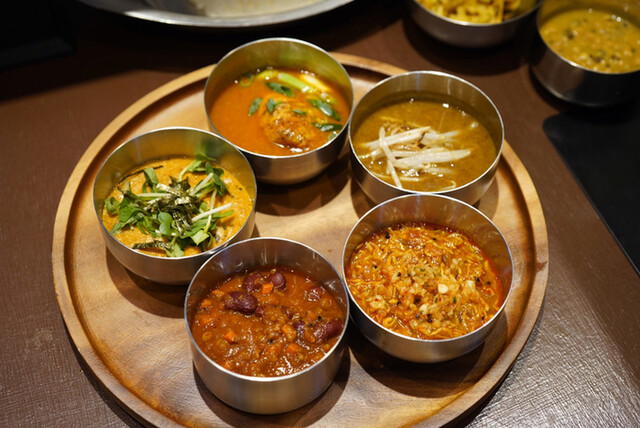
The menu
What to order
- Lemon Chicken Curry
- Sri Lankan Pork Curry
- Spice Curry of the Day
Tokyo rewards focused food formats: quick meals, category-led shops, and tightly edited menus often make scale secondary. Curry fits that ecology: practical for solo lunch, layered enough for a following, and flexible between everyday comfort and specialist interest. Oishii Curry sits in that shift, a Tokyo curry venue whose reputation rests on category recognition rather than theatrics.
Tokyo curry has broadened in recent years. The old split between familiar Japanese-style curry and other regional curry traditions no longer explains the field. Specialist curry venues now often work with clear points of view on spice, rice, texture, and garnish. Selection for Tabelog Curry TOKYO 100 in 2024 matters because the category is crowded and intensely local, placing Oishii Curry in a Tokyo curry tier judged against specialists rather than general neighbourhood cafés.
Tokyo's small-room curry culture suits a focused counter
The format is part of the argument for curry in Tokyo more broadly. Compact, category-led eating belongs to the Tokyo grammar of specialist dining: noodle counters, tempura counters, tonkatsu rooms, and curry shops where turnover and concentration can matter more than lounge-like comfort. The meal is often not built for lingering over courses; it is built around a direct read of the kitchen’s curry style and the room’s pace.
That matters in Tokyo, which keeps producing dense, independent-feeling dining rooms even as visitor traffic grows. The better food addresses often feel specific rather than generic. Curry works here because it can be casual and technically serious. Pannya CAFE CURRY operates in the same broad curry conversation, while spice kitchen moona points to Tokyo’s wider spice-cooking appetite. Oishii Curry is better read through that specialist lens than as a conventional restaurant night out.
In Tokyo, a restaurant can build identity through repetition and a clear dish focus rather than through a grand narrative. Its reputation rests on curry-category recognition, accessible pricing, and fit within the city’s specialist-dining culture.
Tabelog Curry TOKYO 100 recognition puts the shop in a demanding local category
Tabelog’s Hyakumeiten lists are not international trophy systems; they work better as local category maps. For curry, that matters. Tokyo has enough serious curry shops that inclusion signals traction inside a specialist ecosystem, where diners compare curry style, spice profile, rice handling, portion rhythm, and repeat-visit appeal. Oishii Curry’s 2024 selection gives it a clearer credential than a broad popularity claim.
The Tabelog score of 3.71 adds a useful signal, though Japanese rating culture needs calibration. On Tabelog, a high-three score can indicate meaningful local approval, especially in narrow categories where regulars are exacting and hype alone rarely sustains a shop. The number does not settle a ranking; it supports the recognition history: this is a curry specialist consistent enough to register beyond convenience.
For travellers, the point is decision-making. Tokyo’s high-end dining can require long booking windows and high fixed costs, but curry remains one of the city’s more democratic specialist categories. A serious curry stop can sit between shopping, coffee, or bar-hopping without turning the day around, countering the omakase-heavy version of Tokyo dining often shown to visitors.
Comparison defines the category boundaries. Chukasoba KOTETSU represents adjacent focused-counter logic: compact, direct, and comparatively accessible by Tokyo standards. DIALOGUE belongs to a different longer-form dining frame. Flippers sits closer to casual social dining. Curry specialists run on another axis: single-category depth, fast readability, and a dining room where the core dish carries the experience.
How to fold it into a Tokyo food day
The practical strength is flexibility. The Tokyo context makes the shop easy to build into a city itinerary without treating it like a major formal booking. Public pricing places both lunch and dinner in the JPY 1,000–JPY 1,999 range, which is part of the appeal: the visit can be planned as a focused specialist stop rather than a high-commitment splurge.
Because the format is category-led, timing matters more than ceremony. Treat the meal as a focused curry stop rather than a long reservation-led occasion. Tokyo works especially well with other low-commitment eating and drinking formats: a curry lunch, coffee break, casual dinner, then a bar elsewhere in the city. For a broader city scan, see our full Tokyo experiences guide.
The editorial read is simple: Oishii Curry is not a luxury detour, and that is the advantage. It belongs to the part of Tokyo dining where repetition, category discipline, and local momentum create authority. In a city often reduced to grand counters and trophy bookings, a curry specialist with Tabelog category selection gives a more grounded reading of how Tokyo actually eats.
Frequently asked questions
How much does it cost to eat at Oishii Curry?
Pricing at Oishii Curry is listed as JPY 1,000 - JPY 1,999 for dinner and JPY 1,000 - JPY 1,999 for lunch.
What has Oishii Curry built its reputation on?
Oishii Curry’s reputation rests on its 2024 Tabelog Hyakumeiten recognition in the curry category and a Tabelog score of 3.71. Pricing sits in the JPY 1,000–JPY 1,999 range for both lunch and dinner.
Snapshot
Comparable venues by cuisine and price in the same metro.
| Venue | Cuisine | Price | Awards | Notes |
|---|---|---|---|---|
| Oishii CurryThis venue (the venue you are viewing) | Japanese Curry House | $10–20 | Tabelog 100 #43 | Not listed |
| Oiwake Dango Honpo Shinjuku honten | Traditional Japanese dango & wagashi cafe | $10–20 | Tabelog 100 #66 | Shinjuku |
| Hagakure | Udon and curry udon izakaya | $10–20 | Tabelog 100 #26 | Minato |
| 福田家 | Traditional Kaiseki | $300–500 | 2 Michelin Stars | Chiyoda |
| UCHOUTEN | Yoshoku (Japanese-style Western) hamburger steak | $10–20 | Tabelog 100 #67 | Toshima |
| Sabameshi no Sabashou | Japanese saba-focused cafeteria | $10–20 | Tabelog 100 #15 | Chiyoda |
Recognition history
Dated appearances from independent guides and award organizations, with the underlying list record or original source where available.
Tabelog 100 #43 · No. 43
Tabelog · Tabelog 100 - Curry - TOKYO - 2024
Continue exploring
More in Tokyo
Restaurants in Tokyo
All restaurants in Tokyo →



Bars in Tokyo
All bars in Tokyo →






Details
- Cozy
- Trendy
- Intimate
- Solo
- Casual Hangout
- After Work
- Standalone
- A La Carte
- Counter Dining
Current opening hours
- Monday
- 11:30 AM–4 PM
- Tuesday
- 11:30 AM–4 PM
- Wednesday
- 11:30 AM–4 PM, 6–9 PM
- Thursday
- 11:30 AM–4 PM, 6–9 PM
- Friday
- 11:30 AM–4 PM, 6–9 PM
- Saturday
- 11:30 AM–8 PM
- Sunday
- 11:30 AM–8 PM
Hours can change for holidays and private events. Hours as of .
A small, counter-focused curry shop with only ten seats, casual and relaxed with an intimate feel, more about fragrant spices and a focused food experience than decor or design.