Moro



Open since 1997, Moro has spent nearly three decades anchoring Exmouth Market's identity as a serious dining destination. The Moorish-Iberian kitchen runs on wood-roasting and chargrilling, with a seasonal menu shaped by North African and Spanish influences.
Pearl is the En Primeur Club membership app — saves, bookings, and concierge access live there. Same editors, same standards.
- Address
- 34-36 Exmouth Market, London EC1R 4QE, United Kingdom
- Phone
- +44 20 7833 8336
- Website
- moro.co.uk
- Directions
- Get directions
 Saves & bookings on Pearl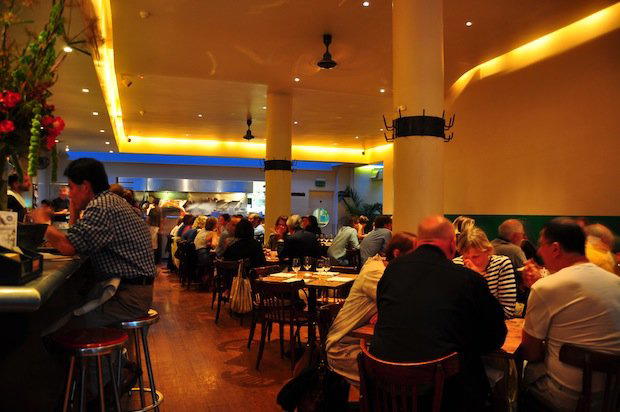
Nearly Thirty Years on Exmouth Market
When Sam and Samantha Clark opened Moro in 1997, London's relationship with Iberian and North African cooking was still forming. The restaurant landed on Exmouth Market, then a quiet Clerkenwell strip, and helped define what that neighbourhood would become. Nearly three decades later, the address is one of the more consistently active dining streets in inner London, and Moro is inseparable from that trajectory. What was a pioneering 1990s proposition has since settled into the status of a mainstream classic, though the kitchen's commitment to seasonal produce and the open wood-fired hearth hasn't shifted.
The Spanish and Moorish tradition Moro drew from was always more complex than simple tapas shorthand suggests. The cuisine stretches from the charcoal-smoke of Andalusian fish grills to the spice-layered stews of Morocco and the charred flatbreads of the eastern Mediterranean. That breadth gives the kitchen a wide operational canvas, and the menu, which shifts with the seasons, uses it fully.
The Atlantic and Mediterranean Seam
Spanish coastal cooking carries a particular logic: proximity to Atlantic and Mediterranean waters means seafood arrives at the kitchen in states of freshness that reward direct, high-heat treatment. Wood-roasting and chargrilling, the technical anchors of Moro's kitchen, are precisely the methods that amplify those qualities rather than obscure them. The approach has deep roots in Galician and Andalusian practice, where fish and shellfish are treated with a restraint that lets salt, heat, and smoke do the work.
At Moro, grilled sea bass with courgette salad (prepared two ways), mint, and chilli exemplifies that philosophy. The combination pulls from the same playbook as a Cadiz beachside chiringuito, where char and citrus-bright garnish frame the fish rather than dominate it. This places Moro in a distinct category from London's heavier, sauce-driven Spanish restaurants, closer in spirit to the pintxos bars of Antonio Bar, Tapas Bar in San Sebastián or Bar Bergara, Tapas Bar in San Sebastián than to a formal Iberian tasting menu.
The wood-roasting element extends beyond fish. Roast pork belly with peas, potatoes, and anise alongside churrasco sauce demonstrates how the same high-heat infrastructure serves the full range of the menu. This is not a kitchen with separate philosophies for separate proteins, it has one method, applied consistently, that produces a coherent flavour identity across the card.
The Room and What It Signals
The dining room at Moro is not designed for quiet conversation. The open kitchen, zinc-topped bar, and room acoustics mean noise is an ambient feature rather than an occasional intrusion. Pavement tables provide a different register entirely, more suited to the slower pace of a long lunch than the chatter-dense interior. The trade-off is transparency: the open kitchen connects what arrives at the table to the process behind it, and in a room built around wood fire and charcoal, that connection matters.
This kind of high-decibel, open-kitchen format was less common in London when Moro opened. It arrived alongside a generation of restaurants, across Clerkenwell and Soho, that rejected the carpet-and-hushed-service template of the previous decade. That generation has now largely dispersed or adapted; Moro is one of the few survivors that still operates with the same format and energy it established at launch.
For comparison within London's Spanish-influenced dining tier, Dehesa, Salt Yard, and Ember Yard each occupy parts of the same general territory, Iberian and Italian small plates, often with charcuterie as a backbone. El Pirata operates at the more traditional Spanish end. Moro sits slightly apart from all of them: it runs a full à la carte rather than a pure small-plates format, and the North African dimension gives it a flavour profile none of the others match directly.
The Menu's Broader Logic
Its longevity provides useful calibration. Moro holds a Michelin Plate (2025), a recognition that sits below the starred tier but confirms consistent kitchen quality.4 across 1,273 reviews adds volume to that picture.
The menu's spicing is described in the awards record as heady and aromatic, with seasonal ingredients driving the selection. Starters such as pan-fried sweetbreads with preserved lemon and asparagus show the kitchen working across more than fish and meat, preserved lemon is a North African technique that appears throughout Moroccan cooking and ties the menu's Moorish register together. Vegetable-forward options, including fresh morels with cherry tomatoes, white beans, and sweet herbs, confirm that the seasonal logic extends across the full card.
Dessert at Moro operates with the same regional coherence. Yoghurt cake with pistachios and pomegranate, and Malaga ice cream, both draw from Andalusian and North African sweet traditions rather than the Franco-British confectionery mainstream. The all-Iberian wine list, with bottles from £32, maintains the regional discipline through to the end of the meal.
The adjacent tapas bar, Morito, functions as an overflow and a lower-intensity version of the same kitchen philosophy. It operates as a separate venue rather than a waiting area, and the awards record specifically identifies it as worth visiting in its own right.
For broader London dining context across price tiers and formats, CORE by Clare Smyth represents the starred Modern British end of the spectrum. Further afield, The Fat Duck in Bray, L'Enclume in Cartmel, Moor Hall in Aughton, Gidleigh Park in Chagford, Hand and Flowers in Marlow, and Le Manoir aux Quat' Saisons, a Belmond Hotel in Great Milton map the broader UK fine dining circuit for those planning wider itineraries.
Know Before You Go
- Address: 34 to 36 Exmouth Market, London EC1R 4QE
- Hours: Monday to Sunday 12 pm to 10:30 pm; Sunday 12 pm to 5:30 pm
- Awards: Michelin Plate (2025); Opinionated About Dining Leading Restaurants #476 (2025) 4 from 1,237 reviews
- Wine List: All-Iberian, from £32
- Adjacent: Morito tapas bar next door, same ownership
- Booking: Reservations are essential
What Should I Order at Moro?
The wood-roasted dishes are the primary reason to order. Grilled sea bass with courgette salad, mint, and chilli represents the kitchen's approach to Atlantic and Mediterranean seafood, high heat, seasonal garnish, no heavy saucing. Pan-fried sweetbreads with preserved lemon and asparagus perform well as a starter, and the vegetable-forward options, such as fresh morels with white beans and sweet herbs, demonstrate range beyond the protein-led sections.
Chef Sam Clark, who opened Moro in 1997 alongside Samantha Clark, has maintained the kitchen's North African and Spanish-Iberian identity across nearly three decades. That continuity is itself a credential in a London restaurant market that turns over frequently.
On dessert, the yoghurt cake with pistachios and pomegranate appears in multiple reviews as the default finish, though the Malaga ice cream and seasonal fruit options, a simple bowl of cherries when in season, offer a lighter alternative. The all-Iberian wine list rewards attention: regional Spanish and Portuguese bottles from £32 make it one of the more coherently curated short lists in this price tier.
Fast Comparison
Comparable venues nearby, for context on price, style, and recognition.
| Venue | Cuisine | Price | Awards | Notes |
|---|---|---|---|---|
| MoroThis venue — the venue you are viewing | Moorish & Spanish Tapas | $$$ | Michelin Plate | Not listed |
| José | Classic Spanish Tapas | $$ | Michelin Plate | Borough |
| Prince Arthur | Modern Spanish Gastropub | $$$ | Michelin Plate | Belgravia |
| Little Social | Modern British Bistro | $$$ | Michelin Plate | Mayfair |
| Decimo | Modern Spanish-Mexican Small Plates | $$$$ | Michelin Plate | St Pancras |
| Arros QD | Authentic Valencian Paella | $$$$ | Michelin Plate | Fitzrovia |
Recognition history
Dated appearances from independent guides and award organizations, with the underlying list record or original source where available.
Michelin Plate
Michelin
Michelin Plate
Michelin
Opinionated About Dining Top Restaurants in North America Ranked #476
Opinionated About Dining
The Good Food Guide GFG Good
The Good Food Guide
Opinionated About Dining Top Restaurants in North America Ranked #501
Opinionated About Dining
Opinionated About Dining Top Restaurants in North America Recommended
Opinionated About Dining
Continue exploring
More in London
Restaurants in London
Browse all →
Bars in London
Browse all →
Hotels in London
Browse all →

At a Glance
- Lively
- Energetic
- Well Known
- Elegant
- Date Night
- Celebration
- Special Occasion
- Group Dining
- Open Kitchen
- Terrace
- Standalone
- Extensive Wine List
- Sommelier Led
- Street Scene
Current opening hours
- Monday
- 12–10:30 PM
- Tuesday
- 12–10:30 PM
- Wednesday
- 12–10:30 PM
- Thursday
- 12–10:30 PM
- Friday
- 12–10:30 PM
- Saturday
- 12–10:30 PM
- Sunday
- 12–5:30 PM
Hours can change for holidays and private events. Last verified .
High-decibel, animated dining room with booming acoustics from the open kitchen and zinc-topped bar; bright, bustling atmosphere with hard surfaces and visible kitchen activity.