Mari Vanna
Mari Vanna brings the warmth of a Russian grandmother's apartment to Knightsbridge, with mismatched vintage furniture, bookshelves of Soviet-era novels, and a menu built around the kind of home cooking that rarely surfaces in London's restaurant circuit. The address places it squarely in the capital's most expensive postcode, but the register is deliberately domestic rather than grand. It is one of the few places in London where borscht and blini occupy the same table as Georgian wines and Soviet-era glassware.
Pearl is the En Primeur Club membership app — saves, bookings, and concierge access live there. Same editors, same standards.
- Address
- Wellington Court, 116 Knightsbridge, London SW1X 7PD, United Kingdom
- Phone
- +44 20 8050 5534
- Website
- marivannalondon.co.uk
- Directions
- Get directions
 Saves & bookings on Pearl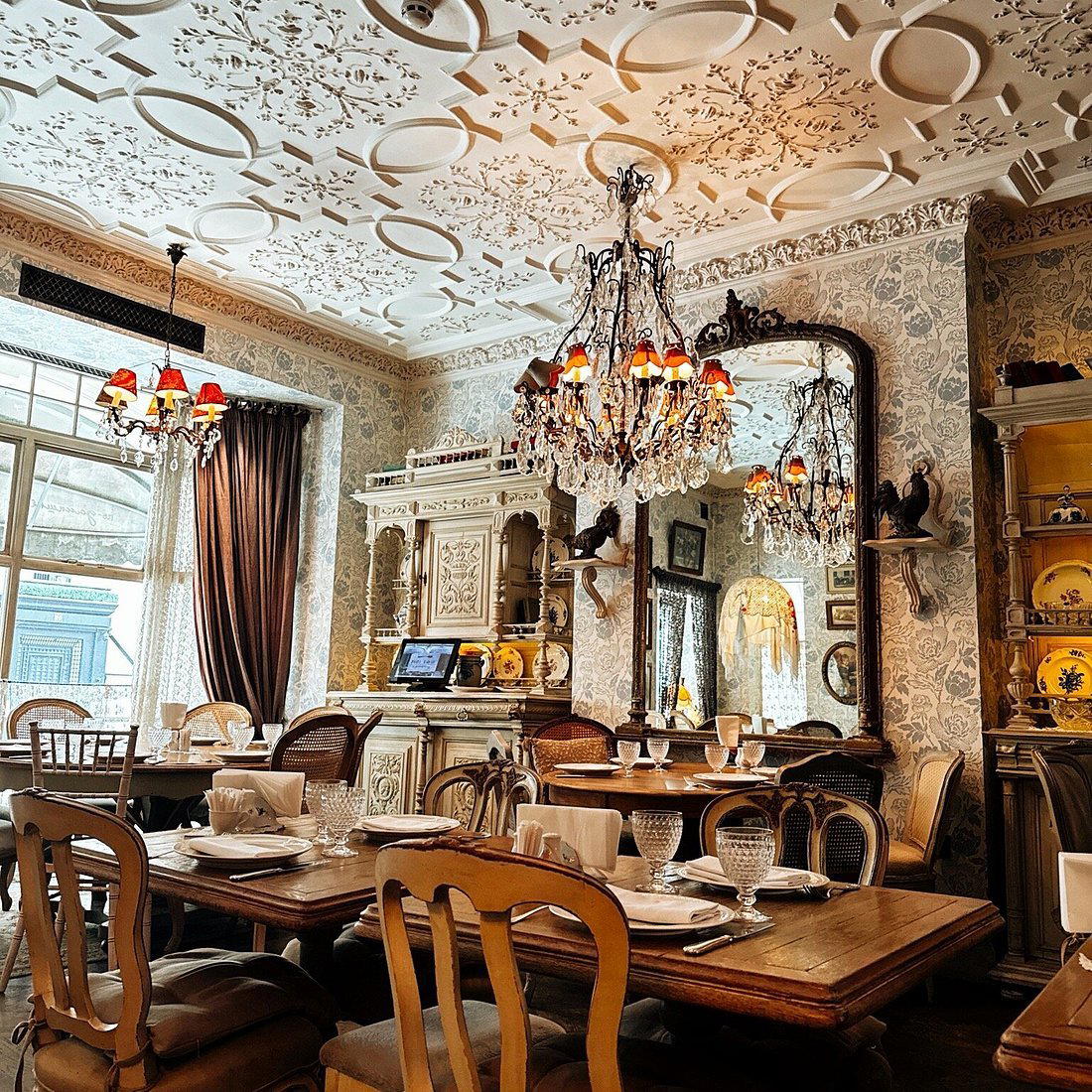
A Different Register in Knightsbridge
Knightsbridge has long been the address where London's restaurant scene performs its most formal version of itself. Within a short walk of Mari Vanna, you will find Dinner by Heston Blumenthal operating out of the Mandarin Oriental, a restaurant whose entire premise is the reconstruction of historical British cooking. Around the corner, the same postcode supports the kind of tasting-menu formality you also encounter at CORE by Clare Smyth in Notting Hill or at The Ledbury in the same neighbourhood. Mari Vanna, at Wellington Court on 116 Knightsbridge, occupies that same expensive postcode while doing something categorically different: staging Russian domestic life as a dining experience, complete with mismatched crockery, lace curtains, and a menu that reads like a Soviet-era family recipe book.
That contrast is the point. London's premium dining bracket has always had room for one or two operators who succeed by refusing to compete on the terms everyone else has accepted. The restaurant's approach to décor, service, and menu construction positions it against a comparable set that is less about Michelin-tracked tasting counters and more about a global network of Russian-inflected hospitality that values warmth of presentation over culinary formalism.
What the Room Communicates Before You Order
The interior design at Mari Vanna is deliberate. Russian hospitality, in its domestic form, has always used abundance of objects as a signal of care: shelves of books, family photographs, layered tablecloths, mismatched china. The room at Wellington Court replicates that grammar. The effect is the opposite of the stripped-back minimalism that defines much of London's contemporary fine dining, where the room at Sketch, The Lecture Room and Library or Restaurant Gordon Ramsay channels restraint as a marker of seriousness. Here, the density of objects signals something different: that the meal is framed as domestic generosity rather than chef-led performance.
This framing changes what the front-of-house team is actually doing. In a tasting-menu room, service is calibrated to explain and pace. At Mari Vanna, the front-of-house operates more like hosts at a dinner party, moving between tables with what feels like personal familiarity. That distinction matters when you consider how the whole room functions as a team exercise: the décor, the service register, and the menu format are calibrated together to sustain a single fiction, that of the babushka's apartment, and sustaining that fiction requires consistent front-of-house discipline rather than less of it.
The Menu as Cultural Argument
Russian home cooking has almost no institutional presence in London's restaurant circuit. The category is not tracked by the guides that define the city's premium tier. Venues like Le Manoir aux Quat' Saisons in Great Milton or L'Enclume in Cartmel operate inside established culinary traditions that the international guide system knows how to evaluate. Russian zakuski, borscht, pelmeni, and blini do not fit that evaluative framework, and as a result they tend to exist outside the prestige economy of London dining entirely.
The restaurant makes that marginality into an argument. By placing Russian domestic cooking inside a Knightsbridge address at prices that sit alongside the area's European fine dining, it forces a comparison that works in its favour: the food is generous, recognisable, and unambiguous in its cultural reference, which reads as confidence rather than limitation. The zakuski table format, where small plates of pickled vegetables, cured fish, and cold meats arrive before the main meal, has structural parallels to the mezze tradition and the Japanese kappo format, but in London it remains specifically Russian in register, and that specificity is what makes the room coherent.
Team Dynamics in a Room Designed to Look Effortless
The editorial angle that matters most at the restaurant is how its service model distributes roles across the room. The theatrical coherence of the space, from the vintage crockery to the curated bookshelves, requires that every person working the floor is maintaining the same fiction. This is a different kind of service discipline from the formal brigade structure at a classical French restaurant, but it is no less demanding. At places like Le Bernardin in New York, the room's precision comes from hierarchy and repetition; at the restaurant, it comes from a shared tone, warm, unhurried, and slightly theatrical, that every member of the front-of-house has to sustain across a full service.
The drinks offering operates inside that same tone. The wine list at a Russian-themed restaurant in London typically has to do two things at once: support the food format with appropriate pairings while also serving a clientele that expects the kind of European list depth that the address implies. Georgian wines, which have grown substantially in London restaurant circulation over the past decade, fit both requirements. They pair well with the food's acidity and salt levels and carry enough credibility with the sommelier community to hold their place on a Knightsbridge list without apology. Whether the restaurant's list currently leans into that category, the Georgian wine trajectory in London represents one interesting structural fit for a kitchen of this type.
Context and Comparisons
For readers who spend time across EP Club's wider London coverage, the restaurant sits in a different tier of intent from the starred addresses in our full London restaurants guide. It is not competing with the technical ambition of The Fat Duck in Bray or the ingredient-led rigour of Moor Hall in Aughton. The comparison set is narrower and more specific: restaurants where the room's design and the service's warmth carry as much weight as the cooking, and where cultural specificity functions as the primary editorial value.
In that respect, the international context matters. The restaurant brand operates across multiple cities, and its London address is one node in a network that includes locations in New York, where the same format has operated in a market that has also supported the formal ambition of Atomix. The multi-city footprint means the concept is not an experiment in one market; it is a tested format with demonstrated demand across different dining cultures. For a restaurant whose primary claim is cultural specificity, that consistency is itself a kind of credential.
The restaurant is located at Wellington Court, 116 Knightsbridge, SW1X 7PD, accessible on foot from Knightsbridge station in under five minutes. Reservations for weekend evenings tend to move faster than midweek slots, and the format works well for groups, where the sharing-plate structure and the room's theatrical warmth make the experience more legible than at a counter-seating tasting venue. Bookings are worth making at least a week ahead for Friday and Saturday, less so for quieter midweek services.
- pirogi
- pelmeni
- khachapuri
- beef stroganoff
- blinis
- chicken kotletki
- syrniki
City Peers
Comparable venues nearby, for context on price, style, and recognition.
| Venue | Cuisine | Price | Notes |
|---|---|---|---|
| Mari VannaThis venue — the venue you are viewing | Russian & Eastern European | $$$$ | Not listed |
| Bolivar at Annabel’s | South American Steakhouse | $$$$ | Mayfair |
| Hemsley + Hemsley | Healthy Grain & Gluten-Free Cafe | $$$ | Marylebone |
| Samaia Georgian Restaurant | Authentic Georgian | $$$ | Castelnau |
| The Cuckoo Club | Modern European Fine Dining | $$$$ | Soho |
| Café Leon Dore | Greek-Inspired Coffee & Pastries | $$ | Soho |
Continue exploring
More in London
Restaurants in London
Browse all →
Bars in London
Browse all →
Hotels in London
Browse all →


At a Glance
- Classic
- Ornate
- Elegant
- Romantic
- Business Dinner
- Group Dining
- Celebration
- Special Occasion
- Live Music
- Private Dining
- Design Destination
- Extensive Wine List
- Craft Cocktails
Current opening hours
- Monday
- 10 AM–1 AM
- Tuesday
- 10 AM–1 AM
- Wednesday
- 10 AM–1 AM
- Thursday
- 10 AM–1 AM
- Friday
- 10 AM–1 AM
- Saturday
- 10 AM–1 AM
- Sunday
- 10 AM–11 PM
Hours can change for holidays and private events. Last verified .
Ornate, kitschy yet cozy Russian imperial aesthetic with dim lighting, vintage furnishings, and live accordion music; atmosphere described as theatrical and nostalgic but occasionally tense due to service inconsistencies.