
MAKIBI sits in Osaka’s Nishitenma orbit, where small-format Italian cooking competes less on ceremony than on precision, wine judgment, and repeat local demand. Its selection for Tabelog Italian WEST “Tabelog 100” 2025 places it inside a crowded but closely watched Kansai category, with Italian, pizza, and pasta as the stated frame rather than a single-course fine-dining script.
Pearl is the En Primeur Club membership app — saves, bookings, and concierge access live there. Same editors, same standards.
- Address
- 大阪府大阪市北区西天満3-1-27 メビウス西天満ビル 1F
- Phone
- +81665850766
- Website
- tabelog.com
 Saves & bookings on Pearl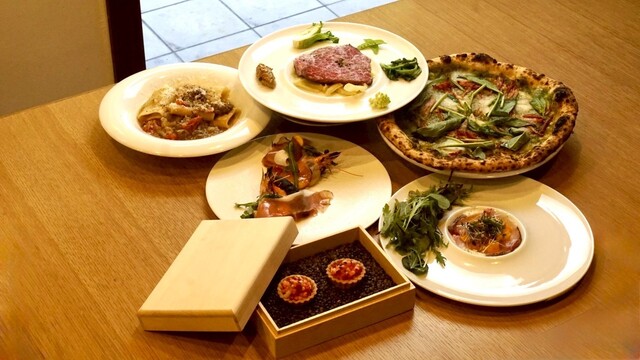
Approaching dinner in Nishitenma changes the register from Osaka’s louder food corridors. The area sits close to courts, offices, galleries, and the river, so the evening rhythm is more adult than theatrical: compact rooms, counter seats, wine lists that matter, and restaurants that rely on regulars as much as destination diners. Within that pattern, MAKIBI belongs to the city’s serious small-restaurant tier rather than the tourist-facing Italian category.
Osaka is often reduced to takoyaki, okonomiyaki, kushikatsu, and late-night appetite, but its Italian scene has long been sharper than that shorthand allows. Kansai cooks tend to absorb Italian technique without treating it as museum material. Pasta, pizza, seafood, and wine become flexible tools for a city that values direct pleasure and quick judgment. A restaurant listed under Italian, Pizza, and Pasta in this context is not automatically casual; it can sit in the same conversation as tighter tasting-menu rooms, wine-led counters, and neighborhood dining rooms where the difference is format rather than ambition.
Nishitenma Italian with awards pressure, not fine-dining stiffness
The useful way to read MAKIBI is through reputation pressure. Selection for Tabelog Italian WEST “Tabelog 100” 2025 puts the restaurant into a regional list that rewards sustained public approval in a category where Osaka, Kyoto, Kobe, and the wider west of Japan compete hard. Tabelog recognition is not a Michelin-style inspection system, but in Japan it carries real behavioral weight: diners use it to sort rooms that have earned repeat confidence, especially in categories where international travelers may lack local context.
That matters because Italian in Osaka splits into several lanes. There are polished French-adjacent rooms such as La Kanro, lower-priced everyday tables such as Osake to Gohan Taku, Chinese-led destination dining such as Gessen, and higher-budget specialist counters such as Makisumi Madara. MAKIBI occupies a different pocket: a compact Italian restaurant with pizza and pasta in the mix, wine as part of the identity, and enough recognition to draw diners looking beyond station-building convenience. It is not selling rarity for its own sake; it is competing in the more demanding middle tier where value, consistency, and mood all have to land.
The restaurant’s stated focus on fish is also a telling Osaka signal. Kansai Italian often works well when it stops trying to imitate Rome or Milan and instead treats local produce, seafood access, and Japanese pacing as advantages. That does not require a manifesto. It requires enough control for fish, pasta, and wine to feel like one conversation rather than separate menu categories. The presence of cocktails alongside wine broadens the evening without changing the central read: this is a dinner room built for people who care what they drink with Italian cooking.
Counter seats, wine, and the compact-room advantage
Small Osaka restaurants often beat larger dining rooms on immediacy. Counter seating turns timing into part of the meal, and the split between counter and table formats usually tells diners how to use the room. A counter dinner suits couples, solo regulars, and anyone who wants the kitchen’s rhythm close at hand. Tables work better for small groups and business meals, especially in Nishitenma, where the neighborhood’s professional crowd shapes weekday dining habits.
MAKIBI’s format fits that reading. The room is small enough that group size, seating type, and pacing affect the experience; this is not a drop-in trattoria scaled for anonymous turnover. The no-smoking policy also places it within the newer Osaka dining norm, where wine aroma and food aroma are protected rather than treated as secondary to the room’s social energy. That point may sound minor, but in Japan’s compact dining rooms it changes the entire feel of a meal.
For travelers building an Osaka itinerary, this is the kind of restaurant to place after a day around Kitahama, Nakanoshima, or Tenma rather than after heavy grazing in Dotonbori. It rewards an evening kept clean: aperitif, dinner, then a bar if the night has another stop in it. For wider planning, Our full Osaka restaurants guide gives the broader dining map, while Our full Osaka bars guide, Our full Osaka hotels guide, Our full Osaka wineries guide, and Our full Osaka experiences guide help shape the rest of the trip.
Where it fits in an Osaka eating day
Osaka dining works when the day has contrast. A serious Italian dinner reads differently if lunch was a bakery stop, a casual bun, or a sharp coffee break rather than another long seated meal. In that rhythm, nearby and citywide references such as.cafe, 52CHO-ME BAKERY, and 551 Horai (551蓬莱) serve a different purpose: they show how Osaka moves between snack culture, casual craftsmanship, and destination dinners without treating one mode as more legitimate than another.
For readers specifically tracking Italian in Osaka, 99 Pizza Napoletana Gourmet and a canto (Italian) help frame the category’s spread, from pizza-led specialization to broader Italian dining. MAKIBI’s appeal sits in the overlap: not just pizza, not just pasta, not just wine bar, but a compact dinner address with enough critical reception to justify planning around it.
Beyond Osaka, the comparison becomes less about cuisine than about how Japan’s regional restaurants define purpose. -Grilled beef Sukiyaki- KAMAKURA TANUKIAN 鎌倉 たぬき庵 in Kamakura. 鮪と炭火焼き うお炭 秋葉原店 in Tokyo.know in Kumamoto, (Shoku) Vietnam in Kawasaki, [Curry Senmon Ten] Maruyama Kyoju. in Sapporo, [ki:] in Kyoto, Jōdo Saké Bar in Los Angeles, and Onigiri Time in Pasadena each point to a different model of specificity: single-dish focus, neighborhood utility, bar-dining crossover, or diaspora interpretation. MAKIBI’s model is Kansai Italian under public scrutiny, with enough structure for a planned dinner and enough looseness to feel like Osaka rather than imported ceremony.
Cuisine and Credentials
Comparable venues at the same tier for side-by-side context.
| Venue | Cuisine | Price | Notes |
|---|---|---|---|
| MAKIBIThis venue — the venue you are viewing | Creative Italian | $$$ | Not listed |
| La Barcaccia | Neapolitan Pizza & Italian Wine Bar | $$$ | Kita |
| PESCE ROSSO | Upscale Seasonal Italian | $$$ | Chūō |
| Shimanouchi Fujimaru Jozosho | Urban winery with Italian-based cuisine | $$$ | Chūō |
| anello | Casual Italian Trattoria & Wine Bar | $$ | Kita |
| BVLGARI IL CAFE Hankyuu umeda honten | Luxury Italian Cafe by Bulgari | $$$$ | Kita |
Recognition history
Dated appearances from independent guides and award organizations, with the underlying list record or original source where available.
Tabelog 100 #59 · No. 59
Tabelog · Tabelog 100 - Italian - WEST - 2025
Continue exploring
More in Osaka
Restaurants in Osaka
Browse all →




Bars in Osaka
Browse all →




Hotels in Osaka
Browse all →




Wineries in Osaka
Browse all →
At a Glance
- Sophisticated
- Cozy
- Modern
- Intimate
- Date Night
- Business Dinner
- Group Dining
- Celebration
- Special Occasion
- Open Kitchen
- Standalone
- Sommelier Led
- Extensive Wine List
- Local Sourcing
A relaxed, warm dining room with a spacious feel that suits anniversaries, business dinners, and other special occasions.