




Two-Michelin-starred Liath Blackrock delivers chef Damien Grey's seasonal surprise tasting menus to just 22 guests, where innovative Irish cuisine built around the five fundamental tastes creates an intimate, living-room atmosphere that has redefined fine dining in Dublin's culinary landscape.
 Discover on Pearl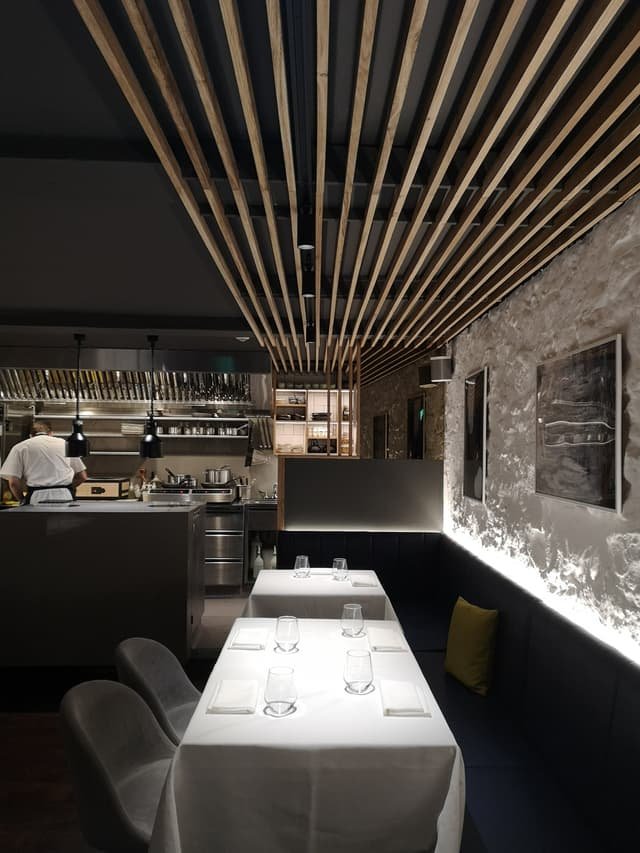
Fourteen Seats, Two Stars: How Liath Redefined What a Neighbourhood Restaurant Can Be
The approach tells you something before you sit down. Liath occupies a modest address inside Blackrock Market, a covered Victorian-era arcade about twelve kilometres south of Dublin city centre on the DART coastal line. The space is small enough that the room itself becomes an argument: that serious cooking does not require a grand stage. Fourteen covers per service, warm lighting, and a format where Damien Grey and his team explain each course directly to guests. The physical setting belongs to the tradition of intimate European dining rooms where proximity between kitchen and table is a design choice, not a constraint.
At this scale, the comparison set shifts away from large-format tasting rooms toward the handful of European counters and micro-restaurants where every variable, from pacing to temperature to the specific moment a dish lands, falls under direct control. Alléno Paris au Pavillon Ledoyen and Enrico Bartolini in Milan operate within a different scale entirely, but the creative ambition that La Liste tracks in its annual rankings places Liath alongside those rooms in intent, if not in size. La Liste scored Liath at 87 points in 2025 and 85 points in 2026, positioning it within a tier of restaurants that the list recognises as among the more compelling tables in their respective cities.
The shortlist, unlocked.
Hard-to-book tables, cellar releases, and concierge-planned trips.
Get Exclusive Access →Irish Creative Cooking and the Discipline of Five Tastes
Irish fine dining has moved through several phases over the past two decades. The first wave leaned heavily on French technique applied to local produce. The second wave, broadly aligned with the rise of Aniar in Galway and the broader Irish-ingredient-forward movement, began to ask sharper questions about what indigenous cooking could actually mean. The current tier, to which Liath belongs alongside Chapter One by Mickael Viljanen, operates without obvious stylistic debt to any single tradition. The reference points are structural rather than geographical.
At Liath, that structure is organised around the five tastes: salty, savoury, sweet, bitter, and sour. This is not an unusual framework in contemporary tasting menus globally, but the rigour with which it governs the surprise menu format here gives it a specific identity. Guests do not choose their dishes; the kitchen choreographs a sequence that moves through these registers with what the Michelin inspectors describe as precision and strong modern technique. The word Grey in Irish is liath, pronounced "le-ah," and the name carries a double register: it refers both to the chef’s surname and to a colour associated in Irish tradition with nuance and ambiguity. That tension between clarity of structure and complexity of execution runs through the critical language that has followed the restaurant since its early years.
Michelin awarded Liath a second star in 2024, retaining it in 2025, which places the restaurant in a small group within Ireland. For context, two-star tables in a country with Ireland’s restaurant density represent a significant concentration of critical consensus. Bastion in Kinsale, Campagne in Kilkenny, dede in Baltimore, and Chestnut in Ballydehob each carry single-star recognition and reflect the geographic spread of serious cooking across the island. Liath sits above that tier by the Michelin measure, and the two-star designation signals cooking where personality and technique have consolidated into something that inspectors consider worth a dedicated journey.
The Wine List as a Parallel Argument
Star Wine List ranked Liath’s wine program number one in its 2026 rankings, which is notable for a fourteen-seat room that operates on a surprise tasting menu format. The programme reportedly offers more than a handful of outstanding bottles for each seat in the house, a density of selection that speaks to a curatorial seriousness disproportionate to the physical scale. In rooms this small, wine lists often function as a supporting element. Here the list appears to operate as a second editorial voice, running alongside the kitchen’s five-taste architecture rather than simply illustrating it. The pairing programme is described by Michelin inspectors as enhancing rather than merely accompanying the food, which is the distinction that separates a considered pairing format from a standard one.
Blackrock’s Position in the Dublin Dining Geography
Blackrock sits in south County Dublin, technically a separate town rather than a city neighbourhood, though the DART line makes it accessible from central Dublin in under twenty minutes. The area has developed a small but coherent dining cluster that includes Three Leaves and Volpe Nera, two restaurants that represent different points on the modern and Italian-influenced spectrum respectively. The presence of a two-star table in a market setting within this cluster reflects a broader Irish pattern: high-end cooking in Ireland frequently resists the city-centre concentration that characterises London or Paris. Terre in Castlemartyr, Homestead Cottage in Doolin, and House in Ardmore are all examples of serious cooking operating well outside the capital. Liath follows that pattern but happens to be reachable from Dublin on public transport in the time it takes to finish a glass of wine.
For visitors building a Dublin-area itinerary, the Blackrock address functions as an argument for splitting time between the city and the coast. The market setting, the modest exterior, and the fourteen-seat format mean there is no visual or architectural cue that prepares most first-time visitors for what the kitchen produces. That gap between expectation set by the setting and the cooking that arrives is part of how the experience registers. You can find more of what the area offers in our full Blackrock restaurants guide, or explore the wider picture through hotels, bars, wineries, and experiences in the area.
Capacity, Growth, and What the Numbers Mean
At fourteen seats per service, Liath operates at a scale where demand structurally exceeds supply. A Google rating of 4.8 across 186 reviews at this capacity means that a disproportionately high share of people who have eaten there have chosen to record the experience in writing, which is one behavioural signal of restaurants that land with force. The La Liste descriptions reference the kitchen’s cooking as complex as a fractal, a phrase that captures something about how the surprise menu format rewards repeated visits differently from restaurants where the menu is fixed and public. Each service offers a different sequence through the same structural framework.
The growth pressure on the space is documented in the La Liste notes from 2025, which mention that the restaurant had outgrown its market footprint and that Grey was seeking a larger space. Whether a move has occurred or is pending is not confirmed in available data, and visitors should verify current address and booking details directly. What the growth pressure itself signals is the gap between what the kitchen can produce and what the current room can accommodate. A fourteen-seat room running a surprise tasting menu with direct table service from the kitchen team has an inherent ceiling, and the critical recognition has pushed demand well beyond it.
Planning a Visit
Liath is located at 19A Main Street, Blackrock, Dublin, A94 C8Y1. The Blackrock DART station places the restaurant within a short walk, making it accessible without a car from the city centre and from the wider south Dublin coastal corridor. Given the fourteen-seat format and the level of recognition the room has accumulated, advance booking is not optional at this level. Guests should treat the booking window as they would for any two-star table in a European capital: plan ahead, confirm in advance, and check current operating details directly with the restaurant, as format, schedule, and location may have evolved since the most recent published records.
Frequently Asked Questions
What is the signature dish at Liath?
Liath operates on a surprise tasting menu format, which means the kitchen does not publish a fixed signature dish and the sequence changes. What the restaurant is known for, based on Michelin inspector notes and La Liste assessments, is a menu architecture built around the five tastes: salty, savoury, sweet, bitter, and sour. Dishes are described as bold and original, with first-class ingredients handled through precision and strong modern technique. Chef Damien Grey has held two Michelin stars consecutively since 2024, and the wine pairing programme, ranked number one by Star Wine List in 2026, is considered a core part of the experience rather than an optional supplement. The surprise format means that what arrives at the table will depend on when you visit, which is part of the editorial point the kitchen is making about how a meal should work.
What It’s Closest To
A compact peer snapshot based on similar venues we track.
| Venue | Cuisine | Awards | Notes |
|---|---|---|---|
| Liath | Creative | Michelin 2 Stars, Star Wine List #1 (2026) | This venue |
| Patrick Guilbaud | Irish - French, Modern French | Michelin 2 Star | Irish - French, Modern French, €€€€ |
| Aniar | Modern Irish, Modern Cuisine | Michelin 1 Star | Modern Irish, Modern Cuisine, €€€€ |
| Bastion | Progressive American, Modern Cuisine | Michelin 1 Star | Progressive American, Modern Cuisine, €€€€ |
| LIGИUM | Creative | Michelin 1 Star | Creative, €€€€ |
| Host | Nordic , Modern Cuisine | Nordic , Modern Cuisine, €€ |
Need a table?
Our members enjoy priority alerts and concierge-led booking support for the world's most difficult tables.
Get Exclusive AccessThe shortlist, unlocked.
Hard-to-book tables, cellar releases, and concierge-planned trips.
Get Exclusive Access →