.png)
Le Saint-Pierre holds a Michelin Plate recognition for 2024 and 2025, placing it among Besançon's tracked traditional dining addresses at the €€€ price point. Situated on Rue Battant in the city's historic left-bank quarter, it represents a case study in what sustained Michelin attention looks like below the starred tier: reliable craft, classical roots, and a value equation that mid-range modern venues in the same city struggle to match. Rated 4.7 across 338 Google reviews.
Pearl is the En Primeur Club membership app — saves, bookings, and concierge access live there. Same editors, same standards.
- Address
- 104 Rue Battant, 25000 Besançon, France
- Phone
- +33 3 81 81 20 99
- Website
- restaurant-saintpierre.com
 Saves & bookings on Pearl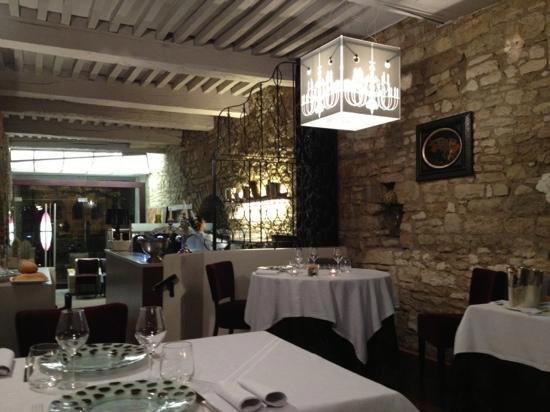
Rue Battant and the Case for Traditional Cooking in Besançon
Rue Battant runs through one of Besançon's oldest and most characterful quarters, a left-bank street where the stone facades carry the weight of centuries and the pace is several degrees slower than the commercial centre. Arriving at number 104, the physical setting does most of the contextual work before you reach the door: this is a neighbourhood that has never much cared for trend cycles, and the restaurants that survive here tend to do so on substance rather than novelty. Le Saint-Pierre sits in that tradition, holding its position in the street's dining fabric without the theatrical renovation or concept-driven rebrand that defines much of the new French mid-market.
That context matters when reading its Michelin Plate recognitions for both 2024 and 2025. For a traditional cuisine address in a provincial city, repeated Plate recognition is a meaningful credential.
What the Value Equation Actually Looks Like
At the €€€ price point, Le Saint-Pierre sits in the same tier as Le Parc (Modern Cuisine), while Le Manège (Modern Cuisine), Le Saint Cerf (Modern Cuisine), and Le Sauvage (Modern Cuisine) operate at €€. That pricing differential invites scrutiny. What, precisely, does the additional outlay buy at a Michelin-recognised traditional address that a well-run modern bistro does not provide?
The answer, in most comparable French provincial cases, is not creativity: it is depth. Traditional cuisine at the €€€ level typically means longer-cooked preparations, sourcing that leans on established regional supply chains, and service calibrated to a slower, more attentive pace. Franche-Comté's larder is not a thin one: smoked meats, Comté cheese at various stages of affinage, freshwater fish from the Doubs, and the slow-braised meat traditions of the wider Burgundy-adjacent region all inform the register in which a restaurant like Le Saint-Pierre operates. The Michelin Plate, against that backdrop, is evidence that those materials are being handled with competence rather than merely assembled.
For diners comparing spend against options like Les Gamins (Modern Cuisine), the calculation is less about cuisine type and more about value. A €€ modern address delivers energy, often some culinary risk-taking, and lighter price exposure. A Michelin-tracked traditional house at €€€ delivers something harder to replicate at lower price points: accumulated technique and the kind of produce that requires longer relationships with suppliers.
Traditional Cuisine in the French Provincial Context
It is worth placing Le Saint-Pierre inside the wider picture of how traditional French cooking is positioned in France. The starred tier of French traditional cuisine includes addresses far to the south and west: Bras in Laguiole, Troisgros - Le Bois sans Feuilles in Ouches, and the institution that is Paul Bocuse - L'Auberge du Pont de Collonges in Collonges-au-Mont-d'Or. At the progressive end, Alléno Paris au Pavillon Ledoyen and Mirazur in Menton represent a different ambition altogether. Flocons de Sel in Megève offers the closest regional parallel in terms of mountain-adjacent traditional produce, albeit at a very different scale and recognition level.
Le Saint-Pierre offers something more specifically useful to a visitor in Besançon: a reliable, Michelin-acknowledged address for traditional cooking in a city with a limited supply of formally recognised dining rooms.
Comparable traditional addresses elsewhere in France confirm the pattern. Auberge Grand'Maison in Mûr-de-Bretagne operates in a similar register: regional produce, classical foundations, and Michelin attention sustained over multiple years. Auga in Gijón demonstrates how seriously Michelin tracks traditional-method restaurants even when the starred tier is elsewhere. The Plate designation, in this company, reads as a consistent curatorial signal rather than a consolation category.
A 4.7 Rating Across 338 Reviews
Google's aggregate gives Le Saint-Pierre a 4.7 rating from 347 reviews. At that volume, a 4.7 does not reflect a handful of enthusiastic regulars: it reflects a broad and sustained base of satisfied diners. Provincial French restaurants at this price point often polarise reviewers between those expecting a specific classical register and those hoping for something more contemporary. A 4.7 across 338 suggests Le Saint-Pierre's kitchen is delivering consistently within its stated register rather than drifting between two audiences.
That consistency is, in some respects, the most useful data point for a visitor. Michelin Plates confirm quality at the moment of inspection. A strong Google aggregate over hundreds of visits confirms that the standard holds between inspector visits. Together, they make a clearer argument than either signal would alone.
Planning Your Visit
Le Saint-Pierre is located at 104 Rue Battant, 25000 Besançon, in the city's Battant quarter on the left bank of the Doubs. The street is walkable from the city centre and sits within a neighbourhood that rewards time before or after a meal: the covered market at nearby Les Halles operates on weekend mornings and gives a clear picture of the produce ecosystem that traditional restaurants in this part of France draw from. Advance reservation is advisable for a Michelin-tracked address at this price point, particularly on weekends.
Accolades, Compared
Comparable venues nearby, for context on price, style, and recognition.
| Venue | Cuisine | Price | Awards | Notes |
|---|---|---|---|---|
| Le Saint-Pierre | French Fish & Seafood Gastronomic | $$$ | Michelin Plate | centre-ville |
| Le Sauvage | Modern French Fine Dining | $$$ | Michelin Plate | Historic District |
| Loiseau du Temps | Modern Franche-Comté Bistro | $$$ | Michelin Plate | Place de la Révolution |
| L'Annexe | French Bistro | $$$ | , | historic center |
| Les Gamins | Modern French Néobistrot | $$$ | Michelin Plate | centre-ville |
| Épicéa | Modern French Author Cuisine | $$$ | Michelin Plate | centre ville |
Continue exploring
More in Besançon
Restaurants in Besançon
Browse all →
Hotels in Besançon
Browse all →
Wineries in Besançon
Browse all →
At a Glance
- Romantic
- Elegant
- Sophisticated
- Date Night
- Business Dinner
- Special Occasion
- Group Dining
- Private Dining
- Local Sourcing
Elegant setting with open stonework, modern touches, and warm, romantic atmosphere.