KPOT Korean BBQ & Hot Pot
Our verdict
KPOT on Phoenix Avenue brings the Korean BBQ and hot pot dual-format to Fort Smith, Arkansas, where tabletop cooking has few direct competitors. The all-in-one model puts raw ingredients and live heat in front of diners, collapsing the distance between sourcing and plate. For a city still building its range of interactive dining formats, it occupies a distinct position in the local mix.

Pearl is the En Primeur Club membership app — saves, bookings, and concierge access live there. Same editors, same standards.
- Address
- 7001 Phoenix Ave, Fort Smith, AR 72903
- Phone
- (479) 551-0800
- Hours
- Mon–Thu 11 a.m.–9:30 p.m.Fri–Sat 11 a.m.–10 p.m.Sun 11 a.m.–9:30 p.m.
- Website
- thekpot.com
- Directions
- Get directions
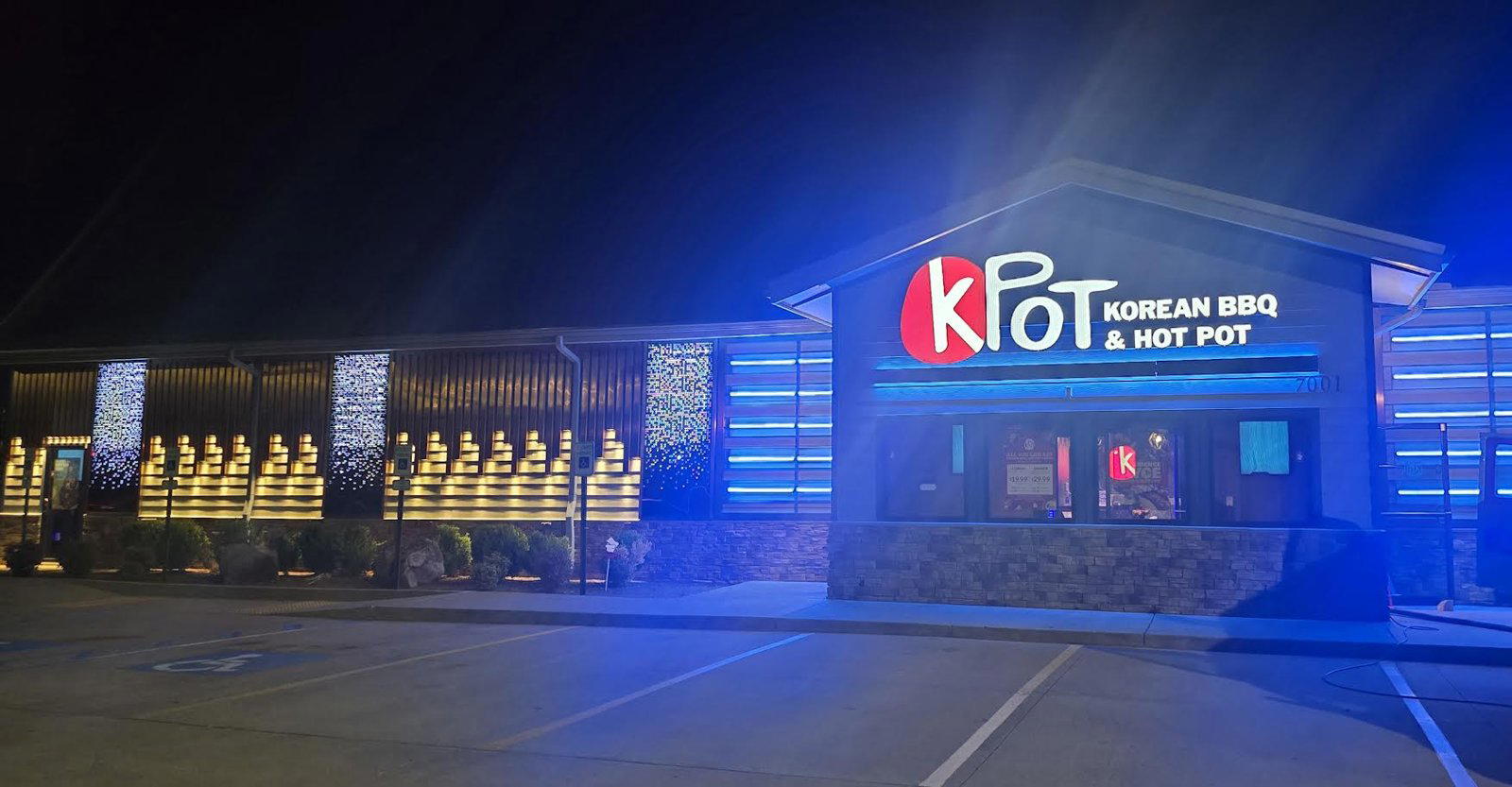
Tabletop Cooking in a City Still Finding Its Range
Fort Smith sits at the Arkansas-Oklahoma border, a mid-size river city whose restaurant scene has historically leaned toward American comfort formats and chain dining. The arrival of Korean BBQ and hot pot in that context is less a novelty than a structural shift: tabletop cooking is an entirely different category from what most Phoenix Avenue dining rooms offer, one where the diner takes an active role in the outcome of the meal. At 7001 Phoenix Ave, KPOT Korean BBQ & Hot Pot operates within that format, combining two interactive cooking traditions under one roof. For a broader look at how Fort Smith's dining options have developed, see our full Fort Smith restaurants guide.
The Format: Why Dual-Concept Dining Works Differently
Korean BBQ and hot pot share a logic: raw ingredients arrive at the table, and heat does the work in front of you. But the two formats produce different results. Korean BBQ concentrates on grilled meat over open charcoal or gas grates, with smoke, char, and timing becoming part of the sensory experience. Hot pot runs the opposite direction, drawing proteins, vegetables, and aromatics through a simmering broth, where flavor transfers both ways. KPOT's dual model places both options in the same session, which changes how a table eats: groups can split between formats, or move through both in sequence.
This kind of hybrid format has become a reliable commercial model for Korean-American chain concepts because it broadens appeal without requiring a kitchen-driven tasting menu approach. The comparison to destination-level tasting formats is useful precisely because KPOT operates at the opposite end of that spectrum. Where Atomix in New York City presents modern Korean cuisine as a choreographed sequence of courses with documented sourcing and wine pairing, KPOT puts the cooking agency at the table. Both take Korean culinary logic seriously, but through radically different lenses.
Ingredient Sourcing and the Tabletop Model
The editorial angle worth pressing on in any Korean BBQ or hot pot format is what arrives at the table raw. The ingredient quality in tabletop cooking is more legible to diners than in a conventional kitchen: there is no sauce to mask a mediocre cut, no reduction to compensate for weak broth bones. When meat hits the grill or protein enters the hot pot, the sourcing decisions made before service become immediately apparent.
Korean BBQ formats have historically organized around specific cuts: galbi (short rib), samgyeopsal (pork belly), and chadolbaegi (thin-sliced brisket) each respond differently to live heat and require different timing and thickness to read correctly. Hot pot broths typically depend on a base built over time, whether a milky bone broth or a spiced mala base, and the quality of that foundation determines how the session develops as more ingredients are added. At a chain-adjacent format operating in a mid-size American city, the supply chain for these proteins is likely national rather than hyper-local, which is an honest reality of this category at this price tier. That is not a flaw so much as a function of operating Korean BBQ at accessible price points far from the coasts where Korean ingredient importers tend to cluster.
For comparison, farm-sourced ingredient transparency at the level of Blue Hill at Stone Barns in Tarrytown or the hyperlocal sourcing commitments at Single Thread Farm in Healdsburg represent a different tier of ingredient-to-table traceability. KPOT operates in a different register, where consistency and accessibility are the primary sourcing goals. Understanding that distinction helps calibrate expectations without diminishing what the format actually delivers.
Where KPOT Sits in the American Korean BBQ Expansion
Korean BBQ has followed a clear geographic pattern in the United States: concentrated first in metro Korean-American communities, then spreading to major cities through food media attention, and now appearing in second and third-tier cities through chain and franchise formats. KPOT's presence in Fort Smith is part of that third wave. It is a different operation from the independent galbi houses of Los Angeles's Koreatown or the high-concept modern Korean dining being done at places like Atomix, but it is also filling a genuine gap: Fort Smith diners who want interactive Korean cooking have limited alternatives.
The restaurants that define American fine dining in 2024 — from Alinea in Chicago to The French Laundry in Napa to Le Bernardin in New York City — operate on entirely different terms: fixed menus, sourced wine programs, and dining rooms designed around a specific culinary argument. The value of contextualizing KPOT against that tier is not to find it lacking, but to clarify what format it actually belongs to. It belongs to the casual communal dining category, where the social architecture of a shared hot pot or grill is the primary draw, not the kitchen's point of view.
The same logic applies when comparing KPOT to ingredient-forward American restaurants like Addison in San Diego, Bacchanalia in Atlanta, or Providence in Los Angeles. These are kitchen-authored experiences built around sourcing narratives and specific produce relationships. KPOT's sourcing is less about narrative and more about delivery: getting consistent proteins and vegetables to a table in Fort Smith that are fresh enough to function in a live-cooking format.
Planning Your Visit
KPOT Korean BBQ & Hot Pot is located at 7001 Phoenix Ave in Fort Smith, AR 72903, positioned along one of the city's main commercial corridors. The Phoenix Avenue strip is car-oriented, so driving is the practical approach; the address is direct to locate via standard mapping apps. The dual BBQ-and-hot-pot format works well for groups of three or more, where splitting options across the table becomes genuinely useful.
Diners comparing this format to destination-level experiences like Lazy Bear in San Francisco, Causa in Washington, D.C., or Frasca Food & Wine in Boulder should note the format difference. Those are kitchen-led, timed experiences with documented wine programs. KPOT is a self-paced communal format where the table controls the outcome. Neither is a substitute for the other; they are answers to different questions about how a group wants to spend an evening eating.
Frequently asked questions
Does KPOT Korean BBQ & Hot Pot work for a family meal?
The tabletop format at KPOT's Phoenix Ave location is well-suited to group dining: raw ingredients arrive at the table and cook communally, which keeps the pace flexible and participation high. Families with varied appetites benefit from the dual Korean BBQ and hot pot options, since both formats allow each person to cook proteins and vegetables to their own preference. The interactive element also makes it a practical choice for mixed-age groups.
Is KPOT Korean BBQ & Hot Pot formal or casual?
KPOT at 7001 Phoenix Ave in Fort Smith operates squarely in casual territory. Tabletop Korean BBQ and hot pot are inherently participatory formats — you're cooking at the table — so the environment skews relaxed by design. Come dressed comfortably; the smoke and steam are part of the experience.
How does KPOT Fort Smith compare to other Korean BBQ options in the region?
Korean BBQ has historically concentrated in cities with established Korean-American communities, which means mid-size Arkansas cities like Fort Smith have had limited exposure to the format until national chains began expanding into secondary markets. KPOT, operating at 7001 Phoenix Ave, represents one of the few dedicated Korean BBQ and hot pot venues available in this part of Arkansas, placing it in a largely uncontested position for the format within the local dining scene.
What should I order at KPOT Korean BBQ & Hot Pot?
In any dual Korean BBQ and hot pot format, the decision point is choosing your heat source first: the charcoal or gas grill for BBQ, or a broth-based hot pot for simmering. From there, the standard approach is to anchor the table with a primary protein — marinated beef cuts like bulgogi or galbi are the reference point for Korean BBQ — and fill out with banchan sides and vegetables. KPOT's Fort Smith location follows the all-you-can-eat model common to the KPOT chain, so the ordering logic favors pacing over volume.
Comparison Snapshot
Comparable venues nearby, for context on price, style, and recognition.
| Venue | Cuisine | Price | Awards | Notes |
|---|---|---|---|---|
| KPOT Korean BBQ & Hot PotThis venue — the venue you are viewing | Korean BBQ & Hot Pot | $30–50 | Not listed | Not listed |
| The Bugler | American Steakhouse & Seafood | $50–100 | Wine Spectator Award of Excellence · Forbes Recommended | Hot Springs |
| Whole Hog Cafe | World Champion BBQ | $20–30 | Not listed | Little Rock |
| Doe’s Eat Place | Classic American Steakhouse | Not listed | Not listed | Little Rock |
| Riverfront Steakhouse | Classic Steakhouse | $50–100 | Not listed | Riverfront |
| Yeyo's El Alma de Mexico | Authentic Mexican Street Food | $20–30 | James Beard Award Semi Finalist | Market District |
Details
- Lively
- Energetic
- Group Dining
- Family
- Casual Hangout
- Open Kitchen
- A La Carte
- Buffet
- Vegetarian Friendly
Current opening hours
- Monday
- 11 a.m.–9:30 p.m.
- Tuesday
- 11 a.m.–9:30 p.m.
- Wednesday
- 11 a.m.–9:30 p.m.
- Thursday
- 11 a.m.–9:30 p.m.
- Friday
- 11 a.m.–10 p.m.
- Saturday
- 11 a.m.–10 p.m.
- Sunday
- 11 a.m.–9:30 p.m.
Hours can change for holidays and private events. Last verified .
Communal and energetic atmosphere with bold flavors and tabletop grilling.