
Six counter seats put il PePe in Osaka’s small-format Italian category, where Japanese seafood, pasta, and wine service carry the experience more than dining-room theatre. The restaurant has been selected for Tabelog Italian WEST “Tabelog 100” in 2021, 2023, and 2025, with dinner positioned in the JPY 15,000–19,999 bracket and lunch in the JPY 3,000–3,999 bracket.
Pearl is the En Primeur Club membership app — saves, bookings, and concierge access live there. Same editors, same standards.
- Address
- 大阪府大阪市北区曽根崎新地1-4-7 小西ビル 2F
- Phone
- +81663457377
- Website
- ilpepe.com
 Saves & bookings on Pearl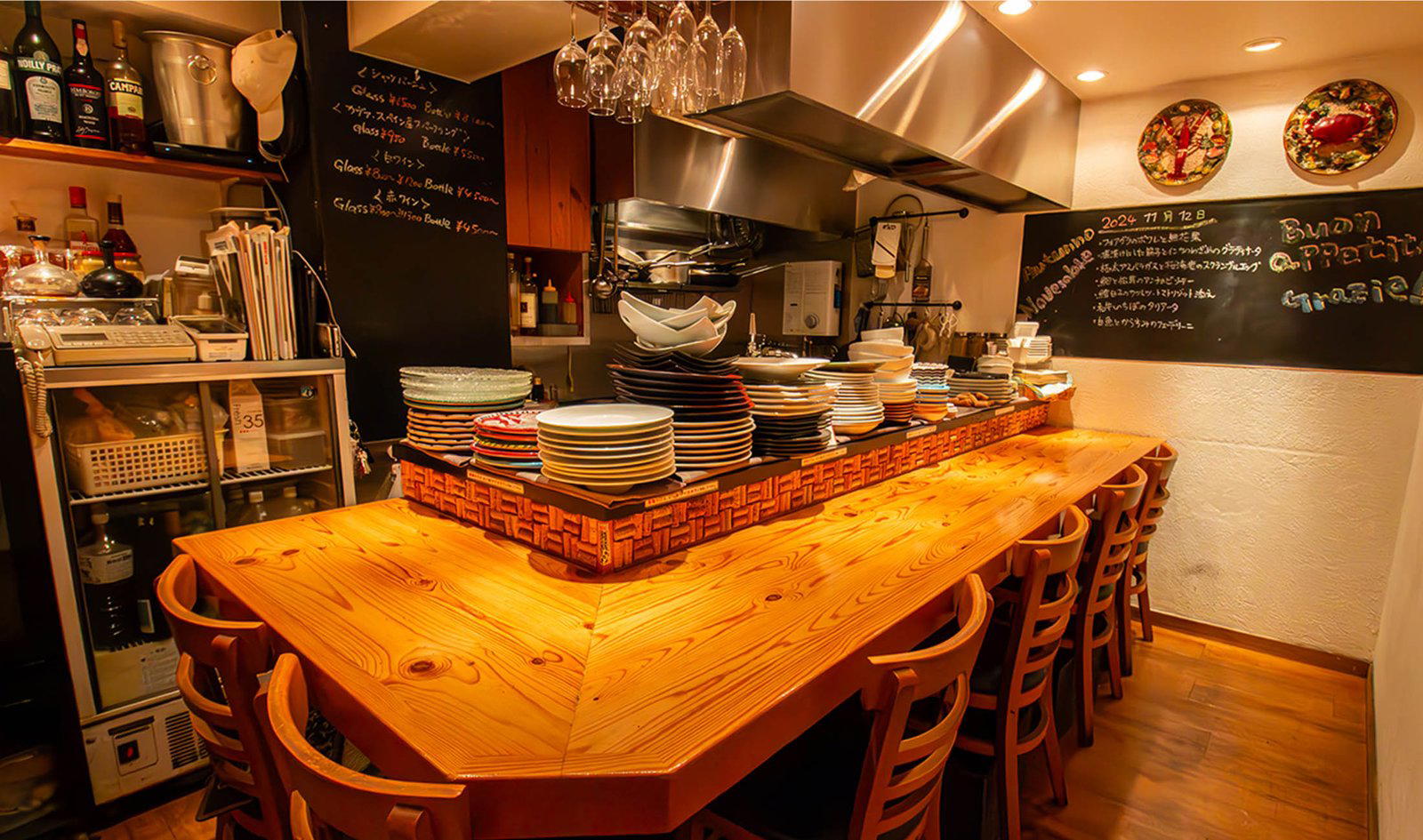
Kitashinchi is built for controlled entrances: narrow lobbies, upper-floor addresses, and rooms revealed only when the elevator opens. There, counter dining has charge. It compresses a meal into direct exchange between kitchen and guest, replacing European fine-dining grandeur with proximity, timing, and restraint. il PePe fits that Osaka pattern: six counter seats, Italian cooking, and a neighbourhood better known for late business dinners than casual foot traffic.
The comparison is not a trattoria with linen and a long menu, but Osaka’s compact, reservation-led dining culture, where imported technique is judged by local appetite. Italian cooking in Japan is not imitation. It absorbs pasta, olive oil, wine, and sequencing, then bends them around Japanese seafood, lighter pacing, and counter-service intimacy closer to sushi and kappo than to a Roman dining room. That is how this restaurant reads properly.
Italian grammar, Osaka scale, and a counter built for close reading
Osaka has long made foreign cuisines practical rather than precious. Yoshoku, pizza, pasta, and French-inflected set menus found audiences here because the city rewards flavour, value signals, and technical clarity over ceremony. The listed categories, Italian, yoshoku, and pasta, place il PePe inside that Osaka habit of translation. It is not framed as regional Italian orthodoxy, but as Japanese-Italian cooking, where technique travels, ingredients do local work, and balance matters more than nostalgia.
The six-seat counter matters. At this scale, service cannot hide behind ambience, and cooking has little room for excess. Counter-only restaurants in Japan ask diners to notice cadence: spacing between courses, plate temperature as food leaves the pass, and wine carrying a meal without becoming a cellar performance. Tabelog Italian WEST “Tabelog 100” recognition in 2021, 2023, and 2025 gives it a public signal within western Japan’s Italian category, but the format is more telling. A room this small competes on discipline.
That discipline separates it from the wider Kitashinchi field. Nearby Iroha, San Bettei Kitashinchi ten, and Shin Chinese HARAKAWA Kitashinchi ten point to a district comfortable with Japanese, Chinese, and higher-spend business dining. London Tea Room Doujima honten sits at the opposite end of the day, showing the area is not only expense-account territory. Against that spread, Italian counter cooking offers a different rhythm: less banquet structure than many Japanese dining rooms, more intimacy than a conventional Western restaurant, and sharper focus on product handling.
Fish, wine, and the Japanese-Italian compromise
The strongest editorial clue is the stated emphasis on fish and wine. In Japan, Italian seafood cooking tests restraint. The danger is over-Italianising delicate local ingredients with sauce weight, or flattening the Italian side until pasta becomes secondary. The better version keeps Italy’s grammar, olive oil, acidity, wheat, herbs, and wine pairing, while Japanese sourcing sets the register. That intersection is where Osaka’s Italian dining has gained confidence.
Wine changes the meal’s reading. In many small Japanese restaurants, the drink programme is secondary or tightly controlled. A wine-forward Italian counter promises alignment, not spectacle. The point is not a collector’s list, but whether bottles support seafood, pasta, and yoshoku-adjacent comfort without overwhelming a compact room. For travellers who know Tokyo’s polished Italian counters, Osaka often feels less formal and more direct: less hushed reverence, more concern for whether the plate lands with conviction.
The price bracket sits above casual pasta dining and below Japan’s highest-spend destination counters. That middle-upper tier creates specific expectations. Diners are not paying for a grand address, sweeping room, or celebrity-chef narrative. They are paying for a focused seat, controlled sequence, and a kitchen that makes Italian technique feel native to Osaka rather than imported whole. In a city with excellent eating at radically different prices, this asks for a deliberate evening, not a spontaneous detour.
How it fits into a wider Osaka itinerary
For a food-focused Osaka trip, il PePe belongs with small specialist rooms rather than broad sightseeing meals. It pairs naturally with a day treating Kita and Kitashinchi as dining districts, not just transit zones. Readers building a broader map can use Our full Osaka restaurants guide for the city’s restaurant spread, then branch into Our full Osaka hotels guide, Our full Osaka bars guide, Our full Osaka wineries guide, and Our full Osaka experiences guide for the rest of the trip architecture.
Osaka’s range is the point. A serious itinerary can move from bread and coffee at 52CHO-ME BAKERY or.cafe to mass-appeal comfort at 551 Horai (551蓬莱), then specialist Italian at 99 Pizza Napoletana Gourmet, a canto (Italian), and this Kitashinchi counter. The contrast is useful: Osaka does not need one dining identity. It is strongest when street-level appetite and polished small rooms sit side by side.
Beyond Osaka, the Japanese dining map changes quickly by city. Beef-focused meals such as -Grilled beef Sukiyaki- KAMAKURA TANUKIAN 鎌倉 たぬき庵 in Kamakura, Tokyo charcoal-and-tuna formats like. 鮪と炭火焼き うお炭 秋葉原店 in Tokyo, Kumamoto’s.know in Kumamoto, and regional specialists such as (Shoku) Vietnam in Kawasaki, [Curry Senmon Ten] Maruyama Kyoju. in Sapporo, and [ki:] in Kyoto show how category labels become local in Japan. Outside the country, Japanese-led formats such as Jōdo Saké Bar in Los Angeles and Onigiri Time in Pasadena underline the same lesson: technique travels, but context decides the meal.
The case for the restaurant is compact but clear. It is an Osaka Italian counter with repeat Tabelog Italian WEST “Tabelog 100” selection, a fish-and-wine emphasis, and the severe intimacy of six seats. Diners seeking theatrical luxury will read the room too literally. Diners interested in how Italian structure adapts to Japanese products, Osaka pacing, and Kitashinchi scale will understand why this category has become such a persuasive part of the city’s dining life.
Price Lens
Comparable venues at the same tier.
| Venue | Cuisine | Price | Notes |
|---|---|---|---|
| il PePe | Kita, Seasonal Omakase Italian | $$$ | Not listed |
| The Grand Cafe | Kita, Italian-style café and dining bar | $$$ | Not listed |
| CarneSio158 | Not listed | $$$ | Kita, Meat-focused Italian Bistro & Steakhouse |
| Shimanouchi Fujimaru Jozosho | Not listed | $$$ | Chūō, Urban winery with Italian-based cuisine |
| Trattoria Cielo | Yodogawa, Casual Italian Trattoria | $$ | Not listed |
| Yakiniku Katsuragi | Not listed | $$$ | Kita Ward, Sakai City, Traditional Osaka Yakiniku Counter |
Recognition history
Dated appearances from independent guides and award organizations, with the underlying list record or original source where available.
Tabelog 100 #64 · No. 64
Tabelog · Tabelog 100 - Italian - WEST - 2025
Continue exploring
More in Osaka
Restaurants in Osaka
Browse all →



Bars in Osaka
Browse all →



Hotels in Osaka
Browse all →



Wineries in Osaka
Browse all →
At a Glance
- Intimate
- Cozy
- Romantic
- Date Night
- Special Occasion
- Business Dinner
- Solo
- Chefs Counter
- Standalone
- Natural Wine
- Extensive Wine List
- Natural Wine
- Local Sourcing
Small, counter-only space with a quiet, intimate atmosphere, suited to dates and special meals, where the focus is on the chef’s seasonal course and relaxed conversation rather than bustle.