Tabelog 100 #26
Our verdict
Honkatry belongs to Tokyo’s compact curry-counter tradition rather than the city’s luxury dining circuit. In Yushima, close to Ochanomizu, it works in the low-priced, high-focus register: curry and Indian curry, counter service, no reservations, and repeat selection for Tabelog’s Curry TOKYO 100 in 2024, following listings in 2022 and 2023.

Pearl is the En Primeur Club membership app, where members save venues, book tables and use the concierge.
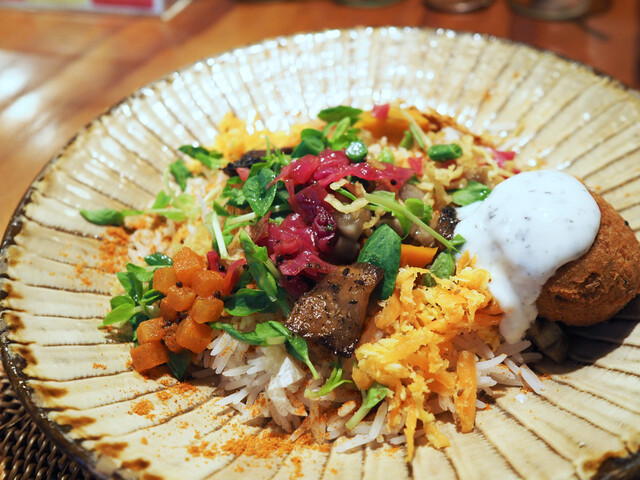
Tokyo’s curry culture is built on focus: quick meals, closely watched favorites, and the quiet choreography of service moving before the pot runs low. Honkatry sits in the Tokyo category where precision matters more than theatre. The city’s curry culture splits among quick-service chains, old-school yoshoku curry, South Asian specialist kitchens, and Japanese interpretations of Indian technique. This venue belongs to the specialist tier, where a clear proposition matters more than decorative flourish.
That matters because curry in Tokyo is never just one tradition. It is a city habit, postwar comfort food, train-station staple, and serious enthusiast category at once. Recognition from Tabelog’s Curry TOKYO 100 in 2024 places Honkatry where local attention carries weight. Tabelog scores are not international trophies, but in Japan they shape real dining behavior, especially in ramen, soba, tonkatsu, and curry, where local regulars often read quality more sharply than overseas lists.
A focused stop in Tokyo's curry specialist lane
The focused format changes everything. A curry specialist does not need a large dining room, roaming service team, or wine program to explain its purpose. Timing, plating, clearing, and payment all become part of the experience. Here, “team dynamic” is less about named personalities than operational discipline: the restaurant works around a defined service rhythm, the meal stays practical, and hospitality is direct rather than performative.
Tokyo has many tightly defined food formats, from sushi to tempura to yakitori. Curry uses the same urban appetite for specialization with a different social code: the guest comes for the plate, not ceremony. There is no need for long explanations of provenance or technique; the test is whether the meal arrives with balance, heat, and consistency during service. Specialist curry can be more exacting than its price tier suggests: it lacks fine dining’s expensive apparatus, yet exposes every weak link.
Honkatry’s category listing as curry and Indian curry sets expectations. Tokyo’s Indian-influenced curry shops are neither replicas of Indian restaurants nor standard Japanese curry-rice counters. Their appeal lies in adaptation: spice structures filtered through Tokyo portioning, lunch culture, and everyday restaurant economics. For travelers who have mapped sushi, ramen, and kaiseki, this is another reading of the city’s food intelligence: less ceremonial, more embedded in weekday life.
Tokyo rewards short, focused meals. Around the city, practical food formats hold ground because they serve repeat use as much as destination dining. A curry specialist here competes for regular loyalty, not just one-off attention. That separates it from design-led Tokyo cafés, or coffee-led neighborhood stops such as Jikaseibaisen Coffee Mijinko and Sakanoue Cafe. The comparison is not cuisine, but how modest-price Tokyo rooms build loyalty through repetition.
Why the award signal matters more than décor
The Tabelog 100 framework matters for a restaurant like this because curry does not always translate into global luxury language. There may be no chef biography for foreign readers, no tasting-menu arc, no sommelier pairing, no private room, and no elaborate booking ritual. The credential comes from category depth. Being named to Tabelog’s Curry TOKYO 100 in 2024 shows the restaurant has held attention in a dense specialist field.
That field is broad. Within Tokyo, diners can move from spice-forward specialists to retro curry-rice shops, South Asian regional cooking, café curry, and cutlet-curry staples. Honkatry sits in a focused specialist lane: curry and Indian curry categories, modest pricing, and a service model built around immediacy. The stronger comparison is not with formal kaiseki rooms such as Eigetsu, nor broader-format neighborhood cafés, but with category specialists whose tight propositions work because the audience understands the point.
EP Club readers planning Tokyo often over-index on high ceremony. The city’s reservation culture rewards planning, but sharper itineraries leave space for low-price, high-specificity food between appointments. Curry suits that role because it reveals a Tokyo tempo that is fast, disciplined, and deeply local without needing luxury codes. For broader planning, Our full Tokyo restaurants guide should be read alongside category-specific stops rather than only formal dining. The same logic applies across the city’s other circuits, from Our full Tokyo bars guide to Our full Tokyo hotels guide, Our full Tokyo wineries guide, and Our full Tokyo experiences guide.
How to place it in a Tokyo eating day
Plan Honkatry as a focused curry stop, not an all-purpose restaurant. Its specialist category suits travelers who can keep the day flexible. The rhythm is best treated as part of a Tokyo sequence, with food stops chosen by category rather than ceremony.
That approach makes a more interesting Tokyo itinerary. Across the same broad city map, travelers can compare specialist formats rather than chase one dining hierarchy: curry at Honkatry, coffee at Jikaseibaisen Coffee Mijinko, sweets or café time at Sakanoue Cafe, or a different restaurant register at Rangitoto Tokyo. The point is not to force comparison across cuisines, but to understand how Tokyo’s smaller rooms earn loyalty through clarity and repetition.
Japan’s wider dining map rewards the same category thinking. Trips beyond Tokyo can compare regional formats through unnamed local counters, cafés, and specialist dining rooms, while Tokyo’s own food conversation keeps turning on category depth. The city’s curry specialists remain their own language: brief, concentrated, modestly priced, and judged by repeat use rather than spectacle.
Frequently asked questions
Where is Honkatry located?
Tokyo.
What does dinner at Honkatry typically cost?
Pricing at Honkatry is listed as JPY 1,000 - JPY 1,999 JPY 1,000 - JPY 1,999 View spending breakdown.
Can I walk in to Honkatry?
Honkatry is listed as a curry and Indian curry specialist in Tokyo, so it is best approached as a focused stop rather than an expansive, all-purpose restaurant.
What do critics highlight about Honkatry?
The main signal is external recognition: Honkatry was selected for Tabelog Curry TOKYO 100 in 2024. Its Tabelog listing also places it in the curry and Indian curry categories, with a score of 3.83.
Reputation First
Comparable venues side-by-side for orientation.
| Venue | Cuisine | Price | Awards | Notes |
|---|---|---|---|---|
| HonkatryThis venue (the venue you are viewing) | Indian-style curry counter | $10–20 | Tabelog 100 #26 | Not listed |
| Ethiopia Curry Kitchen Ochanomizu soracity ten | Curry House | $10–20 | Tabelog 100 #77 | Chiyoda |
| Puja | Authentic Bengali home-style restaurant | $10–20 | Tabelog 100 #99 | Arakawa |
| Ethiopia Curry Kitchen Takadanobaba ten | Japanese Curry | $1–10 | Tabelog 100 #72 | Shinjuku |
| Pork Vindaloo Taberu Fukudaitoryo | Pork vindaloo curry shop | $10–20 | Tabelog 100 #56 | Shibuya |
| ERICK SOUTH Toranomon hiruzu ten | South Indian curry & biryani | $20–30 | Tabelog 100 #80 | Minato |
Recognition history
Dated appearances from independent guides and award organizations, with the underlying list record or original source where available.
Tabelog 100 #26 · No. 26
Tabelog · Tabelog 100 - Curry - TOKYO - 2024