On Rue Eau de Robec, Rouen's atmospheric canal-side street, Ho Lamian brings hand-pulled noodle tradition to a city better known for duck press and Norman cream sauces. The format is built around lamian, the Chinese art of stretched wheat dough, positioning it as a distinct counterpoint to the French bistro circuit that dominates central Rouen's dining scene.
Pearl is the En Primeur Club membership app — saves, bookings, and concierge access live there. Same editors, same standards.
- Address
- 243 Rue Eau de Robec, 76000 Rouen, France
- Phone
- +33276285087
- Website
- facebook.com
- Directions
- Get directions
 Saves & bookings on Pearl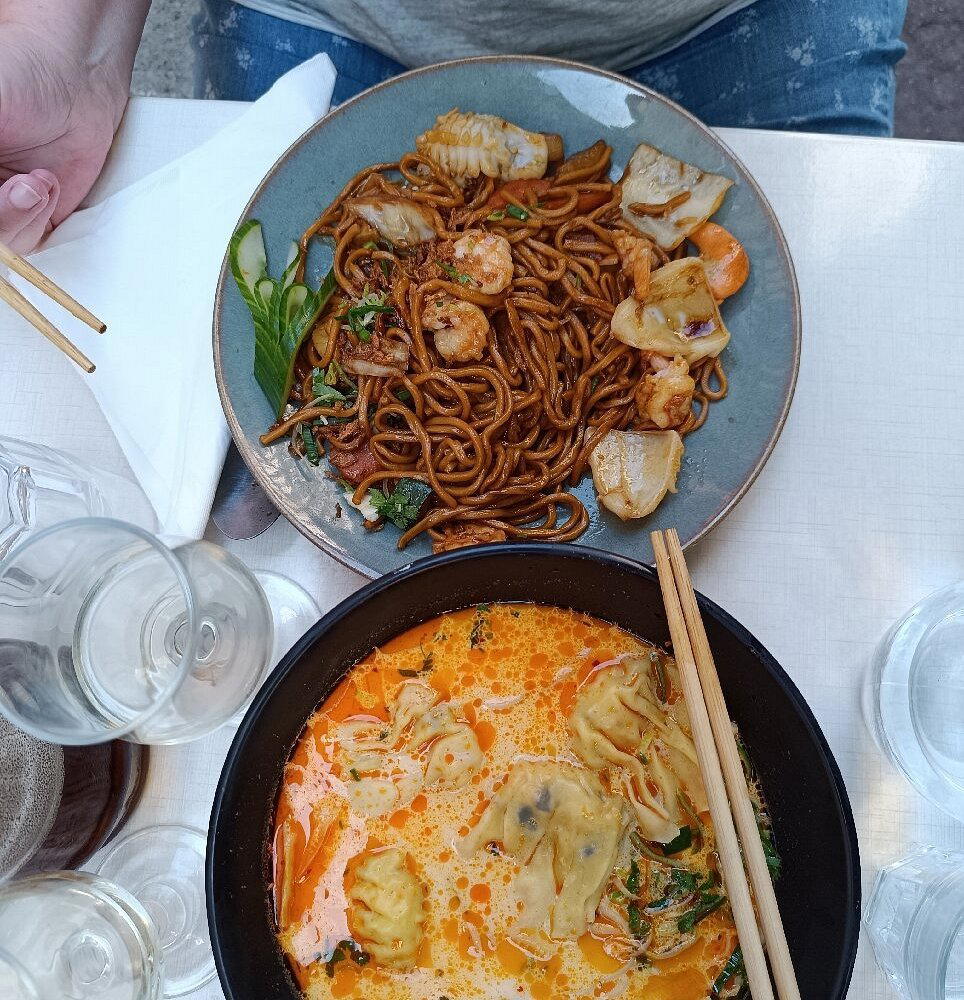
A Different Kind of Bowl on Rouen's Canal Street
Rue Eau de Robec has a particular quality that few streets in provincial France can match: a sequence of half-timbered façades reflected in a narrow canal, the kind of scene that makes first-time visitors reach for their phones before they've found a table anywhere. The street draws a mix of students from the nearby university, tourists following the old textile quarter's history, and locals who know that a few of its addresses reward closer attention. Ho Lamian sits at number 243, operating in a neighbourhood where the competition tends toward crêperies and casual French bistros rather than anything from further east.
That positioning matters. Rouen's central dining circuit, with addresses like Brasserie Paul anchoring the classic end and L'Odas representing the creative French tier, leaves a gap for formats that don't operate on French culinary logic at all. Ho Lamian fills part of that gap with lamian, hand-pulled wheat noodles, a northern Chinese technique that requires the cook to repeatedly stretch and fold a single mass of dough until it forms long, even strands of controlled thickness.
The Technique Behind the Bowl
Lamian is not a casual skill. The pulling process, which involves swinging the dough through the air in doubled loops, determines the noodle's texture, its ability to hold broth, and its behaviour under heat. Different pull counts produce different gauges: fewer folds yield thick, chewy strands suited to heavier broths; more folds create fine, silky noodles that work with cleaner soups. It's a tradition with roots in Lanzhou and Shanxi provinces, refined over centuries in northern China before spreading through the Chinese diaspora across Asia and, more recently, into European cities.
In France, the lamian format remains genuinely rare outside Paris. The capital has seen a small number of specialist noodle houses open over the past decade, tracking a broader European interest in regional Chinese cooking beyond the generalised stir-fry menus that dominated immigrant restaurant culture for much of the twentieth century. Rouen's position, a city of around 110,000 people, two hours from Paris by car and connected to the capital by frequent rail, means it receives culinary influences with a delay, but it also means that an operator bringing something genuinely specific has less direct competition than it would face in Paris or Lyon.
Reading the Progression of a Lamian Meal
A meal built around hand-pulled noodles has a different narrative arc than a French multi-course dinner. The broth, if there is one, sets the register immediately: a bone-white beef marrow soup, a darker soy-based liquid, or a numbing Sichuan-inflected base each signals what the meal intends to do. Cold starters, where they appear, often function as palate anchors, vinegared vegetables, chilled proteins, pickled aromatics, before the heat of the main bowl arrives.
The noodle itself is the centrepiece, not a vehicle. At a serious lamian counter, the dough is pulled to order, which means the strand structure is at its most elastic and fresh when it reaches the table. This is meaningfully different from dried or pre-cut noodles, which have already undergone structural changes during storage. The texture in the first few minutes, somewhere between al dente pasta and a chewier Japanese ramen noodle, is the point of the dish. Leaving the bowl to sit defeats it.
Toppings and accompaniments complete the sequence: braised meats, slow-cooked in soy and aromatics; soft-cooked eggs; crisp-fried shallots or garlic; fresh herb additions that cut through the fat of longer-cooked components. The balance between the bowl's richness and those punctuating elements is where the kitchen's judgement shows most clearly. Ho Lamian's address on a student-adjacent street suggests a format that is accessible rather than precious, which in practice often means generous portion calibration and broth that is built for satisfaction rather than delicacy.
How Ho Lamian Sits in Rouen's Broader Dining Map
Rouen's dining scene is more considered than its tourist-circuit reputation suggests. Beyond the Norman classics, duck à la rouennaise, apple-enriched sauces, aged Livarot and Camembert, the city has addresses that position themselves against a national standard. ACQUA & FARINE works the Italian-inflected end of the market; Chez L'Gros and Au Flaméron occupy the convivial French bistro register. The restaurant operates in a different category entirely, drawing its logic not from French culinary tradition but from a Chinese regional one.
For context on what serious French dining looks like at its most ambitious, the reference points are considerably further afield: Mirazur in Menton, Alléno Paris au Pavillon Ledoyen, or Troisgros in Ouches represent a tier of formal French ambition that Rouen's dining scene doesn't directly attempt to occupy. What the city does well is mid-format eating with genuine specificity, and a lamian specialist on a canal-side street fits that model. It is the kind of address that works because it commits to something narrow rather than attempting to be broadly appealing.
Elsewhere in provincial France, kitchens at addresses like Flocons de Sel in Megève, Assiette Champenoise in Reims, or Au Crocodile in Strasbourg demonstrate how regional French cities sustain serious kitchen ambition. The restaurant's operation is less formally ambitious than those, but it answers a different question: what does authentic, technique-driven noodle work look like in a city that isn't Paris?
Planning a Visit
The restaurant is at 243 Rue Eau de Robec, in Rouen's old textile district east of the cathedral. The street is walkable from the city centre and well-served by the network of streets around Place du Vieux-Marché. Given its location on a street with high pedestrian footfall from both tourists and locals, arriving earlier in a service is the more reliable approach.
Reputation First
Comparable venues nearby, for context on price, style, and recognition.
| Venue | Cuisine | Price | Notes |
|---|---|---|---|
| Ho LamianThis venue — the venue you are viewing | Authentic Cantonese Hand-Pulled Noodles | $$ | Not listed |
| Chez Yulin | Authentic Chinese & Korean | $$ | Vieux Palais |
| Gill Côté Bistro | Traditional French Bistro with Norman Specialties | $$ | Vieux Marché |
| ACQUA & FARINE | Italian Pizza and Pasta | $$ | Vieux Marché Cathédrale |
| Chez Philippe | Traditional French Bistro | $$ | Centre-ville |
| Lé Là Restaurant | Réunion-Norman Fusion | $$$ | Centre Ville |
Continue exploring
More in Rouen
Restaurants in Rouen
Browse all →
Hotels in Rouen
Browse all →
Wineries in Rouen
Browse all →
At a Glance
- Lively
- Cozy
- Casual Hangout
- Group Dining
- Terrace
- Open Kitchen
Current opening hours
- Monday
- Closed
- Tuesday
- 12–2 PM, 7–10 PM
- Wednesday
- 12–2 PM, 7–10 PM
- Thursday
- 12–2 PM, 7–10 PM
- Friday
- 12–2 PM, 7–10 PM
- Saturday
- 12–2 PM, 7–10 PM
- Sunday
- Closed
Hours can change for holidays and private events. Last verified .
Warm and lively atmosphere, especially lively in summer when terraces flanking Rue du Robec fill with diners; intimate counter-style setting with authentic, unpretentious charm.