Our verdict
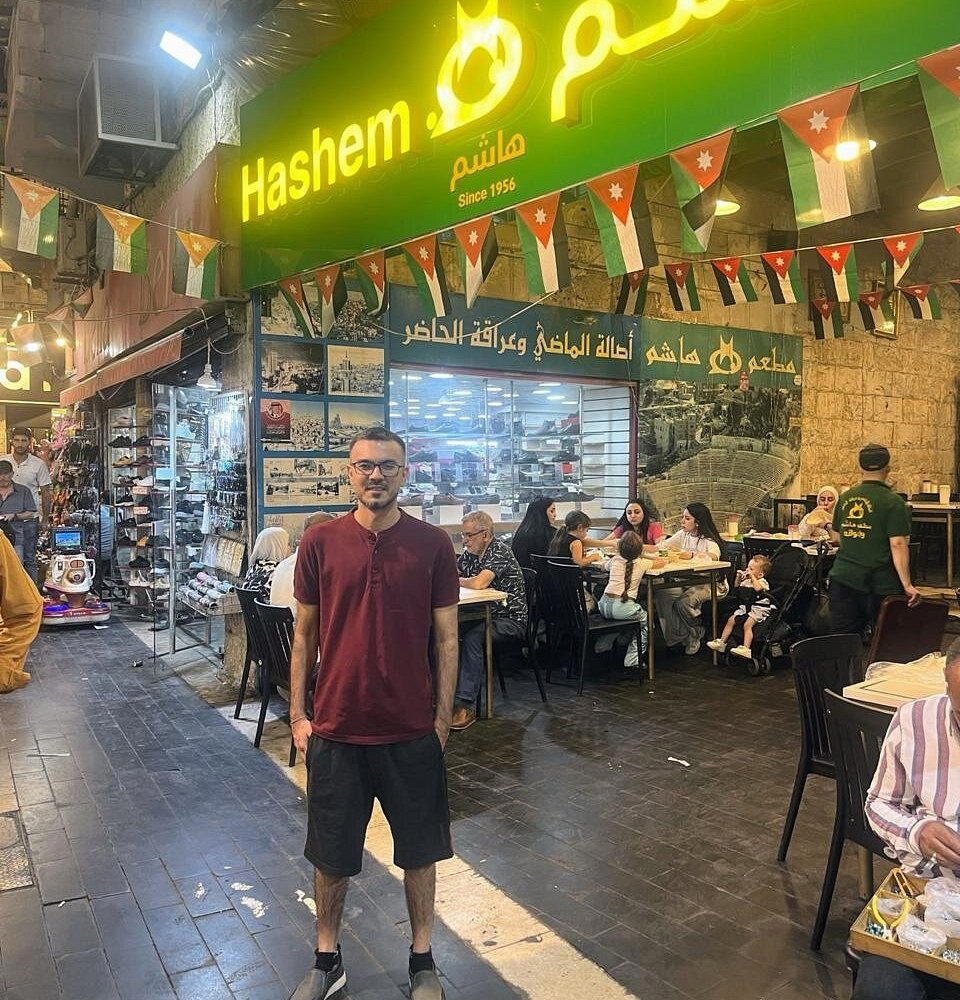
On King Faisal Street in downtown Amman, Hashem Restaurant occupies a position that few places in the Arab world can claim: a falafel and ful counter so embedded in the city's daily rhythm that it operates as a social institution rather than a dining option. It draws everyone from government ministers to construction workers, and has done so for decades.

Pearl is the En Primeur Club membership app, where members save venues, book tables and use the concierge.
The menu
What to order
- Falafel
- Hummus
- Ful medames
- Moutabel
- Fattet hummus
Downtown Amman's Most Consistent Address
King Faisal Street runs through the commercial heart of old Amman, and the stretch around the First Circle has always been the city's economic and social mixing bowl. Street-level trade, government offices, and century-old storefronts sit in close proximity, and the foot traffic reflects that density. In this context, Hashem Restaurant is not simply a place to eat. It is a fixed point in a neighbourhood that changes slowly but continuously, and its position on the street functions as a kind of civic anchor for the area's daily life.
The dynamics of downtown Amman differ sharply from the dining culture developing in Jabal Amman and Jabal Al-Weibdeh, where restaurants like Fakhreldin, Dara Dining by Sara Aqel, and Sufra have built more formal, reservation-led propositions around Jordanian and Levantine cooking. Downtown operates on a different register entirely: faster, more transactional, and anchored in the working-class and merchant traditions that still define its streets. Hashem sits squarely within that register. The food it serves, primarily falafel, ful medames, hummus, and fresh flatbread, is the food of the neighbourhood's morning and midday hours, eaten standing or at close-packed tables, without ceremony.
What the Ordering Pattern Reveals
In Levantine street-food culture, the falafel house is a precise institution with its own grammar. Freshness is the governing variable: falafel fried to order from a chickpea-and-herb paste that has been ground that morning, served immediately, deteriorates quickly once it sits. The establishments that have built lasting reputations across Beirut, Damascus, and Amman have done so by holding that standard across thousands of covers a day, not by innovating around it. Hashem's reputation rests on exactly this kind of consistency over volume.
The ordering sequence at places like this follows a well-established pattern across the Levant. Ful medames, slow-cooked fava beans finished with lemon, olive oil, and cumin, typically arrives as a foundation dish, alongside hummus and warm khubz. Falafel comes next, and the benchmark is the exterior-to-interior ratio: a crust that fractures cleanly against a green, herb-dense interior that has not dried out. Fresh mint, sliced tomato, and pickled vegetables complete the spread. These are the components regulars return for, and their consistency over years is the metric by which downtown Amman measures its falafel houses.
For comparison, the genre of Jordanian cooking being explored at higher price points, the mansaf traditions and regional meze presentations at places like Shams El Balad, belongs to an entirely different category of dining intention. Hashem addresses a different need, and its loyal following reflects that clarity of purpose. The same clarity appears at regional institutions elsewhere in Jordan: Deretna My Mom Recipe in Petra and Alibaba Restaurant in Aqaba each occupy a comparable civic role in their own cities, anchoring local eating habits rather than serving visitor expectations.
The Social Geography of King Faisal Street
The cross-section of people who pass through Hashem across any given day is itself a form of editorial comment on how Amman works. Downtown is not a neighbourhood that trades on curated atmosphere, there is no bar program to compare with 13C Bar in the Back, no tasting-menu ambition. What King Faisal Street offers instead is a form of urban legibility that wealthier, more developed neighbourhoods often lose. The social geography of the street is visible in the food: a counter that charges the same price for falafel regardless of who is ordering it, that operates without a reservation system or dress code, that functions as a shared space across income levels, is a genuinely unusual thing in any city. Amman's urban growth has created increasing separation between its dining tiers, which makes downtown's persistence as a mixed social space more notable, not less.
Proximity to central Amman's main commercial and transport arteries means Hashem is accessible from most parts of the city without a car, a practical point in a city where most dining decisions otherwise require driving. The surrounding streets contain some of Jordan's oldest commercial infrastructure: gold souks, textile merchants, and the Roman theatre are all within walking distance. Eating at Hashem fits naturally into a morning in that part of the city rather than requiring a dedicated trip.
Where Hashem Sits in Amman's Eating Spectrum
Amman's restaurant scene has expanded considerably over the past decade, with serious cooking emerging at multiple price points. The city's higher-end addresses now draw enough regional attention to be discussed alongside Levantine dining in Beirut and fine-dining destinations farther afield, a comparison set that, at the international level, includes the kind of technically rigorous programs found at Le Bernardin in New York City, Atomix in New York City, or Amber in Hong Kong. Hashem does not belong to that conversation, nor does it need to.
That kind of longevity is harder to maintain than it looks. The economics of high-volume street food require sustained sourcing discipline, daily preparation routines that cannot be shortcut, and a willingness to keep prices within reach of the neighbourhood's working population. The institutions that have done this across decades in the Levant, in Beirut's Hamra district, in Damascus's Bab Touma, and in Amman's own downtown, share a common characteristic: they did not scale upward or reposition when the opportunity arose. They stayed on the street. See our full Amman restaurants guide for the broader spectrum of what the city offers, from addresses like this one to the more structured dining rooms reshaping the upper end of the market.
Hashem sits at the foundational end of that spectrum, not as a lesser option, but as a category that operates by entirely different standards. Judged on those standards, its continued presence on King Faisal Street, drawing the same cross-section of the city it always has, is itself a form of credibility that no award or review can manufacture. Also worth exploring in the region: أكلة وفتلة in Ajloun, where a similar commitment to traditional cooking anchors a smaller city's food identity.
Planning Your Visit
Hashem is located on King Faisal Street in downtown Amman, within easy reach of the city centre. No reservation is needed or possible, the format is walk-in, and the operation runs continuously through the day. Dress code does not apply. Prices are in line with the street-food tier of the Jordanian market, making it one of the most accessible eating options in the city by cost. Morning hours, when falafel production is freshest, tend to draw the densest crowd, though the kitchen operates across the main meal periods. No website or phone booking exists; arriving is the only method of entry.
Frequently asked questions
How do I find Hashem Restaurant?
Hashem Restaurant is located at King Faisal Street Amman, ʿAmman, Jordan, Amman.
Is Hashem Restaurant in Amman suitable for solo travellers eating alone?
The walk-in, no-reservation format on King Faisal Street is inherently suited to solo diners, there is no minimum party size and no table-holding convention to navigate. Counter and communal seating is standard at downtown Amman street-food addresses, which means solo visitors integrate into the normal flow of service without friction. Its location near central downtown landmarks also makes it a practical first stop for anyone arriving in the city for the first time.
What do regulars order at Hashem Restaurant?
The order at Hashem follows a consistent pattern across the Levantine street-food tradition: freshly fried falafel, ful medames, hummus, and warm khubz flatbread. Falafel freshness, assessed by crust, herb balance, and timing out of the fryer, is the operative standard by which the kitchen is judged. Most customers at the King Faisal Street address eat the same core four dishes regardless of time of day.
What's the best way to book Hashem Restaurant?
Hashem does not operate a reservation system. The format is walk-in only, in keeping with the traditional street-food model that defines downtown Amman's King Faisal Street addresses. Arrival at off-peak hours reduces wait time, but no advance booking is possible or necessary.
What's the defining dish or idea at Hashem Restaurant?
The falafel is the reference point. Across the Levant, falafel is judged on a narrow set of criteria, freshness from the fryer, crust texture, and the herb-to-chickpea ratio, and Hashem is assessed on those same terms by Amman regulars. The broader idea is consistency: a downtown address on King Faisal Street that holds to the same short menu without revision.
Can Hashem Restaurant accommodate dietary restrictions?
The core menu at Hashem, falafel, ful medames, hummus, and flatbread, is plant-based by default. This means the standard offering aligns with vegan and vegetarian requirements without modification.
Does Hashem Restaurant justify its prices?
Hashem prices within the street-food tier of the Amman market, which sits at the lower end of the city's eating spectrum by price point. Assessed against other falafel and ful medames counters in downtown Amman, the value proposition is straightforward: the same dishes available elsewhere in the neighbourhood, at comparable prices, with a consistent execution record. The cost-per-meal is low enough that the question of justification rarely arises.
A Tight Comparison
Comparable venues nearby, for context on price, style, and recognition.
| Venue | Cuisine | Price | Notes |
|---|---|---|---|
| Hashem RestaurantThis venue (the venue you are viewing) | Authentic Levantine Breakfast | $1–10 | Not listed |
| Jubran Restaurant | Levantine & Jordanian Rooftop Dining | $20–30 | Abdali, Levantine & Jordanian Rooftop Dining |
| Little Italy Pizzeria | Authentic Neapolitan Pizza & Italian Trattoria | $20–30 | Abdoun, Authentic Neapolitan Pizza & Italian Trattoria |
| Adam's Secrets Restaurant & Cafe | Jordanian & International Cafe | $10–20 | Abdoun, Jordanian & International Cafe |
| Levant | Modern Armenian-Lebanese Levantine | $30–50 | 3rd Circle, Modern Armenian-Lebanese Levantine |
| Romero | Classic Italian Fine Dining | $50–100 | Jabal Amman, Classic Italian Fine Dining |
Continue exploring
More in Amman
Restaurants in Amman
All restaurants in Amman →
Bars in Amman
All bars in Amman →

Details
- Well Known
- Lively
- Rustic
- Classic
- Casual Hangout
- Brunch
- Late Night
- Group Dining
- Open Kitchen
- Historic Building
- Standalone
- Street Scene
- A La Carte
- Vegetarian Friendly
- Vegan Options
- Halal
Current opening hours
- Monday
- Open 24 hours
- Tuesday
- Open 24 hours
- Wednesday
- Open 24 hours
- Thursday
- Open 24 hours
- Friday
- Open 24 hours
- Saturday
- Open 24 hours
- Sunday
- Open 24 hours
Hours can change for holidays and private events. Hours as of .