Gare
Gare sits on Avenue de la Gare in Lucens, a small Vaudois town where the restaurant scene is defined by proximity to some of Switzerland's most productive agricultural land. The address places it squarely in the tradition of the Swiss railway-town dining room, a format that, at its best, prioritises local sourcing and seasonal discipline over metropolitan spectacle. Visitors to Lucens would do well to check the current programme before booking.
Pearl is the En Primeur Club membership app — saves, bookings, and concierge access live there. Same editors, same standards.
- Address
- Av. de la Gare 13, 1522 Lucens, Switzerland
- Phone
- +41219061250
- Website
- gare13.ch
- Directions
- Get directions
 Saves & bookings on Pearl
Arriving in Lucens: The Railway-Town Dining Tradition
Gare is a restaurant in Lucens, Switzerland, serving classic French fine dining at about $120 per person. Lucens, a commune of a few thousand in the canton of Vaud, sits between Lausanne and Bern in a corridor of farmland that supplies particularly productive dairy and produce in the country. Avenue de la Gare, the street that runs from the railway station into town, is the address where Gare operates, and that address is not incidental. The railway-station street in a Swiss agricultural town has historically been where the working restaurant lives: closer to the source of the food than to the theatre of fine dining.
That distinction matters more now than it did a decade ago. Swiss restaurant culture has bifurcated sharply between high-concept destination dining, properties like Schloss Schauenstein in Fürstenau or Memories in Bad Ragaz, operating in the €€€€ tier with international draw, and the quieter, deeply local formats that serve the communities around them. Lucens belongs to the latter geography, and Gare sits within it.
Sourcing and the Vaud Agricultural Corridor
The editorial angle that makes Lucens worth the detour from Lausanne or Fribourg is ingredient provenance. The canton of Vaud is one of Switzerland's principal food-producing regions: the plains around the Broye River, which runs through Lucens, support mixed farming, and the nearby Lac de Neuchâtel and Lac de Morat zones add freshwater fish to the regional palette. A restaurant at this address, in this commune, has access to a supply network that larger city restaurants spend considerable effort trying to replicate through sourcing partnerships.
That proximity is the structural advantage of dining in small-town Vaud. The comparison set for ingredient access is not the Lausanne brasserie but the farmhouse table: products move shorter distances, arrive fresher, and change with the week rather than the season. Swiss culinary culture has long recognised this. The tradition of the auberge and the restaurant de gare in the French-speaking cantons is built on exactly this logic, that a kitchen close to production is a kitchen with inherent advantages, provided it has the discipline to use them.
For regional context on how this tradition connects to the broader French-Swiss dining scene, our full Lucens restaurants guide covers the commune's current dining options. The nearby De la Gare - La Table des Suter in Lucens occupies a similar address logic and offers a useful point of comparison for understanding how different operators interpret the railway-town format.
What the Swiss Small-Town Format Delivers
Across Switzerland's French-speaking cantons, the restaurant that earns its place in a town like Lucens tends to operate on different terms than its urban counterparts. The price pressure is different, the regulars are local rather than tourist, and the kitchen is accountable to a community that knows what the seasonal produce should actually taste like. This creates a specific type of discipline that can be harder to find in destination restaurants built around an experience architecture.
Compare the model to something like focus ATELIER in Vitznau or Taverne zum Schäfli in Wigoltingen, both Swiss creative operations in smaller communities, and the pattern holds: the restaurants that survive and develop a reputation outside their immediate catchment area tend to be the ones where sourcing and seasonal response are treated as a kitchen discipline rather than a marketing position.
Further afield in Switzerland's dining hierarchy, the contrast sharpens further. Hotel de Ville Crissier in Crissier and Cheval Blanc by Peter Knogl in Basel represent the formal, heavily awarded end of the Swiss table. Maison Wenger in Le Noirmont shows how a small-town location can carry serious culinary ambition when the kitchen commits to it. The question for any restaurant at the Lucens address is where on that spectrum it positions itself, and whether the local sourcing advantage is being used to that end.
Dining in Lucens: Practical Notes
Lucens is accessible by regional train from Lausanne (approximately 35 minutes on the Lausanne-Payerne line) and sits within driving range of Fribourg and Yverdon-les-Bains. The town's restaurant scene is modest in scale, which means booking ahead, particularly for weekend service, is the practical approach rather than the cautious one. Avenue de la Gare is a short walk from the railway station, making arrival by train one direct option.
Current hours run Wednesday through Saturday, with Monday, Tuesday, and Sunday closed. For travellers routing through western Switzerland and building a multi-stop itinerary, Lucens works as a lunch stop between Lausanne and Bern, or as a dinner base if staying in the Broye region.
Restaurants at this address level, the local Swiss table rather than the destination dining room, tend not to carry the formal award designations of Einstein Gourmet in Sankt Gallen or Da Vittorio in St. Moritz. That absence is not a deficit. It reflects a different set of priorities: community service, seasonal rotation, and the kind of regional ingredient focus that award committees increasingly recognise but that local restaurants have been practising for generations. For broader comparisons beyond Switzerland, the community-rooted dining model has parallels at places like Lazy Bear in San Francisco, where format and sourcing philosophy carry more weight than conventional luxury signals.
Who Eats Here and Why It Matters
The clientele that sustains a restaurant on Avenue de la Gare in Lucens is not the tasting-menu tourist making a pilgrimage. It is the local professional, the extended family lunch, the business table that meets weekly. That audience is especially demanding in one specific respect: it knows the food, knows the prices, and returns or stops returning based on consistency rather than novelty. A kitchen that holds that audience over time is doing something technically correct, even if it never appears in a major ranking.
For travellers who have spent time at the formal end of Swiss dining, the kind of table represented by Mammertsberg in Freidorf, La Table du Valrose in Rougemont, or La Brezza in Ascona, eating in a small Vaudois railway-town restaurant is a different register entirely. The value is in proximity to the agricultural source, in the absence of performance, and in the chance to eat what the region actually produces rather than what a destination kitchen has assembled from it. Skin's in Lenzburg and The Japanese Restaurant in Andermatt represent other formats of the non-metropolitan Swiss table, each in a different register. Le Bernardin in New York is the opposite pole: a restaurant where ingredient sourcing is also the central argument, but executed at a different level of resource and formality. The gap between those poles is where most good eating actually happens.
In Context: Similar Options
Comparable venues nearby, for context on price, style, and recognition.
| Venue | Cuisine | Price | Awards | Notes |
|---|---|---|---|---|
| GareThis venue — the venue you are viewing | Classic French Fine Dining | $$$$ | Not listed | Not listed |
| De la Gare - La Table des Suter | Classic French Fine Dining | $$$$ | Michelin Plate | Lucens |
| Anne-Sophie Pic | Modern French Fine Dining with Swiss Influences | $$$$ | Not listed | Ouchy |
| Basique | Modern French Neo-Bistro | $$$$ | Not listed | historic center of Sion |
| La Cordée | Alpine Brasserie with French Influences | $$$$ | Not listed | Verbier |
| Auberge de Bogis-Bossey | Modern French Fine Dining | $$$$ | Not listed | Bogis-Bossey |
Continue exploring
More in Lucens
Restaurants in Lucens
Browse all →
Bars in Lucens
Browse all →
Hotels in Lucens
Browse all →
Wineries in Lucens
Browse all →
At a Glance
- Elegant
- Romantic
- Sophisticated
- Classic
- Date Night
- Special Occasion
- Business Dinner
- Celebration
- Terrace
- Garden
- Historic Building
- Hotel Restaurant
- Extensive Wine List
- Sommelier Led
- Local Sourcing
- Farm To Table
- Garden
Current opening hours
- Monday
- Closed
- Tuesday
- Closed
- Wednesday
- 10 AM–12 AM
- Thursday
- 10 AM–12 AM
- Friday
- 10 AM–12 AM
- Saturday
- 11 AM–12 AM
- Sunday
- Closed
Hours can change for holidays and private events. Last verified .
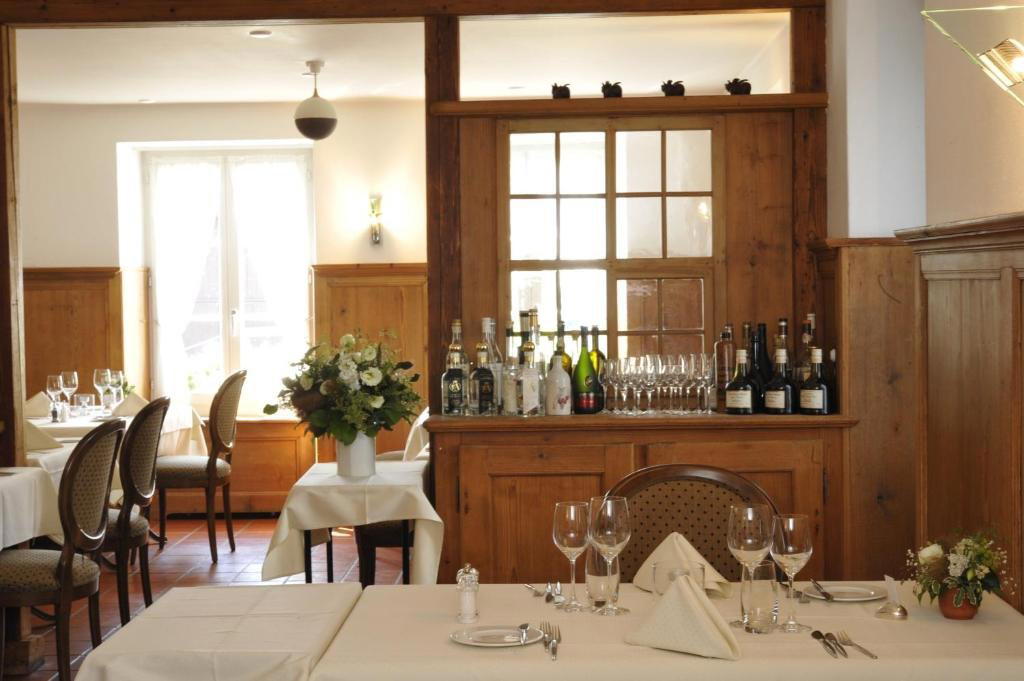
Warm, elegant atmosphere with a buzzy, friendly vibe; polished service in a charming setting that balances sophistication with genuine hospitality.