
Tabelog 100 #38
Our verdict
Gaina Seimenjo gives Kasai a serious udon address in rural Hyogo, with Tabelog 100 Udon WEST 2024 recognition and a format built around wheat noodles, tempura, and oden rather than luxury dining theater. The case for going is regional specificity: a low-priced noodle shop whose reputation sits inside western Japan’s competitive udon culture.

Pearl is the En Primeur Club membership app, where members save venues, book tables and use the concierge.
The menu
What to order
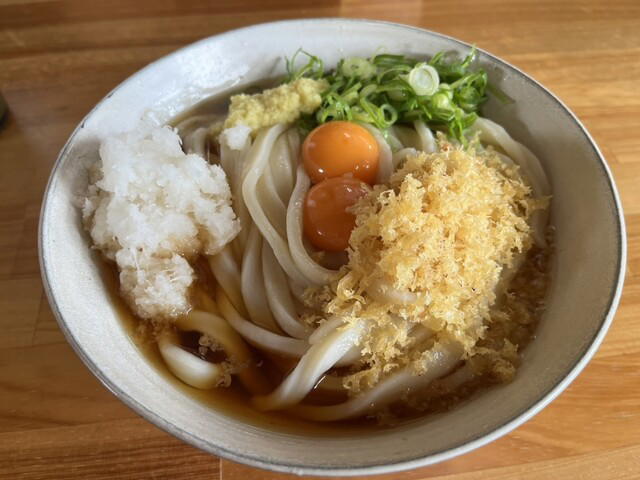
- バター釜たまうどん (Butter kama-tama udon)
- 温泉たまごのとり天おろし釜たま
- 播磨キングカレーうどん (Friday-only Harima King curry udon)
- 肉うどん定食
- キス天とアスパラ天のおろしぶっかけ
The approach to serious udon in Kasai is different from the polished counter rituals of major-city fine dining. It is quieter, more practical, and tied to the daily rhythm of wheat, broth, frying oil, and quick turnover. In Kasai, that matters: the city is not a high-density dining district, so a noodle shop with Tabelog 100 Udon WEST 2024 recognition carries a different kind of weight. It signals that the cooking is being judged against western Japan’s udon specialists, not merely against local convenience.
Gaina Seimenjo belongs to that category of Japanese restaurants where the ingredient logic is the story. Udon is a wheat craft before it is a menu genre: flour selection, hydration, kneading, resting, cutting, and cooking all decide whether the bowl has structure or simply bulk. Tempura and oden broaden the meal without changing its center of gravity. The point is not maximal choice; it is a short, familiar set of forms that lets the noodle work remain visible.
Wheat noodles as the main argument
Japan’s udon map is regional rather than uniform. Elastic noodle styles, restrained broths, roadside noodle houses, station counters, and destination shops all sit under the same word, but they reward different expectations. Kasai’s version of a serious udon stop is closer to the regional-destination model: a place people plan around because the category is humble, fast, and technically unforgiving.
The Tabelog 100 Udon WEST 2024 selection is the cleanest public trust signal here, supported by a listed Tabelog score of 3.70. In a category with low average spend and high daily repetition, consistency matters. Udon shops do not have the cover of long tasting menus, rare wine allocations, or theatrical service. The cooking has to make its point in a bowl, with supporting dishes kept in proportion.
That is why the ingredient-sourcing question matters even when supplier names are not part of the public conversation. Wheat noodles reveal shortcuts. Overworked dough turns heavy; underdeveloped dough lacks pull; careless boiling flattens the distinction between a competent lunch and a destination bowl. Tempura adds another test, because frying can either sharpen the meal or swamp it. Oden, when present in this format, anchors the shop in everyday eating rather than in destination dining performance.
Kasai's udon case is stronger because it is not trying to be grand
Kasai does not need the same dining vocabulary as larger urban centers. Its appeal lies in the small-city and countryside routes that connect local routines, independent businesses, and everyday lunch rooms. A serious udon shop fits that geography better than a formal restaurant would. The experience is built for people who understand that a focused bowl can justify a detour when the underlying craft is strong enough.
Compared with out-of-metro Hyogo dining at higher spends, such as Niku Ryori Tatsuki or Niku Ryori Nigatsu Kokonoka, this restaurant sits in a different decision category entirely. Those meals point toward meat-focused occasion dining; this one points toward regional noodle literacy. Compared with low-spend casual stops such as Cafe Domusshu Himeji ten or Bakery Lamp, the distinction is the Tabelog 100 udon signal and the narrower technical brief. The useful comparison is not luxury versus casual, but whether a place gives a traveler a clearer read on local food culture.
For Kasai, the answer is yes. A city’s food identity is not only written by dinner reservations. It is also written by specialist shops, casual counters, simple regional rooms, and the kind of restaurant that makes more sense as part of a local route than by hotel concierge planning. That friction is part of the editorial value: it separates a casual stop from a place that teaches something about how regional Japan eats outside the large urban grid.
How to fit it into a Kasai itinerary
The practical reading is simple: treat this as a focused food stop rather than a formal restaurant plan. The stop works strongest when paired with a broader Kasai day, especially for travelers already moving through Hyogo by rail, bus, bicycle, or car. The meal should be approached with the same discipline as other specialist Japanese formats: go for the core category first, then use the supporting dishes to understand how the kitchen frames the bowl.
There is no need to force a luxury lens onto the experience. The editorial value is the opposite. Gaina Seimenjo gives travelers a grounded, specific reason to pay attention to Kasai’s food culture: recognized udon craft in a modest regional setting, with tempura and oden as context rather than distraction. For readers building a wider plan, start with Our full Kasai restaurants guide, then map lodging through Our full Kasai hotels guide, evening options through Our full Kasai bars guide, regional drinks through Our full Kasai wineries guide, and cultural planning through Our full Kasai experiences guide.
For broader Japan dining context, EP Club also tracks specialist and casual formats across the country, from udon-focused regional stops and casual noodle counters to everyday cafes, meat-focused dining rooms, bakeries, and other destination restaurants where the useful question is not prestige alone, but whether a place gives travelers a clearer read on how its city eats.
Frequently asked questions
Would Gaina Seimenjo be comfortable with kids?
It should be approachable for families looking for a simple stop in Kasai. The menu focus is udon, tempura and oden, and the listed lunch range of JPY 1,000–JPY 1,999 keeps it practical.
How would you describe the vibe at Gaina Seimenjo?
The setting is casual rather than formal, with udon, tempura and oden at the center. It operates in Kasai and has been selected for Tabelog 100 Udon WEST 2024, so the tone is modest but the credentials are real.
How much does it cost to eat at Gaina Seimenjo?
Pricing at Gaina Seimenjo is listed as - JPY 999 JPY 1,000 - JPY 1,999 View spending breakdown.
What are the opening hours for Gaina Seimenjo?
Specific opening hours are not provided here; confirm current hours directly before planning a visit to Gaina Seimenjo in Kasai.
How It Stacks Up
Comparable venues by cuisine and price in the same metro.
| Venue | Cuisine | Price | Awards | Notes |
|---|---|---|---|---|
| Gaina SeimenjoThis venue (the venue you are viewing) | Sanuki-style udon and tempura | $1–10 | Tabelog 100 #38 | Not listed |
| 麺dining 月乃家 | Japanese Tsukemen and Ramen | Not listed | Not listed | 有田川町 |
| ひろめで安兵衛 | Kochi yatai gyoza & Japanese snack bar | $1–10 | Tabelog 100 #82 | 帯屋町 |
| Chuka Soba Hayami | Traditional Wakayama Ramen | Not listed | Not listed | Shingu |
| Ramen Nikkou | Japanese Ramen | $10–20 | Tabelog 100 #46 | Hikone City |
| Umemura | Japanese Soul Food | Not listed | Tabelog 100 #44 | Koto |
Recognition history
Dated appearances from independent guides and award organizations, with the underlying list record or original source where available.
Tabelog 100 #38 · No. 38
Tabelog · Tabelog 100 - Udon - WEST - 2024
Continue exploring
More in Kasai
Restaurants in Kasai
All restaurants in Kasai →
Hotels in Kasai
Browse all →
Wineries in Kasai
Browse all →
Details
- Lively
- Casual
- Cozy
- Solo
- Family
- Group Dining
- Casual Hangout
- After Work
- Brunch
- Standalone
- A La Carte
- Set Menu
- Counter Dining
- Pescatarian Friendly
Current opening hours
- Monday
- 10:30 AM–3 PM
- Tuesday
- Closed
- Wednesday
- 10:30 AM–3 PM
- Thursday
- 10:30 AM–3 PM
- Friday
- 10:30 AM–3 PM
- Saturday
- 10:30 AM–3 PM
- Sunday
- 10:30 AM–3 PM
Hours can change for holidays and private events. Hours as of .