
Tabelog 100 #48
Our verdict
Fumiya Okonomiyaki Honten anchors Takamatsu’s everyday okonomiyaki culture in Kawaramachi, where Kansai-style comfort food sits beside the city’s better-known Sanuki udon circuit. Its Tabelog Okonomiyaki 100 selections in 2018, 2022, 2023, and 2025 place it among Japan’s recognized specialists for the category rather than a casual filler stop.

Pearl is the En Primeur Club membership app — saves, bookings, and concierge access live there. Same editors, same standards.
- Address
- Japan, 〒760-0052 Kagawa, Takamatsu, Kawaramachi, 2-chome−2−35
- Phone
- +81 87-831-5090
- Hours
- Mon 11:30 AM–1:30 PMTue–Wed ClosedThu–Fri 11:30 AM–1:30 PMSat–Sun 11:30 AM–1:30 PM, 4–6:30 PM
- Website
- tabelog.com
- Directions
- Get directions
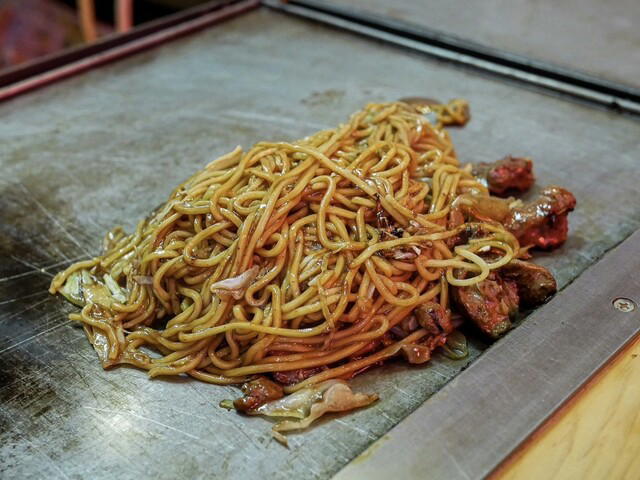
The menu
What to order
- Okonomiyaki
- Kimo tamayaki (offal and egg okonomiyaki)
- Vegetable okonomiyaki
- Squid and egg okonomiyaki
Takamatsu is not only postcard scenery. It is also a working food city: station approaches, compact side streets, quick lunches, and everyday dining that rarely asks for ceremony. That setting matters for okonomiyaki, a dish of the counter, griddle, and short meal rather than tasting-menu theatre. In a city whose food identity is dominated by Sanuki udon, Fumiya Okonomiyaki Honten gives another view of Kagawa dining: griddle-led, inexpensive, and built for repeat local use.
Okonomiyaki carries different regional meanings across Japan. Osaka frames it as layered social food, Hiroshima builds it around noodles and staged assembly, and smaller regional shops preserve narrower house styles without branding language. Takamatsu’s version sits within that national grammar while operating in a city better known for wheat noodles than cabbage pancakes. That contrast is the point: a serious okonomiyaki address here must win attention where udon is the default answer to almost every lunch question.
Why an okonomiyaki counter matters in a Sanuki udon city
Kagawa’s dining reputation travels on udon: self-service counters, quick turnover, and bowls priced for daily life. That culture shapes Takamatsu expectations. Meals are functional without being careless, and value is judged by repetition as much as novelty. Okonomiyaki fits the rhythm but asks diners to slow down just enough for griddle cooking. The difference is not luxury versus casual; it is speed versus heat, broth versus batter, slurp versus slice.
Fumiya Okonomiyaki Honten’s recognition matters because okonomiyaki rarely receives the international attention given to sushi, kaiseki, or ramen. Selection for Tabelog’s Okonomiyaki 100 in 2025 signals category relevance in a field where many strong shops remain intensely local. This is not a Michelin-style claim or fine-dining validation. It is more interesting: a Japanese user-driven specialist list recognizing a regional griddle restaurant in a city where the obvious food pilgrimage points elsewhere.
That makes the Takamatsu comparison set awkward in a productive way. Mendokoro Wataya Takamatsu ten, Udon Shokunin Sanuki Men no Suke, Udonya Goemon, and Teuchi Udon Tsurumaru sit in the noodle lane, while 鮨舳 belongs to another register entirely. Against them, okonomiyaki is a change of pace, not a substitute. A serious Takamatsu eating day should read the city through contrasts: one meal for Sanuki udon, one for griddle cooking, and, if budget and planning allow, one for a more formal Japanese counter.
The format is casual, but the category signal is serious
Okonomiyaki shops often suffer from lazy travel writing because the dish is easily reduced to comfort-food cliché. The better reading is technical and cultural. Batter ratio, cabbage cut, heat control, sauce use, and final-set timing all change the result. None needs a chef’s manifesto. The craft sits in repetition, exactly what small Japanese specialist restaurants are built to protect.
Fumiya Okonomiyaki Honten belongs in that specialist tier. Its Tabelog score of 3.52, category listing as okonomiyaki, and 2025 Tabelog recognition point to a focused, unfussy operation rather than a broad destination built around ceremony. That narrowness is not a weakness here. It keeps attention on the griddle and makes the meal easy to place within a Takamatsu day, especially for travellers already planning multiple stops around the city’s noodle culture.
There is discipline in that narrowness. In many Japanese cities, premium attention has drifted toward reservation-only counters and chef-led narratives. Takamatsu’s more revealing meals are often simpler: a station-area udon bowl, a compact grill room, a specialist shop selected by domestic diners rather than international lists. For a broader read on the city’s range, compare this stop with other Takamatsu dining rooms and specialist counters. Together they sketch a city where everyday formats carry more weight than imported luxury signals.
How to fit it into a Takamatsu food itinerary
The smart way to use this address is not to make it compete with the udon pilgrimage. Let it interrupt it. A day built only around Sanuki udon can become repetitive for visitors, even when the bowls are excellent. Okonomiyaki changes texture, pacing, and cooking method without leaving the casual price culture that defines much of Kagawa dining. Takamatsu also works as a dining anchor because it connects easily with central city movement rather than requiring a dedicated excursion.
Treat the shop as a focused meal rather than a lingering drinks evening. The format suits friends, solo diners comfortable with compact restaurants, and anyone interested in Japanese regional food beyond the categories that dominate English-language itineraries. It is less suited to diners seeking private rooms, formal service, or a chef-driven tasting format. The distinction matters: the appeal comes from category precision, not luxury theatre.
For city planning beyond one meal, use Our full Takamatsu restaurants guide alongside Our full Takamatsu hotels guide, Our full Takamatsu bars guide, Our full Takamatsu wineries guide, and Our full Takamatsu experiences guide. Readers extending the trip through Japan can compare how casual specialization appears in other cities and how specific Japanese formats translate outside Japan. The same lesson applies across many food cities: everyday counters and narrow specialties often explain a place more clearly than imported luxury cues.
The editorial case is clear: Fumiya Okonomiyaki Honten is not the place to understand Takamatsu’s luxury ambitions. It is the place to understand how a city with a dominant noodle identity still makes room for another everyday Japanese staple, and how category recognition can matter more than ceremony.
Frequently asked questions
What are Fumiya Okonomiyaki Honten's hours?
Check current opening hours directly before visiting Fumiya Okonomiyaki Honten, as schedules can change.
Where exactly is Fumiya Okonomiyaki Honten?
Takamatsu.
How much does it cost to eat at Fumiya Okonomiyaki Honten?
Pricing at Fumiya Okonomiyaki Honten is listed as - JPY 999.
What is Fumiya Okonomiyaki Honten known for?
Fumiya Okonomiyaki Honten is known for okonomiyaki in Takamatsu and for appearing on Tabelog’s 100 list for the category in 2025. Its listed price is - JPY 999, keeping the focus on an accessible local-style meal rather than a long sit-down format.
Booking and Cost Snapshot
Side-by-side context: comparable cuisine and price.
| Venue | Cuisine | Price | Awards | Notes |
|---|---|---|---|---|
| Fumiya Okonomiyaki HontenThis venue — the venue you are viewing | Okonomiyaki (Japanese savory pancakes) | $1–10 | Tabelog 100 #48 | Not listed |
| Kawafuku Honten | Traditional Sanuki Udon & Udon-suki | $10–20 | Tabelog 100 #86 | Takamatsu, Traditional Sanuki Udon & Udon-suki |
| Teuchi Udon Ueda | Traditional Sanuki udon shop | $1–10 | Tabelog 100 #72 | Takamatsu, Traditional Sanuki udon shop |
| Matsubara | Japanese Udon Noodle Bar | $1–10 | Tabelog 100 #24 | Takamatsu, Japanese Udon Noodle Bar |
| 両忘 | Modern Italian Omakase | $100–150 | Tabelog Bronze #375 | Takamatsu, Conveyor Belt Sushi |
| Mensho Kusugami | Creative Sanuki udon & chuka soba | $10–20 | Tabelog 100 #89 | Takamatsu, Creative Sanuki udon & chuka soba |
Recognition history
Dated appearances from independent guides and award organizations, with the underlying list record or original source where available.
Tabelog 100 #48 · No. 48
Tabelog · Tabelog 100 - Okonomiyaki - 2025
Continue exploring
More in Takamatsu
Restaurants in Takamatsu
Browse all →
Bars in Takamatsu
Browse all →
Details
- Well Known
- Lively
- Cozy
- Solo
- Casual Hangout
- After Work
- Standalone
- Zero Proof
- A La Carte
- Counter Dining
- Soft Drinks
- Tea
Current opening hours
- Monday
- 11:30 AM–1:30 PM
- Tuesday
- Closed
- Wednesday
- Closed
- Thursday
- 11:30 AM–1:30 PM
- Friday
- 11:30 AM–1:30 PM
- Saturday
- 11:30 AM–1:30 PM, 4–6:30 PM
- Sunday
- 11:30 AM–1:30 PM, 4–6:30 PM
Hours can change for holidays and private events. Last verified .