Our verdict
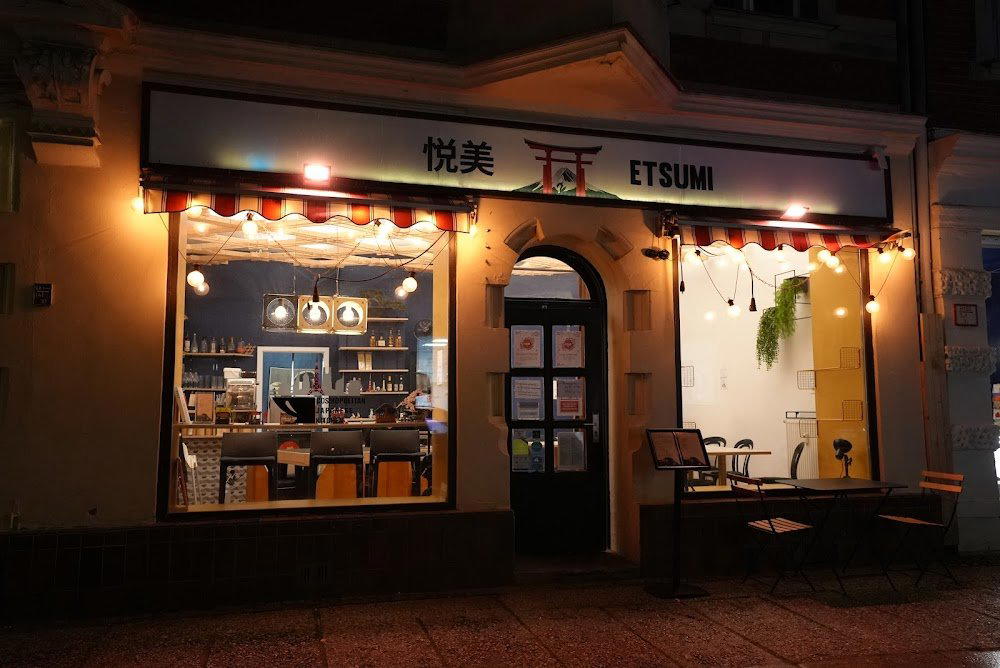
On Kolonnadenstraße in central Leipzig, Etsumi occupies a quietly considered position in a city whose restaurant scene has matured well beyond its post-reunification reputation. The address places it within reach of the city's cultural core, and the kitchen's apparent orientation toward ethical sourcing and environmental consciousness aligns it with a growing tier of German restaurants rethinking what responsible dining looks like in practice.

Pearl is the En Primeur Club membership app — saves, bookings, and concierge access live there. Same editors, same standards.
- Address
- Kolonnadenstraße 17, 04109 Leipzig, Germany
- Phone
- +4934124902111
- Hours
- Mon–Thu 6–10 PMFri–Sat 12–4 PM, 6–10 PMSun 12–4 PM, 6–9 PM
- Directions
- Get directions
The menu
What to order
- Miso ramen
- Karaage
- Gyoza
- Sushi
Leipzig's Quieter Side of the Table
Kolonnadenstraße is not Leipzig's loudest street. The stretch running through the 04109 postcode sits close enough to the city centre to be genuinely convenient, but removed enough from the Barfußgässchen bar corridor that the atmosphere arriving at number 17 carries a different register: less performance, more intention. German cities have spent the better part of a decade splitting their restaurant offerings between high-volume, concept-driven spaces and smaller, more purposeful rooms where the sourcing story and the plate are given equal weight. Etsumi belongs to the latter current.
That positioning matters in Leipzig specifically. The city's fine dining tier has consolidated around a handful of addresses: Stadtpfeiffer at the Creative end of the spectrum, operating at €€€€ price points, and Kuultivo pushing Modern Cuisine at €€€. Below that, a wider range of international and neighbourhood-focused rooms fills the middle ground, including Addis Café, Alfa Restaurant, and 997 Sushi Restaurant. Etsumi's placement on Kolonnadenstraße suggests it is operating in the considered middle of this map, where the competition is for the repeat local rather than the destination traveller.
The Sustainability Current in German Restaurant Cooking
Across Germany's restaurant scene, a structural shift has been underway for several years. The generation of chefs who trained under the classical Michelin model and then filtered through kitchens oriented toward Nordic and New German Cuisine have increasingly made sourcing ethics a structural part of their proposition, not an afterthought on the menu's back page. Venues like ES:SENZ in Grassau and Schanz in Piesport demonstrate how this plays out at the recognised end of the spectrum: hyper-regional sourcing, minimal waste kitchen protocols, and menus that shift not by season but by what is actually available from named suppliers. The model has since filtered down into the city tier, where it has become less of a differentiator and more of a baseline expectation for rooms aiming at an informed guest.
That broader movement is the context in which Etsumi sits. A restaurant at this address in this city, orienting itself toward ethical sourcing and environmental consciousness, is not operating in a vacuum. It is participating in a German dining conversation that stretches from the three-Michelin-star rooms of Schwarzwaldstube in Baiersbronn and Waldhotel Sonnora in Dreis down to neighbourhood kitchens making deliberate choices about what arrives at the back door and what leaves as waste. The credibility of that conversation depends on specificity: which farmers, which fisheries, which protocols for offcuts and fermentation. It is a conversation that rewards transparency.
What Ethical Sourcing Looks Like in Practice
The sustainability story in restaurant kitchens is rarely about grand gestures. The most coherent versions of it tend to be structural: menus built around what is in supply rather than what is on the concept board, relationships with producers that predate the menu print, and kitchen systems that treat waste reduction as a discipline rather than a marketing point. At the recognised end of this approach internationally, venues like Lazy Bear in San Francisco have made the sourcing infrastructure a visible part of the dining experience, while Le Bernardin in New York City has built decades of credibility around the ethics of ingredient selection without making it the front-of-house talking point. The question for any room operating in this register is whether the commitment shapes the food or merely frames it.
Germany's own recognised kitchens have increasingly answered that question through specificity. Victor's Fine Dining by Christian Bau in Perl, Aqua in Wolfsburg, and JAN in Munich each demonstrate that precision sourcing and formal technique are not in opposition. CODA Dessert Dining in Berlin has pushed further still, building an entire format around zero-waste principles at the dessert-led tasting menu level. The cumulative effect across the German scene is that environmental consciousness has moved from niche positioning to table stakes for any kitchen with serious intent. Etsumi's location in Leipzig places it inside that national conversation while operating at a city level where the expectation is more grounded and the audience more local.
Leipzig as a Dining City
Leipzig has spent the last fifteen years building a restaurant culture that no longer apologises for not being Berlin. The city's creative and academic population sustains a dining scene that values quality without requiring spectacle. The concentration of worthwhile addresses in the centre is high relative to the city's size: the walk from the main station to Kolonnadenstraße is short, and the density of options in between reflects a city that has attracted both returning talent and new investment in hospitality. For a full picture of what is currently operating in the city, the EP Club Leipzig restaurants guide maps the range across price tiers and cuisine types.
Within that picture, the address at Kolonnadenstraße 17 is an accessible entry point. The postcode puts it within reasonable distance of the main cultural institutions and hotel concentration, which makes it viable for the visitor with a single evening, not only for the resident building a regular rotation. That dual utility is something Leipzig's better rooms have learned to serve without compromising on what makes them worth seeking out in the first place. Vendôme in Bergisch Gladbach and Restaurant Haerlin in Hamburg operate in comparable mid-sized German city contexts where the destination-versus-local dynamic has been resolved through consistency rather than theatre.
Planning a Visit
Kolonnadenstraße 17 in the 04109 district is central enough to reach on foot from the main rail station, which makes Etsumi a practical option for visitors arriving by rail without requiring additional transport. Given the limited public information currently available on hours, booking channels, and format, contacting the restaurant directly before visiting is advisable, particularly for groups or specific dietary requirements. Leipzig's higher-demand tables tend to book out on weekend evenings with reasonable lead time, so midweek visits generally offer the most flexibility. Given the ethical sourcing orientation suggested by the restaurant's profile, the menu composition may shift more frequently than at kitchens working from a fixed format, which is worth factoring into expectations if a specific dish or preparation is the draw.
Frequently asked questions
How do I find Etsumi?
Etsumi is located at Kolonnadenstraße 17, 04109 Leipzig, Germany, Leipzig.
Is Etsumi a good option for visitors exploring Leipzig's independent restaurant scene?
Etsumi's address at Kolonnadenstraße 17, in the 04109 district, places it within walking distance of Leipzig's Hauptbahnhof, making it a practical stop for visitors moving through the city rather than staying in one neighbourhood. Leipzig has developed a restaurant culture shaped by its creative and academic communities, and independently run kitchens like Etsumi reflect that shift away from tourism-facing dining toward a more local, sourcing-conscious approach.
What's the signature dish at Etsumi?
Specific menu details for Etsumi are not published at this time. What the body of work here reflects — consistent with the broader movement among Leipzig's independent restaurants — is a kitchen built around seasonal procurement rather than a fixed showpiece dish. Checking directly at Kolonnadenstraße 17 or through the venue on arrival will give you the current picture.
Do I need a reservation for Etsumi?
Booking ahead is advisable for any restaurant operating in Leipzig's 04109 city-centre corridor, where covers are typically limited and walk-in availability is inconsistent, particularly on weekend evenings. Etsumi does not currently list online reservations or a public phone number, so contacting the venue directly in person or through local channels is the practical route.
What's the standout thing about Etsumi?
Etsumi sits on Kolonnadenstraße, a street close enough to Leipzig's centre to be accessible from the main rail station on foot, yet removed from the city's more trafficked dining strips. That positioning puts it in step with the generation of Leipzig restaurants that have built a credible food culture over the past fifteen years without replicating Berlin's model.
Cuisine and Recognition
Comparable venues nearby, for context on price, style, and recognition.
| Venue | Cuisine | Price | Notes |
|---|---|---|---|
| EtsumiThis venue — the venue you are viewing | Authentic Japanese | $20–30 | Not listed |
| maza pita - syrian specialties | Syrian Specialties | $10–20 | Schleußig |
| Lutherburg | Traditional German Gaststätte | $20–30 | Eutritzsch |
| Kenkō Burger | Asian Fusion Burgers | $10–20 | Anger-Crottendorf |
| GAO Vegan Restaurant | Vegan Vietnamese | $20–30 | Zentrum-West |
| endless | Modern International Breakfast | $10–20 | Zentrum |