Empire Szechuan
Our verdict
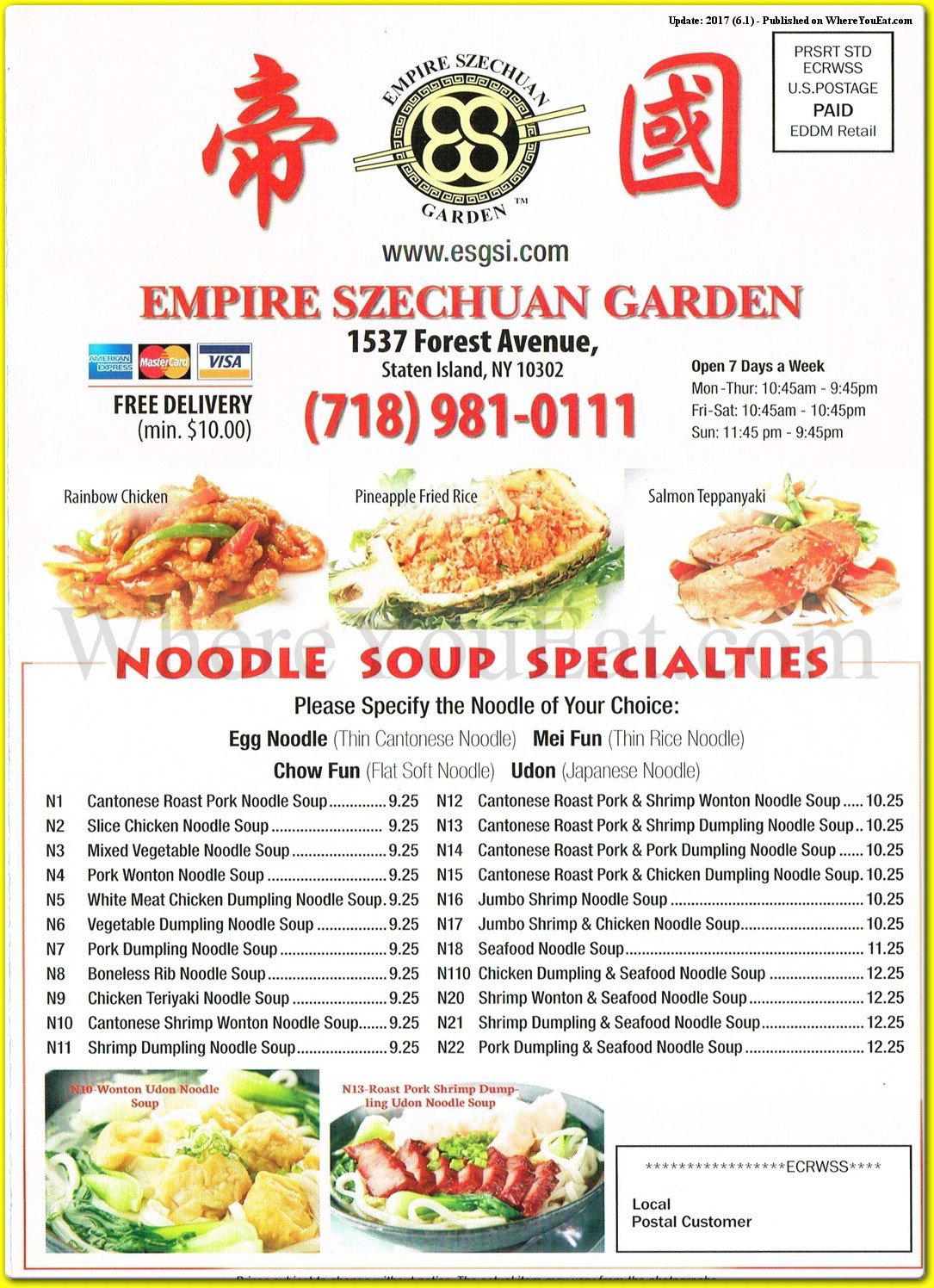
Empire Szechuan serves Szechuan Chinese & Noodles at 193 Columbus Ave, with Shrimp Dumplings Noodle Soup, General Tso's Chicken, and Volcano Beef on the menu.

Pearl is the En Primeur Club membership app, where members save venues, book tables and use the concierge.
The menu
What to order
- Shrimp Dumplings Noodle Soup
- General Tso's Chicken
- Volcano Beef
What the Upper West Side's Chinese Regulars Already Know
Columbus Avenue above 70th Street has never been the address New York food writers circle on a map when discussing the city's Chinese dining scene. That's precisely the condition that allows a neighborhood restaurant to build the kind of loyal clientele that fills tables on a Tuesday without a reservation push. Empire Szechuan, at 193 Columbus Ave, operates in that register: a local fixture in a part of Manhattan where residents eat out frequently and return to the places that hold up over time.
The Upper West Side's dining character has always skewed toward consistency over novelty. While the press cycle churns through the latest openings downtown or in the outer boroughs, neighborhoods like this one reward the restaurants that show up reliably, season after season. That dynamic shapes how regulars relate to a place like Empire Szechuan: it becomes part of the weekly rotation rather than a destination occasion.
Szechuan Cooking in a City That Now Expects More of It
New York's relationship with Szechuan cuisine has shifted considerably over the past two decades. The arrival of Flushing's mainland Chinese restaurants in the 2000s, followed by a wave of regional specialists across Manhattan, Brooklyn, and Queens, trained a significant portion of the dining public to look for the specific heat signatures of mala seasoning: the numbing compound from Szechuan peppercorn layered against chili oil's direct burn. That combination, once a novelty for most New York diners, is now a baseline expectation at any Szechuan address worth taking seriously.
For a neighborhood restaurant on the Upper West Side, this shift creates a particular pressure. The clientele increasingly includes diners who have eaten at regional specialists elsewhere in the city and have calibrated expectations. What keeps them returning to a local Szechuan spot is not a lack of alternatives but a specific set of satisfactions: proximity, familiarity, and a kitchen that delivers the dishes they want without reinterpretation.
That's a different value proposition than what drives bookings at the tasting-menu tier, where Le Bernardin, Atomix, Eleven Madison Park, Masa, and Per Se compete on entirely different terms.
The Regulars' Logic: What Brings People Back
In neighborhood restaurants, the menu items that regulars order are rarely the ones that make the description sheet. They are the dishes that proved themselves over multiple visits: the version of mapo tofu that hits the right ratio of silk and spice, the dry-fried green beans that arrive properly blistered rather than steamed, the cold appetizers that a table orders automatically before considering anything else. These are the unofficial anchor dishes, the ones that explain why a local doesn't need to look at the menu after a few visits.
Szechuan cooking at its functional neighborhood level tends to organize itself around a few consistent pleasures: the mala flavor profile applied across proteins and vegetables, rice and noodle dishes that anchor a meal, and a handful of crowd-anchors like General Tso's preparations that have long since crossed over into the broader New York Chinese restaurant canon. A restaurant that handles all of these competently, in portions and at a pace suited to weeknight dinners with family or colleagues, serves a need that the more specialized or expensive addresses in the city don't meet.
For Upper West Side residents making the decision between cooking, delivery, and going out, the calculus is simple: a reliable local Szechuan kitchen within walking distance of a densely populated residential corridor is not a luxury, it is a practical anchor of neighborhood life.
Where This Fits in the New York Dining Map
New York's restaurant scene at the higher end of the price and attention spectrum is extensively documented. Our full New York City restaurants guide covers the range from the city's most decorated addresses to the neighborhood level. Across the country, comparison points exist at very different price tiers: the produce-driven intensity of Blue Hill at Stone Barns in Tarrytown, the technique-forward ambition of Smyth in Chicago, or the farm-to-table precision of Single Thread Farm in Healdsburg. Those venues operate at a register that shares almost no competitive space with a neighborhood Szechuan address in the 70s on Columbus.
The more useful comparison is the broader category of American neighborhood Chinese restaurants that have sustained themselves across decades in high-cost cities. New York is unusually hard on restaurant longevity: rents, labor costs, and the density of competition work against survival. A Szechuan restaurant that maintains a local customer base in one of Manhattan's most expensive residential neighborhoods is doing something right at the operational level, even if that something is difficult to quantify from the outside.
For readers who track destination dining across the country, venues like Lazy Bear in San Francisco, Providence in Los Angeles, Addison in San Diego, Emeril's in New Orleans, The French Laundry in Napa, The Inn at Little Washington, Frasca Food & Wine in Boulder, Atelier Moessmer Norbert Niederkofler in Brunico, and Dal Pescatore in Runate represent a different category of dining entirely. Empire Szechuan's place in the New York dining picture is adjacent to none of those. It belongs to the local-institution tier: the restaurants that a neighborhood would notice if they disappeared.
Planning Your Visit
Empire Szechuan is located at 193 Columbus Ave, New York, NY 10023, on the Upper West Side of Manhattan. Getting there: The address sits on Columbus Avenue, accessible by subway on the 1, 2, and 3 lines at 72nd Street, or the B and C lines at 72nd Street on Central Park West, a short walk across. Reservations: Budget: Neighborhood Chinese restaurants in Manhattan at this category typically run moderate per-head costs well below the fine-dining tier; confirm current pricing directly with the venue. Hours:
Frequently asked questions
What's Empire Szechuan's location?
Empire Szechuan is located at 193 Columbus Ave, New York, NY 10023, New York City.
How does Empire Szechuan compare to other Szechuan restaurants in New York City?
Empire Szechuan sits in a different category from the Flushing restaurants that drew New York's attention to mainland Chinese cooking over the past two decades, and from the higher-profile Szechuan spots in Midtown. Its position on the Upper West Side makes it a neighbourhood anchor rather than a destination address, which shapes both its menu breadth and the way it serves its regulars. For diners in the area around 193 Columbus Ave, New York, NY 10023, it fills a role that few nearby restaurants do with the same Szechuan specificity.
What do people recommend at Empire Szechuan?
Regulars at Empire Szechuan on Columbus Avenue tend to order from the Szechuan-focused sections of the menu rather than the broader American-Chinese staples. The dishes that bring people back consistently are those built around the numbing heat of Szechuan peppercorn. Specific current menu items and pricing are best confirmed directly with the restaurant at 193 Columbus Ave, New York, NY 10023.
Do I need a reservation for Empire Szechuan?
Empire Szechuan operates as a neighbourhood Chinese restaurant on the Upper West Side, where walk-in dining is generally more viable than at destination dining rooms with fixed seatings. That said, weekend evenings on Columbus Avenue draw consistent local foot traffic, so calling ahead is a practical step. Contact details are available by searching the restaurant directly at 193 Columbus Ave, New York, NY 10023.
What's the standout thing about Empire Szechuan?
Empire Szechuan occupies a part of Manhattan, Columbus Avenue above 70th Street, that New York food media rarely covers for Chinese cuisine, yet it sustains a loyal repeat clientele. That longevity in a competitive city is its own credential. The Szechuan cooking tradition it draws on has a clear identity distinct from the Cantonese and pan-Asian menus that once dominated neighbourhood Chinese dining in New York.
Is Empire Szechuan good for vegetarians?
Szechuan cooking includes a substantial range of vegetable-forward preparations, from dry-fried green beans to mapo-style tofu dishes, that work well for vegetarians. Whether the specific menu at Empire Szechuan reflects that breadth is worth confirming when you contact the restaurant at 193 Columbus Ave, New York, NY 10023, as menus shift seasonally and by availability.
Comparable Venues
Comparable venues nearby, for context on price, style, and recognition.
| Venue | Cuisine | Price | Notes |
|---|---|---|---|
| Empire SzechuanThis venue (the venue you are viewing) | Szechuan Chinese & Noodles | $20–30 | Not listed |
| Deluxe Food Market | Cantonese Dim Sum and Hot Food | $10–20 | SoHo-Little Italy-Hudson Square |
| Wonderful Asian Restaurant | Chinese Takeout | $10–20 | Bedford-Stuyvesant (West) |
| Prosperity Dumpling | Traditional Chinese Dumplings | Not listed | Chinatown |
| Yum Cha | Cantonese Dim Sum & Chinese | $20–30 | Greenwich Village |
| Spicy Village | Henan Chinese Noodles | $20–30 | Lower East Side |
Continue exploring
More in New York City
Restaurants in New York City
All restaurants in New York City →
Bars in New York City
All bars in New York City →







Details
- Casual Hangout
- After Work
- A La Carte
- Vegetarian Friendly
Current opening hours
- Monday
- 10:30 AM–11 PM
- Tuesday
- 10:30 AM–11 PM
- Wednesday
- 10:30 AM–11 PM
- Thursday
- 10:30 AM–11 PM
- Friday
- 10:30 AM–11 PM
- Saturday
- 10:30 AM–11 PM
- Sunday
- 10:30 AM–11 PM
Hours can change for holidays and private events. Last verified .
Informal urban dining room with direct, no-frills atmosphere focused on hearty, robustly seasoned dishes.