EcuaLatino Restaurant
EcuaLatino Restaurant on Rue des Deux-Ponts brings Latin American and Ecuadorian cooking into Geneva's left-bank dining scene, a neighbourhood better known for its proximity to universities and local trade than for destination dining. In a city where French and Italian kitchens dominate the premium tier, the address represents a distinct culinary register — one that Geneva's internationally mixed population has quietly sustained for years.
Pearl is the En Primeur Club membership app — saves, bookings, and concierge access live there. Same editors, same standards.
- Address
- Rue des Deux-Ponts 25, 1205 Genève, Switzerland
- Phone
- +41228001657
- Website
- ecualatinorestaurant.com
- Directions
- Get directions
 Saves & bookings on Pearl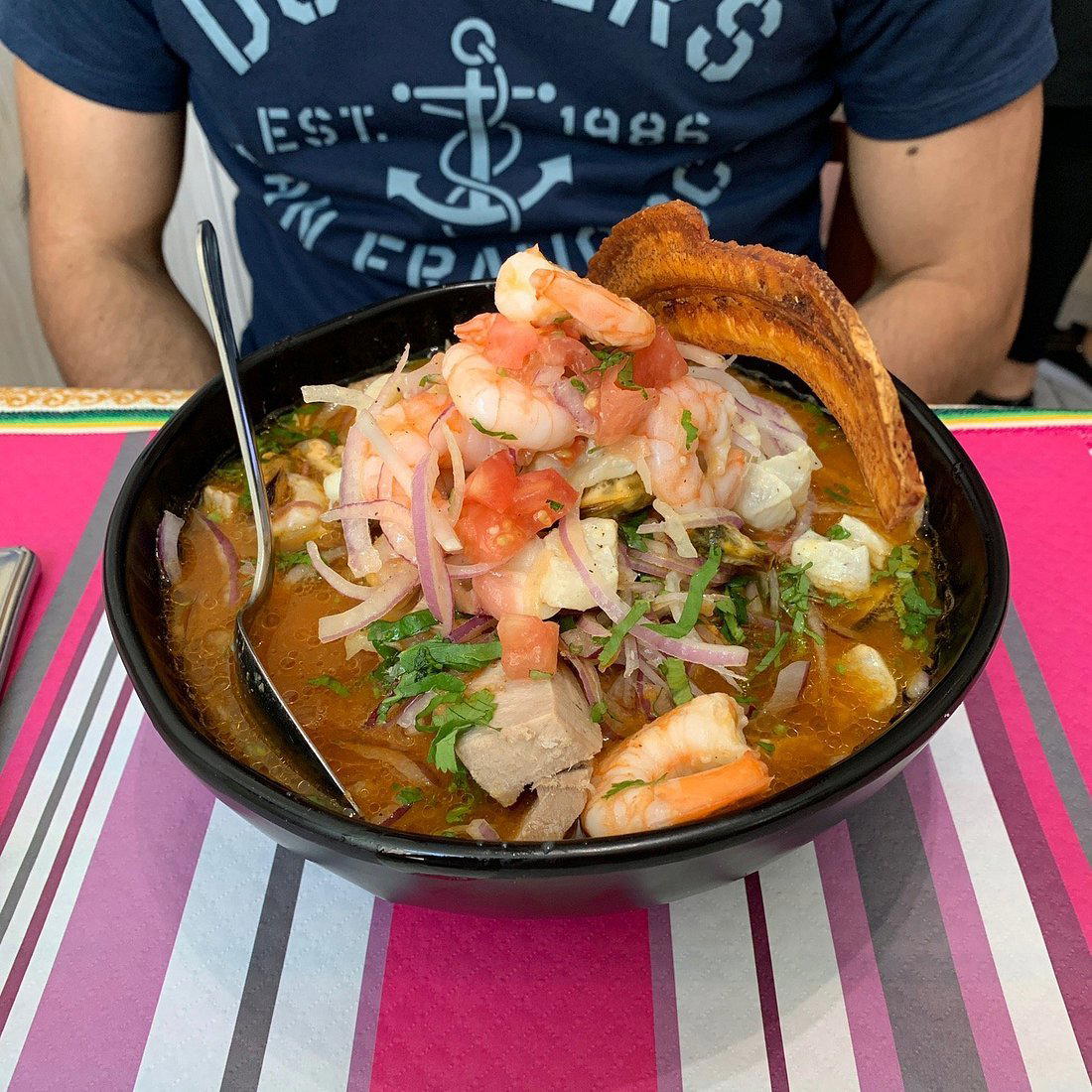
A Different Register on the Left Bank
Geneva's restaurant scene is heavily weighted toward French technique and Italian tradition. The premium tier — venues like L'Atelier Robuchon and Il Lago — operates inside a familiar European culinary grammar. Step away from the lakefront and the Quartier des Banques, cross toward the Plainpalais side of the Arve, and the city's dining map shifts. Rue des Deux-Ponts sits in the 5th arrondissement, a neighbourhood shaped by the university, the arts scene around the Plaine de Plainpalais, and a resident population drawn from across the world. It is in this context, not the white-tablecloth lakefront circuit, that EcuaLatino Restaurant operates.
Latin American cooking has a limited footprint in Swiss restaurant culture. Unlike Paris or Madrid, where South American cuisines have established durable footholds through diaspora communities and culinary cross-pollination, Switzerland's restaurant scene has been slower to absorb these traditions at any scale. Geneva, with its outsized international population relative to its size, is the Swiss city most likely to support such an address, and the Plainpalais district is the neighbourhood within Geneva most likely to host it.
The Physical Setting and What It Signals
The editorial angle of design and space matters here because the physical container of a restaurant communicates its competitive intent before a single dish arrives. In the middle-market Geneva dining scene, restaurants that sit between the canteen and the destination, space design often signals whether a kitchen is positioning itself as a local regular or as a cultural statement. Addresses in this part of Geneva tend toward compact, lived-in rooms: tiled floors, close-set tables, walls that carry some evidence of the cuisine's origin through colour, material, or object.
Latin American restaurants outside their home countries frequently make deliberate spatial choices to anchor authenticity: warm palette materials, hand-crafted elements, and a room temperature that reads warmer than the Swiss norm. These are not decorative accidents but functional signals to a clientele that is partly diasporic, partly curious, and partly drawn by the simple scarcity of this cuisine type in the city. The spatial register of EcuaLatino, positioned on a street that is walkable from both the university campus and the Plainpalais tram hub, speaks to a neighbourhood audience first, a different orientation than the hotel-adjacent dining rooms of the right bank.
For context on how Geneva's broader dining scene organises itself spatially and by cuisine type, the full Geneva restaurants guide maps the city's key dining corridors and price tiers.
Ecuadorian and Latin American Cooking in a European Context
Ecuadorian cuisine is among the less-travelled South American food traditions in Europe. Peruvian cooking has achieved a degree of international recognition, Lima's influence on global fine dining is well documented, and Brazilian and Argentine grilling traditions have broad European familiarity. Ecuadorian food occupies a different position: coastal seafood preparations, corn-based dishes, slow-cooked meat traditions, and a set of flavour profiles shaped by both Pacific coast and Andean influences. When these traditions appear in European cities, they typically do so in restaurants that blend across the broader Latin American spectrum rather than presenting a single national cuisine in depth.
The name EcuaLatino signals exactly this: a frame that references Ecuador specifically while acknowledging the wider Latin American context in which the kitchen operates. This is a common and sensible positioning for diaspora restaurants in cities where the audience for any single South American national cuisine is too small to sustain a narrowly focused menu. The result is typically a kitchen that anchors in Ecuadorian preparation and ingredient logic while offering a menu legible to a broader Latin American and European audience.
Restaurants working in this register sit in a different competitive conversation than the formal French and Italian addresses that define Geneva's headline dining. Comparison venues like Arakel or L'Aparté represent the modern French and contemporary European mainstream; La Micheline anchors the Mediterranean end of the mid-market. EcuaLatino operates in a lane largely its own within the city.
Switzerland's Wider Fine Dining Frame
To understand where a neighbourhood Latin American restaurant sits in the Swiss food culture, it helps to know what the best of that culture looks like. Switzerland's most decorated addresses, Hotel de Ville Crissier in Crissier, Schloss Schauenstein in Fürstenau, and Memories in Bad Ragaz, operate at the multi-Michelin level within a tradition of precision European technique. Cheval Blanc by Peter Knogl in Basel, Maison Wenger in Le Noirmont, Einstein Gourmet in Sankt Gallen, Da Vittorio in St. Moritz, Mammertsberg in Freidorf, La Table du Valrose in Rougemont, and focus ATELIER in Vitznau extend that picture across the country's cantons. This is the formal structure into which a diaspora neighbourhood restaurant does not attempt to enter, it occupies a parallel economy of everyday dining that serves a different need.
The international reference points for where Latin American cooking intersects with high-end technique, Le Bernardin in New York or the community-led format of Lazy Bear in San Francisco, illustrate how wide the spectrum of serious cooking runs. EcuaLatino occupies a different tier of that spectrum, one defined by cultural specificity rather than technical ambition.
Planning a Visit
EcuaLatino Restaurant is located at Rue des Deux-Ponts 25, in Geneva's 5th arrondissement, within walking distance of the Plainpalais tram stops served by lines connecting to the city centre and the main train station. The neighbourhood is compact and navigable on foot from the university district. For a neighbourhood restaurant of this type in Geneva, walk-in availability is more common than at the city's higher-demand destination addresses, though weekend evenings in an active local district may warrant a call ahead.
How EcuaLatino Restaurant Geneva compares with similar nearby venues.
| Venue | Cuisine | Price |
|---|---|---|
| La Cantine des Commerçants | Modern French | €€ |
Continue exploring
More in Geneva
Restaurants in Geneva
Browse all →
Bars in Geneva
Browse all →
Hotels in Geneva
Browse all →

At a Glance
- Cozy
- Casual Hangout
- Group Dining
- Standalone
Current opening hours
- Monday
- Closed
- Tuesday
- 12–2:30 PM, 6:30–10 PM
- Wednesday
- 12–2:30 PM, 6:30–10 PM
- Thursday
- 12–2:30 PM, 6:30–10 PM
- Friday
- 12–2:30 PM, 6:30–10 PM
- Saturday
- 12–2:30 PM, 6:30–10 PM
- Sunday
- 12–2:30 PM, 6:30–9 PM
Hours can change for holidays and private events. Last verified .
Cozy and familial atmosphere with simple Latino-themed decor, colorful and cheerful interior featuring small rooms and a welcoming bar area.
Know Before You Go
- Getting there
- Rue des Deux-Ponts 25, 1205 Genève, Switzerland