Cote W4
Côte W4 brings the French brasserie format to Chiswick's Turnham Green Terrace, positioning itself within the Côte group's sourcing-led approach to everyday French cooking. In a part of west London where neighbourhood dining skews heavily independent, the brasserie model offers a structured alternative with consistent execution. It sits a level below the destination dining tier occupied by London's Michelin-heavy addresses, serving a local crowd that returns for reliability over occasion.
Pearl is the En Primeur Club membership app — saves, bookings, and concierge access live there. Same editors, same standards.
- Address
- 50-54 Turnham Green Terrace, Chiswick, London W4 1QP, United Kingdom
- Phone
- +44 20 8747 6788
- Website
- cote.co.uk
- Directions
- Get directions
 Saves & bookings on Pearl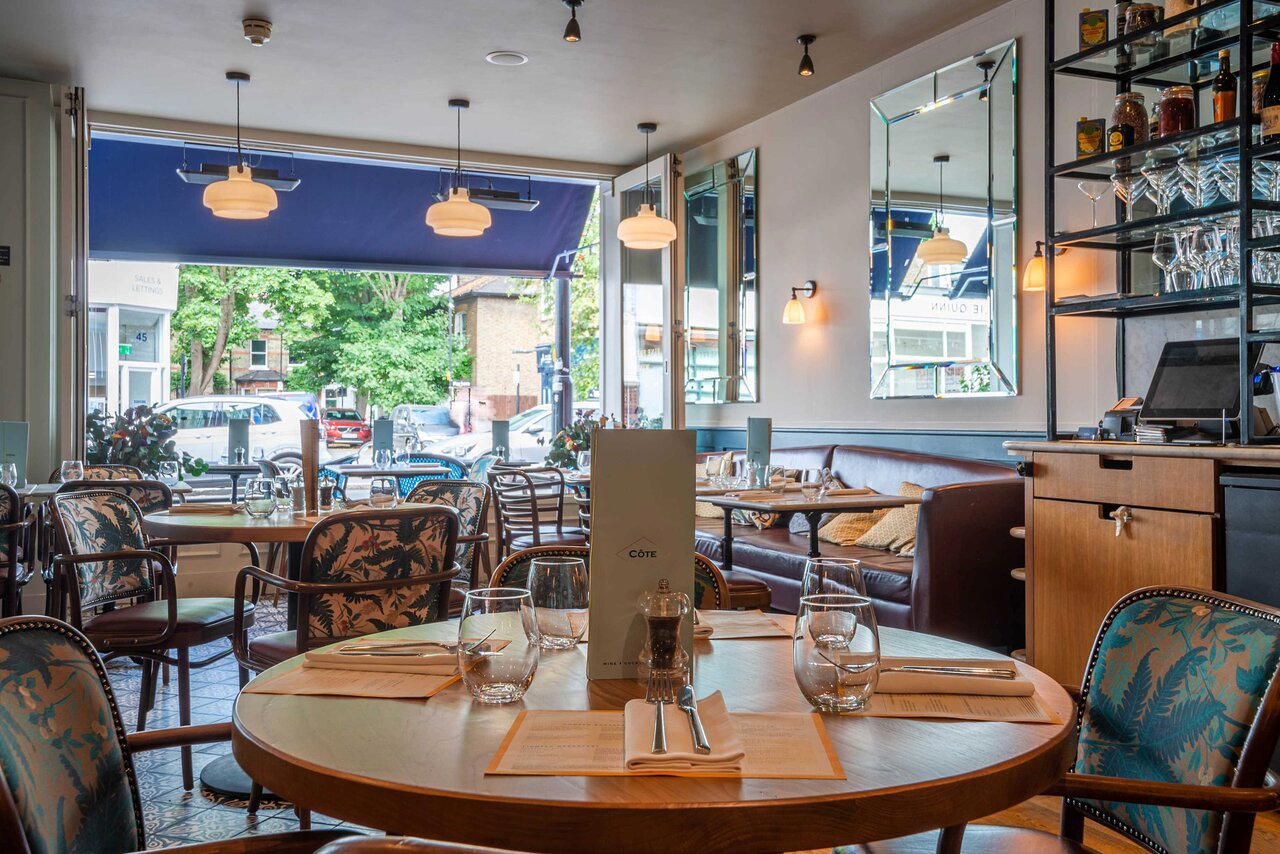
The French Brasserie in West London: A Format With History
The brasserie as a dining format predates most of what London now considers modern restaurant culture. Originating in Alsace, where brewery-attached dining rooms served hearty, unfussy food at hours most restaurants wouldn't consider, the brasserie model spread across France and then across Europe as a study in democratic hospitality: the same menu at lunch and dinner, predictable classics executed with care, wine by the carafe, and no expectation that you leave quickly. When Côte launched its first site in London, that format had largely been absent from the mid-market British dining scene, which oscillated between gastropubs and ambitious tasting-menu rooms with little comfortable ground between.
Côte W4, at 50-54 Turnham Green Terrace in Chiswick, sits within that original project. Turnham Green Terrace has long been one of west London's more composed neighbourhood high streets, a corridor of independent shops and restaurants that has resisted the blank-shopfront character of many comparable zones. In that environment, a group-operated brasserie with French credentials occupies a specific position: not the experimental local favourite, but the dependable room that a neighbourhood at this income level tends to support over the long term.
Sourcing as a Structural Commitment, Not a Selling Point
In the current British restaurant conversation, ingredient sourcing has become something close to mandatory language. Every menu, from the neighbourhood wine bar to the three-Michelin-star counter, now uses the word. What distinguishes approaches is whether sourcing shapes the menu or merely annotates it. The Côte group's publicly stated sourcing framework leans toward the former: a commitment to higher-welfare British and European meat, MSC-certified seafood, and free-range eggs across the estate. For a group operating at scale, maintaining those standards across multiple sites is a logistics problem as much as a culinary one, and it shifts the credential from marketing language into operational architecture.
This matters in the context of the French brasserie specifically. Classic brasserie dishes, steak frites, moules marinière, duck confit, croque monsieur, are deceptively technique-dependent but ingredient-transparent. The quality of the steak determines the dish. The freshness of the mussels determines the broth. There is less room to engineer around a weak primary ingredient than in more complex cooking styles. So sourcing commitments in this format carry more direct consequence than they might in a cuisine where sauce, reduction, and technique can compensate. A brasserie that genuinely sources its proteins with care is a structurally different proposition to one that uses the same language for appearance.
By comparison, London's upper tier of French-influenced dining, venues like Sketch, The Lecture Room and Library or Restaurant Gordon Ramsay, operates with bespoke supplier relationships and tasting menus built around seasonal produce at a price point that reflects those relationships. The question Côte W4 answers is different: whether a group-scale operation can deliver sourcing rigour at accessible prices in a neighbourhood setting. That is a harder question than it looks.
Chiswick's Dining Position in the Wider London Picture
Chiswick occupies an interesting coordinate in London's restaurant geography. It is close enough to the centre to attract serious operators, far enough to support a different dining rhythm, one shaped by local regulars rather than destination-seekers. The restaurant culture along Chiswick High Road and Turnham Green Terrace has historically trended toward neighbourhood reliability: well-sourced Italian, solid wine bars, and long-running independents. It is not the address where London's most discussed kitchens tend to open.
That context places Côte W4 clearly. It is not competing with The Ledbury or CORE by Clare Smyth for the same diner, any more than those rooms compete with each other for the everyday local booking. The competitive comparable set here is the neighbourhood restaurant that does French-adjacent food with similar price discipline. Within that set, the sourcing framework and kitchen consistency that a structured group operation can provide represents a meaningful differentiator. Independent neighbourhood restaurants often deliver higher creative highs but more variable execution; the group model trades creative ceiling for reliability floor.
For those whose London dining extends further, the city's wider range of destination addresses ranges from Dinner by Heston Blumenthal at the historical-British end through to the technically rigorous modern rooms covered in our full London restaurants guide. Beyond London, those interested in British restaurant cooking at its most ambitious might also follow the work at L'Enclume in Cartmel, Moor Hall in Aughton, or The Fat Duck in Bray, which operate at a different register entirely but share a similar preoccupation with sourcing as foundation rather than garnish.
Planning a Visit
Côte W4 is located at 50-54 Turnham Green Terrace, a short walk from Turnham Green station on the District line, which puts it roughly 25 minutes from central London. The brasserie format runs through lunch and dinner, making it a reasonable option for both weekend meals and weekday evenings when the neighbourhood pace suits a slower table. Booking ahead for weekend sittings at this address is advisable; Turnham Green Terrace draws from a loyal local base that fills the better-positioned rooms consistently.
Nearby destination alternatives for those willing to travel for a meal include Gidleigh Park in Chagford and Hand and Flowers in Marlow for those reaching into the countryside from west London. For coastal British cooking, hide and fox in Saltwood represents the kind of sourcing-led, region-grounded approach that shares a philosophical thread with what Côte attempts at scale, even if the format and ambition differ considerably.
The Short List
Comparable venues nearby, for context on price, style, and recognition.
| Venue | Cuisine | Price | Notes |
|---|---|---|---|
| Cote W4This venue — the venue you are viewing | Chiswick, Classic French Bistro | $$ | Not listed |
| Aventure | Not listed | $$ | St. John's Wood, Classic French Bistro |
| Pierre Victoire | Fitzrovia, Classic French Bistro | $$ | Not listed |
| Cigalon | Holborn, Contemporary Provençal French | $$$ | Not listed |
| Le Boudin Blanc | Mayfair, Classic French Bistro | $$$ | Not listed |
| Bistro Vadouvan | Not listed | $$ | Putney, Modern French-Asian Fusion Bistro |
Continue exploring
More in London
Restaurants in London
Browse all →
Bars in London
Browse all →
Hotels in London
Browse all →

At a Glance
- Classic
- Cozy
- Family
- Casual Hangout
- After Work
- Open Kitchen
- Street Scene
Current opening hours
- Monday
- 8 AM–10 PM
- Tuesday
- 8 AM–10 PM
- Wednesday
- 8 AM–10 PM
- Thursday
- 8 AM–10 PM
- Friday
- 8 AM–11 PM
- Saturday
- 8 AM–11 PM
- Sunday
- 9 AM–9 PM
Hours can change for holidays and private events. Last verified .
Attractive classic bistro feel with a buzzy atmosphere, closely spaced tables, and a few outdoor tables.