Cora


Cora is a ten-cover tasting menu restaurant on the first floor of a Pontcanna townhouse, recognised by the Michelin Guide with a Plate in 2025. Chef Lee Skeet — formerly of Hedone in London — cooks a six-course no-choice menu built around Welsh seafood and seasonal produce. Book by contacting the chef directly; availability is limited and demand is high.
Pearl is the En Primeur Club membership app — saves, bookings, and concierge access live there. Same editors, same standards.
- Address
- 186-188 Kings Rd, Pontcanna, Cardiff CF11 9DF, United Kingdom
- Phone
- +44 29 2037 2055
- Website
- gorserestaurant.co.uk
- Directions
- Get directions
 Saves & bookings on Pearl
A Room Above Pontcanna
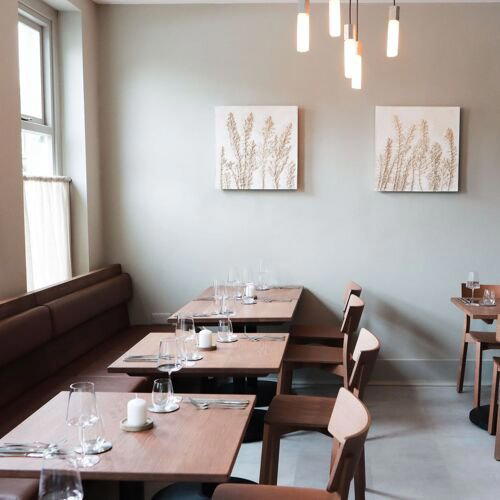
Pontcanna has been Cardiff's most food-focused residential neighbourhood for some years, and the strip of Kings Road that runs through it now holds a concentration of serious cooking that punches well above the postcode. Within that scene, Cora occupies an interesting structural position: it is not a restaurant in any conventional sense. There is no sign to speak of, no front-of-house team waiting at street level, no dining room visible from the pavement. You ring a bell at 186-188 Kings Road, and someone leads you up a workaday staircase, past an open kitchen, and into a white-walled, wood-floored room with ten covers and suburban views. The format sits at the most compressed end of the intimate-tasting-menu tier that has emerged across British cities over the past decade, a tier where low capacity and a single operator drive both the quality ceiling and the booking difficulty.
That tier has precedents at considerably higher price points across the country. Houses like L'Enclume in Cartmel, Moor Hall in Aughton, and The Fat Duck in Bray represent one end of the spectrum — destination-led, multi-staffed, capital-intensive. Cora represents a different structural model entirely: one chef, one room, one sitting, and a price point of £££ that sits meaningfully below the national fine-dining average for equivalent technical ambition. Within Cardiff itself, the comparison set includes Gorse at ££££, which operates at the top of the city's tasting menu market, and ember at No. 5 at ££, which occupies the more accessible modern British tier. Cora lands between them in price and arguably above both in intimacy.
Six Courses, One Kitchen, No Choices
The editorial angle around British tasting menus often defaults to the Sunday roast tradition — the idea that the weekly ritual of shared protein, seasonal vegetables, and long table conversation forms the cultural DNA of serious British cooking. That lineage is present at Cora, but it operates at a remove. Skeet's cooking is classically rooted in the sense that it respects produce hierarchies and seasonal logic, but the expression is precise and restrained rather than communal and abundant. A six-course no-choice menu built heavily around seafood has more in common with the pared-back Modern British format practised at places like The Ledbury in London or CORE by Clare Smyth than it does with a carving trolley. What connects it to that broader British tradition is the sourcing discipline: Welsh lamb from Abergavenny, Orkney scallops, Cornish spider crab, Welsh seasonal produce tracked by what is actually good rather than what is predictable.
The Michelin Plate awarded in 2025 is a meaningful signal in this context. The Plate designation does not carry the star's reservation-booking urgency, but in a city where starred recognition has historically been sparse, it marks Cora as the kind of kitchen Michelin inspectors return to. For the reader's planning purposes, that distinction matters: it indicates a consistent kitchen operating above the general Cardiff baseline, without the automatic waiting-list effect that a star typically generates. That said, ten covers per service creates its own scarcity regardless of formal award tier.
The Produce Logic Behind the Menu
Modern British cuisine at its most considered is a sourcing argument as much as a cooking style. The question the format keeps asking is whether British and Irish ingredients, applied with classical French technique and contemporary restraint, can produce food that competes on the world stage. At Cora, the answer is framed through seafood. The menu documented by Michelin inspectors included a caramelised Orkney scallop served with soy and ginger broth, Cornish spider crab with marinated tomatoes and tomato consommé finished with basil oil, and a slice of turbot with Persian courgettes, peas, pea shoots, Granny Smith apple, and a Crémant butter sauce. These are not simple dishes. The flavour architecture, acid against fat, sea-mineral against sweetness, requires precise calibration, and the sourcing geography (Orkney, Cornwall, Wales) reflects a kitchen that thinks in supply chains.
The menu is not exclusively seafood. A rack of Abergavenny lamb with cherries and seaweed sauce appeared alongside the fish courses during one inspection, and desserts have run to yoghurt panna cotta with marinated strawberries and meringue. The seaweed sauce on the lamb is a telling detail: it is the kind of cross-category move, land protein, coastal condiment, that characterises thoughtful Modern British cooking rather than ingredient-category orthodoxy. For comparison, Gidleigh Park in Chagford and Hand and Flowers in Marlow both operate within this produce-first British framework, though at higher price points and with larger teams. Cora achieves comparable sourcing ambition through a fundamentally different operational structure.
Jackson's and the Same Premises
The same address also houses Jackson's, a wine and oyster bar run by the same team. The dual-format approach, tasting menu restaurant above, more casual bar-format operation in the same building, is a model that has appeared in several British cities as operators look for ways to make a single site economically viable without scaling up covers. Jackson's provides a lower-commitment entry point to the same kitchen's sensibility and a natural overflow for guests who cannot secure a Cora booking. The wine list at Cora itself is described as short and deliberately non-predictable, with bottle prices around the £30 mark, a deliberate positioning choice that keeps the total spend accessible relative to the cooking ambition.
Within Pontcanna, Cora sits alongside a neighbourhood that has accumulated genuine dining depth. Thomas and The Sorting Room represent different registers of the same neighbourhood energy, and Asador 44 anchors the Spanish grill end of Cardiff's wider dining map. For visitors building a multi-day Cardiff itinerary, the neighbourhood is a coherent base. Full planning resources are available through our full Cardiff restaurants guide, our full Cardiff hotels guide, our full Cardiff bars guide, our full Cardiff wineries guide, and our full Cardiff experiences guide.
Planning a Visit
Booking at Cora operates outside the standard reservation platform model: you contact the chef directly to secure a table. With ten covers per service, availability is structurally limited and demand has grown consistently since the Michelin Plate recognition in 2025. The restaurant is on the first floor at 186-188 Kings Road, Pontcanna, Cardiff CF11 9DF. The price range sits at £££, which in Cardiff's current market represents good-value access to Michelin-recognised cooking. The wine list holds prices around £30 per bottle. No dress code is specified, and the room's white-walled informality suggests that smart casual is the practical norm. For visitors coming from outside Cardiff, Pontcanna is a short taxi or bus ride from Cardiff Central station.
Cost Snapshot
| Venue | Cuisine | Price | Awards |
|---|---|---|---|
| CoraThis venue — the venue you are viewing | Modern British | £££ | Not listed |
| Gorse | Modern British | ££££ | Michelin 1 Star |
| Heaneys | Not listed | £££ | Modern Cuisine, £££ |
| ember at No. 5 | Not listed | ££ | Modern British, ££ |
| Heathcock | Not listed | ££ | British Contemporary, ££ |
| Purple Poppadom | Not listed | ££ | Indian, ££ |
Recognition history
Dated appearances from independent guides and award organizations, with the underlying list record or original source where available.
Michelin Plate
Michelin
Michelin Plate
Michelin
The Good Food Guide GFG Very Good
The Good Food Guide

At a Glance
- Intimate
- Cozy
- Modern
- Date Night
- Special Occasion
- Open Kitchen
- Extensive Wine List
- Local Sourcing
Current opening hours
- Monday
- Closed
- Tuesday
- Closed
- Wednesday
- 6:30–8 PM
- Thursday
- 12–2 PM, 6:30–8 PM
- Friday
- 12–2 PM, 6:30–8 PM
- Saturday
- 12–2 PM, 6:30–8 PM
- Sunday
- Closed
Hours can change for holidays and private events. Last verified .
Relaxed, laid-back atmosphere in a simple, homely dining room with warm personal service.
Know Before You Go
- Getting there
- 186-188 Kings Rd, Pontcanna, Cardiff CF11 9DF, United Kingdom