On Rue Pizay in Lyon's 1st arrondissement, Chez Hugon is one of the city's most enduring bouchons, a room where checked tablecloths, handwritten menus, and the smell of rendered pork fat set the register immediately. Lyon's bouchon tradition is among the more codified in French regional cooking, and Chez Hugon sits comfortably inside that canon, serving the quenelles, tablier de sapeur, and pot-au-feu that define the genre.
Pearl is the En Primeur Club membership app — saves, bookings, and concierge access live there. Same editors, same standards.
- Address
- 12 Rue Pizay, 69001 Lyon, France
- Phone
- +33478281094
- Website
- bouchonlyonnais.fr
- Directions
- Get directions
 Saves & bookings on Pearl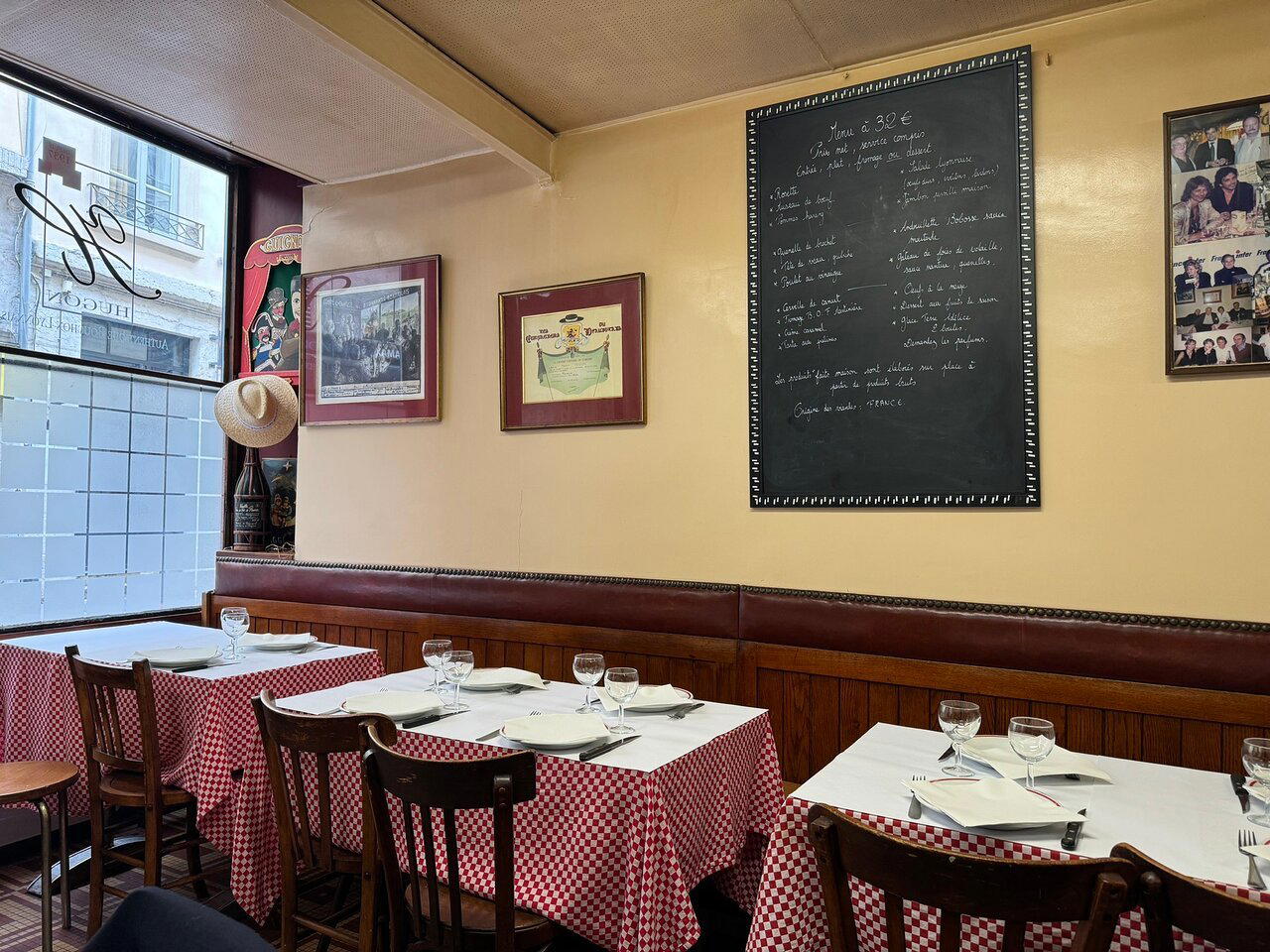
The Room Before the Menu
Step into 12 Rue Pizay and the first thing that orients you is not the food, but the room itself. Checked tablecloths in red and white, a low ceiling that holds the noise, walls lined with the kind of accumulated memorabilia that takes decades to accumulate without looking curated. This is the visual grammar of the Lyonnais bouchon, a dining format that operates as much as a social institution as a category of restaurant. The bouchon does not aspire to the register of La Mère Brazier or the invention of Le Neuvième Art. It plays a different and in many ways harder game: consistency, informality, and a menu that does not change because the people who come do not want it to.
Chez Hugon sits in the Presqu'île, the narrow peninsula between the Rhône and the Saône that forms Lyon's commercial and culinary centre. This is not the haute-cuisine corridor that sends visitors toward Takao Takano or Au 14 Février. It is older, denser, and more vernacular. The bouchons of the 1st and 2nd arrondissements have been absorbing lunchtime workers, market traders, and visiting journalists for well over a century, and Chez Hugon is among the rooms that have held that tradition without softening it for export.
What the Bouchon Format Actually Means
The word bouchon is older than the modern restaurant concept, and its etymology is contested. What is not contested is what it means in practice: a small room, a fixed or near-fixed menu, wine served by the pot (a 46cl Lyon-specific measure), and cooking that draws from the offal-heavy, fat-intensive repertoire that made Lyon's working-class tables famous. The Association de Défense des Bouchons Lyonnais maintains a certification list of establishments that meet defined criteria for authenticity, and Chez Hugon appears on that list. This is not a marketing designation. It carries conditions: the menu must feature traditional dishes, the atmosphere must be convivial, and the experience must be recognisably tied to Lyon's culinary identity.
That identity is built on dishes that France's fine-dining circuit has largely set aside. Tablier de sapeur, the breaded and fried honeycomb tripe named after a regiment of Lyon's imperial guard, sits on menus here as a main course rather than a footnote. Quenelles de brochet, the poached pike dumplings that define Lyonnais starch cookery, arrive with a Nantua sauce made from crayfish. Pot-au-feu, salade lyonnaise with lardons and a poached egg, cervelle de canut (the fresh cheese spread seasoned with herbs and shallots), these are the coordinates. The cooking is not about technique for its own sake. It is about the correct execution of forms that have been set for generations.
This places Chez Hugon in a specific competitive frame. Against the tasting-menu restaurants that Lyon has produced at the leading end, from Paul Bocuse's Auberge du Pont de Collonges in Collonges-au-Mont-d'Or to Flocons de Sel in the Alps, it is not competing at all. Against other certified bouchons, it competes on warmth, the quality of its kitchen execution, and the coherence of its service. French regional cooking at this level is less about novelty and more about precision within known parameters, a discipline that distinguishes Lyon's bouchon culture from the bistro traditions of Paris or the auberges of Alsace.
The Team as the Experience
In fine-dining rooms from Mirazur to Le Bernardin, the editorial conversation centres on the named chef, the sommelier's programme, and the choreography of front-of-house. The bouchon collapses that hierarchy by design. There is no celebrity chef to profile, no wine list that requires a master of wine to navigate. What there is, instead, is a room where the integration of kitchen, service, and host presence is the entire product.
At a bouchon operating at the restaurant's level, the front-of-house carries more expressive weight than in almost any other French dining format. The person taking your order and recommending a Beaujolais cru or a Côtes du Rhône by the pot is also the person setting the temperature of the room, deciding how long a table lingers, and managing the compressed timing of a lunchtime service. This is not a lesser form of hospitality than the kind performed at Alléno Paris au Pavillon Ledoyen or Troisgros. It is a different set of skills deployed in a different register, and the bouchon format tests it more visibly because there is less production design to absorb the gaps.
The wine dynamic at a bouchon is worth addressing separately. Lyon sits between Burgundy to the north and the Rhône Valley to the south, and the city's restaurants have historically drawn from both without the reverence that each region inspires on its own. The pot of Beaujolais-Villages on a bouchon table is not a compromise; it is the correct pairing for the food, and it reflects a regional drinking culture that treats wine as a daily condiment rather than a subject for analysis. Visitors accustomed to the wine programmes at Georges Blanc or Bras will find the format disorienting in the leading sense.
When to Come and How to Think About It
Autumn and winter are the seasons that suit the bouchon format most directly. The menu's reliance on slow-cooked meats, offal preparations, and braised dishes registers differently in October than it does in July, and the room's low-ceiling warmth is an asset in cold weather rather than a liability. Lyon's gastronomic calendar builds toward the Fêtes des Lumières in December and the truffle season that follows, and a bouchon lunch sits naturally inside that rhythm.
Practically, the restaurant addresses the lunch and dinner trade from its address at 12 Rue Pizay, within walking distance of the main Presqu'île thoroughfares and the Hôtel de Ville metro stop. As with most established bouchons, the room fills quickly at both services, and the preference is for reservations rather than walk-in attempts, particularly on weekday lunches when the local professional trade competes with visitors for the same tables. Visitors with specific dietary requirements should flag them at the point of booking; the bouchon menu is structurally built around meat and offal, and kitchen adaptability has practical limits inside a format that does not change its core repertoire. For broader context on where the restaurant sits among Lyon's full dining offer, the EP Club Lyon guide maps the city across categories and price points. Those building a longer itinerary might also reference Burgundy by Matthieu and La Table du Castellet for a sense of how regional cooking in France performs across different formats and price tiers. The Lazy Bear model in San Francisco and the Les Prés d'Eugénie tradition each show how deeply a restaurant can embed regional identity, but the bouchon does it at a fraction of the price and without the apparatus of destination dining.
- pike quenelle
- chicken in vinegar
- andouillette with mustard sauce
- praline tart
- saucisson de Lyon brioche
- chicken liver cake
- meurette eggs
Comparable Options
Comparable venues nearby, for context on price, style, and recognition.
| Venue | Cuisine | Price | Notes |
|---|---|---|---|
| Chez HugonThis venue — the venue you are viewing | Traditional Lyonnaise Bouchon | $$ | Not listed |
| Grive | Modern French Bistro with Tapas | $$ | Quartier Quartiers Anciens |
| L'arquebuse | Modern French Bistronomic | $$ | Quartier Bas des Pentes Presqu'île |
| Sathonay | Classic French Brasserie | $$ | Quartier Haut et Coeur des Pentes |
| Breizh Café - Lyon | Authentic Breton Crêperie & Galettes | $$ | Quartier Bas des Pentes Presqu'île |
| Le Café du Peintre | Traditional Lyonnais Bouchon | $$ | Quartier Brotteaux |
Continue exploring
More in Lyon
Restaurants in Lyon
Browse all →
Bars in Lyon
Browse all →
Hotels in Lyon
Browse all →

At a Glance
- Classic
- Cozy
- Well Known
- Rustic
- Group Dining
- Family
- Casual Hangout
- Celebration
- Historic Building
- Standalone
- Open Kitchen
- Local Sourcing
Current opening hours
- Monday
- 12–1 PM, 7:30–9 PM
- Tuesday
- 12–1 PM, 7:30–9 PM
- Wednesday
- 12–1 PM, 7:30–9 PM
- Thursday
- 12–1 PM, 7:30–9 PM
- Friday
- 12–1 PM, 7:30–9 PM
- Saturday
- Closed
- Sunday
- Closed
Hours can change for holidays and private events. Last verified .
Warm, convivial atmosphere with outdated but charming decor, tablecloths, and energetic service; feels like dining at home with neighbors chatting at adjacent tables.