.png)
Cave at 29 Rue Jeannin earned a Michelin Bib Gourmand in 2025 after holding a Michelin Plate in 2024, placing it in the tier of Dijon restaurants where serious cooking meets accessible pricing. Chef Yuichiro Akiyoshi works within the traditional cuisine category, bringing a cross-cultural perspective to a city whose food identity is anchored in Burgundian produce and technique. The €€ price range puts it well below Dijon's starred contemporaries while sharing the same Michelin oversight.
 Discover on Pearl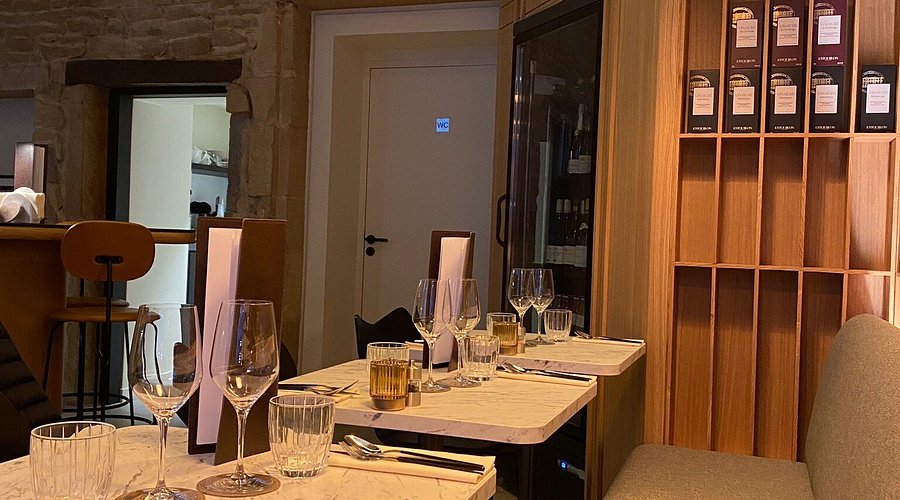
A Cellar Address in a City Built on What It Grows
Rue Jeannin sits in the older residential and commercial fabric of central Dijon, a few minutes from the covered market at Les Halles and the Palais des Ducs. Arriving at number 29, you are in the kind of street where the building's stonework does more communicating than any signage. The name Cave signals something below or behind the street level, the spatial metaphor of a wine cellar translated into a dining room where the materials and the mood suggest restraint. In a city that has spent centuries treating its soil as its primary credential, that framing is deliberate.
Dijon's dining culture organises itself around Burgundian terroir. The region's mustard, the Charolais cattle to the west, the Bresse poultry to the south, the first-growth vineyards running along the Côte de Nuits and Côte de Beaune to the immediate south of the city: these are not decorative references but the actual inputs that define what serious cooking here looks like. The restaurants in Dijon's upper tiers, from William Frachot at the two-star level down through starred contemporaries like CIBO, L'Aspérule, and Origine, all draw on the same regional supply lines, though with different price points and creative registers. Cave operates at the €€ tier, below Loiseau des Ducs and its peers, but within the same Michelin framework of accountability.
The shortlist, unlocked.
Hard-to-book tables, cellar releases, and concierge-planned trips.
Get Exclusive Access →What the Bib Gourmand Signals About Sourcing
The Michelin Bib Gourmand, awarded to Cave in 2025 following a Michelin Plate recognition in 2024, is a specific kind of endorsement. It identifies restaurants where inspectors find cooking of notable quality at a price point they consider accessible, broadly defined as a three-course meal under a set threshold. The distinction matters because it separates a restaurant that is simply inexpensive from one that is delivering genuine culinary intent without inflating costs. In the Burgundy context, that usually requires careful sourcing choices: shorter supply chains, seasonal calendars aligned with what local producers are actually harvesting, and a kitchen discipline that substitutes technique and timing for premium ingredient budgets.
Cave's classification as traditional cuisine positions it alongside a French culinary lineage that prizes those sourcing disciplines as foundational rather than fashionable. Across France, this category includes restaurants that take regional product seriously as a starting point rather than as a marketing overlay. The comparison runs wide: Auberge Grand'Maison in Mûr-de-Bretagne and Auga in Gijón each operate within traditional cuisine frameworks shaped by their own regional produce logic. In Burgundy, the logic is particularly demanding because the region's reputation for ingredient quality sets an implicit standard against which any kitchen operating here is measured.
Chef Yuichiro Akiyoshi and the Cross-Cultural Register
The presence of a Japanese chef in a traditional French cuisine kitchen in Dijon is not anomalous in the current French dining scene, but it does carry a specific interpretive weight. French cooking's classical technique and Japanese culinary culture's commitment to ingredient integrity overlap in ways that have produced some of France's more interesting kitchens in recent decades. At the three-star end, that synthesis appears at houses like Mirazur in Menton or is evident in the sourcing rigour at places like Bras in Laguiole, though in different registers. At the Bib Gourmand tier, it tends to express itself more quietly: in the precision of cuts, in the restraint applied to saucing, in an attention to the quality of a single ingredient that might otherwise be treated as background rather than subject.
Cave's classification as traditional cuisine means the framework is French, but a chef with Akiyoshi's background brings a set of ingredient instincts that align well with what Burgundy actually offers. The question for any Dijon kitchen working in this territory is whether the cooking serves the produce or the other way around. At the Bib Gourmand level, the answer is usually the former, and that discipline tends to produce meals that taste of a place rather than of a kitchen's ambition.
Cave in the Context of Dijon's Dining Tiers
Dijon's restaurant scene organises into a fairly clear hierarchy. At the leading, William Frachot holds two Michelin stars and prices accordingly, with a creative French approach built around Burgundian materials at the €€€€ level. Below that, CIBO, L'Aspérule, and Origine each hold one star and operate at the €€€ or €€€€ tier. Cave at €€ with a Bib Gourmand occupies a distinct position: Michelin-validated, meaningfully less expensive, and working within a traditional rather than creative or innovative register. For a visitor whose reference points are the broader French fine dining circuit, from Alléno Paris au Pavillon Ledoyen in Paris to Flocons de Sel in Megève or Troisgros in Ouches, Cave reads as the Dijon entry point where serious sourcing and Michelin recognition intersect at a price that allows for a bottle of Burgundy without the meal becoming a financial exercise.
The Google review score of 4.7 across 59 reviews is a consistent positive signal at a sample size that reflects a local and visitor audience rather than a large tourist volume. Restaurants at the Bib Gourmand level in secondary French cities often build their reputations on repeat local custom as much as destination dining, which tends to produce that kind of sustained rating over time.
Planning a Visit
Cave is at 29 Rue Jeannin, 21000 Dijon, a central address within walking distance of the main market and the city's historic core. The €€ price range, combined with the Bib Gourmand classification, makes it the most accessible Michelin-recognised option in the city's current lineup. Phone and website details are not listed in our current data, so booking is leading approached directly at the address or through a hotel concierge familiar with Dijon's dining circuit. Given the restaurant's Michelin profile and the relatively modest seat count typical of this format, reservations are advisable, particularly on weekends and during the autumn harvest season when Burgundy draws visitors from across the wine world. For the wider Dijon dining picture, our full Dijon restaurants guide maps the city's full range. If you are extending your stay, our Dijon hotels guide, bars guide, wineries guide, and experiences guide cover the rest of the city's offer, including access to the Côte de Nuits and Côte de Beaune producers whose raw materials define what ends up on plates like the ones at Cave. For traditional cuisine at a comparable Michelin-recognised level in other French regions, Auberge de l'Ill in Illhaeusern provides a useful Alsatian reference point.
What Do People Recommend at Cave?
With a Google rating of 4.7 and a 2025 Michelin Bib Gourmand, the consistent point of reference across Cave's recognition record is the quality of cooking relative to price. The traditional cuisine classification and Chef Yuichiro Akiyoshi's cross-cultural background suggest that the kitchen's strengths lie in ingredient-led dishes where Burgundian produce, Charolais beef, regional poultry, local seasonal vegetables, is handled with precision rather than elaboration. Michelin's Bib Gourmand inspectors do not award on ambiance or service alone; the food has to justify the recognition. Specific dishes are not listed in our current data, but the sourcing logic of a traditional French kitchen in Burgundy, at this price and recognition level, points toward straightforwardly seasonal plates where the ingredient carries most of the weight.
29 Rue Jeannin, 21000 Dijon, France
+33 3 80 41 48 26
A Pricing-First Comparison
A small comparison set for context, based on the venues we track.
| Venue | Price | Awards | Notes |
|---|---|---|---|
| Cave | €€ | Bib Gourmand | This venue |
| William Frachot | €€€€ | Michelin 2 Star | Modern French, Creative, €€€€ |
| CIBO | €€€€ | Michelin 1 Star | Modern Cuisine, €€€€ |
| Sublime | €€ | Innovative, Modern Cuisine, €€ | |
| Origine | €€€€ | Michelin 1 Star | Creative, €€€€ |
| L'Aspérule | €€€ | Michelin 1 Star | Modern Cuisine, €€€ |
Need a table?
Our members enjoy priority alerts and concierge-led booking support for the world's most difficult tables.
Get Exclusive AccessThe shortlist, unlocked.
Hard-to-book tables, cellar releases, and concierge-planned trips.
Get Exclusive Access →