Caro Amico Italian Cafe
A neighborhood Italian cafe on SW Barbur Boulevard, Caro Amico sits in a part of Portland where European-style casual dining trades on consistency rather than spectacle. The format places it in the tradition of Italian cafes that anchor residential corridors, where the emphasis falls on familiar preparations executed without flourish. Portland's Italian dining scene ranges from wood-fired destination spots to low-key neighborhood fixtures, and Caro Amico occupies the latter end of that spectrum.
Pearl is the En Primeur Club membership app — saves, bookings, and concierge access live there. Same editors, same standards.
- Address
- 3606 SW Barbur Blvd, Portland, OR 97239
- Phone
- +15032236895
- Website
- caroamicoitaliancafe.com
- Directions
- Get directions
 Saves & bookings on Pearl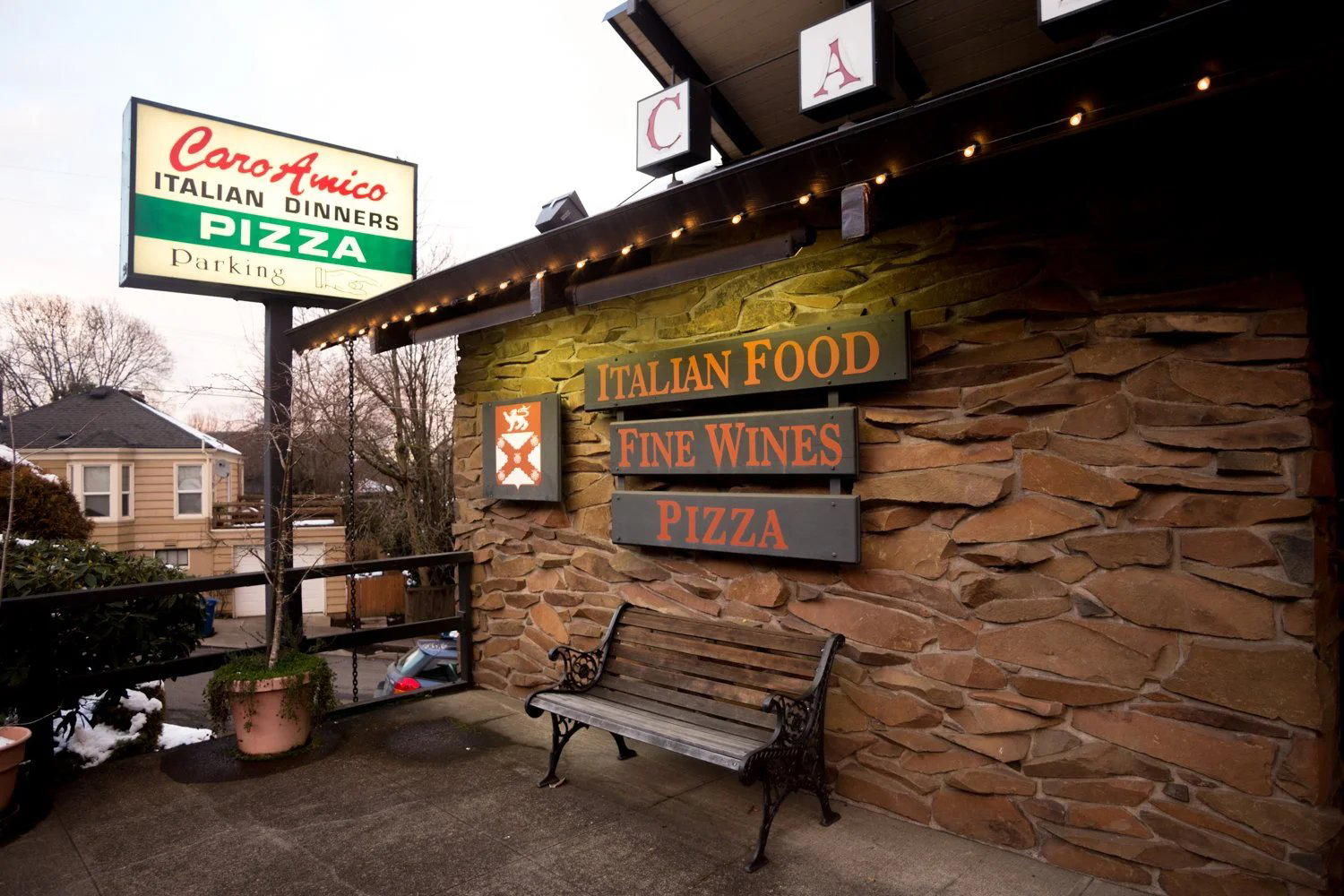
SW Barbur and the Neighborhood Italian Question
Portland's Italian dining options have never been more stratified. At one end sits Nostrana, the wood-fired institution on Cass Street that draws citywide attention for its Roman-influenced pizza and serious wine program. At the other end, residential corridors like SW Barbur Boulevard support a quieter tier of Italian cafes, the kind of places that fill a different function: regulars who want pasta twice a week without a reservation, families who don't need a sommelier, and neighborhood workers who treat the dining room like a second kitchen. Caro Amico Italian Cafe at 3606 SW Barbur Blvd is a casual Traditional Italian Trattoria in Portland with a recommended reservation policy and an average price of about $25 per person.
The Barbur corridor is a functional stretch of southwest Portland, more commuter artery than dining destination. Restaurants that survive here do so through consistency and neighborhood loyalty. That context shapes what Caro Amico is and what it isn't: it isn't competing with Ken's Artisan Pizza for a destination dining audience, and it isn't trying to. It's serving a neighborhood that wants Italian comfort food within a short drive, without the friction of high-demand booking windows.
Italian Cafe Traditions and What Portland Does With Them
The Italian cafe format, as it exists in American cities, is a hybrid that developed through decades of adaptation. The original trattoria model, with its fixed menus, communal tables, and seasonal market logic, passed through Italian-American immigrant culture and emerged as something more elastic: booths instead of long tables, laminated menus instead of chalkboards, house red served by the carafe rather than by region. This isn't a lesser form, it's a different one, shaped by different conditions and serving a different social role.
Portland's approach to that format has generally leaned toward sourcing transparency. Even casual Italian spots in the city tend to call out Oregon-grown ingredients, whether that means Willamette Valley wheat in pasta dough, Hood River produce in seasonal vegetable preparations, or Pacific Northwest proteins in what might otherwise be straightforwardly Sicilian or Roman preparations. That intersection of imported technique and local product is a defining characteristic of how Portland handles European cuisine at every price point. The city's agricultural access, particularly through the Willamette Valley's farms and the proximity of Oregon Coast seafood, makes local sourcing a practical option rather than a marketing claim.
This pattern appears across Portland's dining scene broadly: Langbaan's Thai tasting menu uses Pacific Northwest ingredients within a deeply traditional Thai framework; Berlu applies Vietnamese technique to Oregon-sourced produce; even Kann's Haitian format engages with local product. Italian cafes on Barbur operate in the same broader context, where the expectation of local sourcing is ambient rather than notable.
What the Cafe Format Signals About Price and Access
In cities where Italian dining has bifurcated into two tiers, tasting-menu destinations that reference Piedmontese or Neapolitan traditions with precision, and fast-casual pasta concepts that prioritize speed, the mid-range Italian cafe occupies increasingly contested ground. It tends to hold its position through value density: more food, more familiar flavors, and lower spend-per-head than the tasting-menu tier, with more hospitality than the counter-service tier.
That value position is particularly relevant on SW Barbur, where the surrounding residential mix skews toward middle-income households rather than the demographic drawn to inner Southeast or the Pearl District. A neighborhood Italian cafe in this location isn't priced against Le Bernardin or The French Laundry; it's priced against the domestic cooking its regulars might otherwise do on a Tuesday. That's a different kind of competition, and winning it requires reliability over ambition.
Portland's dining scene doesn't typically touch this category. Venues like Lazy Bear, Smyth, or Providence operate at a different altitude. The Italian cafe exists below that atmosphere, where awards don't circulate but return visits do.
Oregon Ingredients and Italian Technique: A Working Relationship
The editorial angle worth holding onto for any Italian cafe in Portland is the way the region's agricultural profile pressures Italian culinary convention in productive ways. Italian cooking is fundamentally ingredient-driven; the Roman reverence for offal, the Sicilian obsession with citrus and sardines, the Bolognese doctrine around slow-braised meat, all of it starts from what the land and sea nearby produce. Transplant that logic to Oregon and the available ingredients shift: Dungeness crab instead of Adriatic shellfish, Pinot Noir reductions instead of Chianti, Pacific halibut instead of branzino.
Whether a given neighborhood Italian cafe in Portland engages consciously with that substitution logic or simply follows American-Italian convention depends heavily on the kitchen's orientation. The more interesting neighborhood spots tend to make at least some of that substitution visible on the menu, even if they don't frame it as a culinary statement. For visitors comparing Italian options across the Pacific Coast, this regional ingredient logic is worth tracking across venues: Addison in San Diego and Single Thread in Healdsburg both illustrate how local product can be integrated into European frameworks at the fine dining tier; the question for casual Italian is whether that logic survives the translation downmarket.
Planning a Visit: SW Barbur Practicalities
SW Barbur Boulevard is accessible from central Portland via the 12 bus line, which runs along the corridor and stops near the 3600 block. By car, Barbur connects directly from downtown Portland heading south and has parking available along the commercial strips. The neighborhood sits outside the inner-ring dining clusters of Division Street, Mississippi, and the Pearl, which means it draws primarily from southwest Portland residents rather than from visiting food tourists.
For travelers building a Portland itinerary around dining, the Italian cafe category on Barbur functions as a local contrast to the destination-dining circuit. Pairing a meal here with a visit to a more program-intensive restaurant, whether that's Langbaan's ticketed tasting format or the wood-fired ambition of Nostrana, gives a more complete picture of how Portland's food culture operates across different price points and neighborhood contexts.
Cuisine and Credentials
Comparable venues nearby, for context on price, style, and recognition.
| Venue | Cuisine | Price | Notes |
|---|---|---|---|
| Caro Amico Italian CafeThis venue — the venue you are viewing | Traditional Italian Trattoria | $$ | Not listed |
| Scottie's Pizza Parlor | New York- and Neapolitan-Style Pizza | $$ | Hosford-Abernethy |
| Cibo | Neighborhood Italian with Wood-Fired Pizza | $$ | Richmond |
| Brooklyn Trattoria | NYC-Style Italian Trattoria | $$ | Bethany Village |
| Yum's of PDX | Brooklyn-Inspired Neapolitan Pizza | $$ | Central Eastside Industrial District |
| Fillmore Trattoria | Italian-American Trattoria | $$ | Northwest District |
Continue exploring
More in Portland
Restaurants in Portland
Browse all →
Bars in Portland
Browse all →
Hotels in Portland
Browse all →
At a Glance
- Classic
- Cozy
- Historic
- Family
- Casual Hangout
- Special Occasion
- Historic Building
- Terrace
- Waterfront
- Street Scene
Current opening hours
- Monday
- Closed
- Tuesday
- 4–8 PM
- Wednesday
- 4–8 PM
- Thursday
- 4–8 PM
- Friday
- 4–9 PM
- Saturday
- 4–9 PM
- Sunday
- 4–8 PM
Hours can change for holidays and private events. Last verified .
Cozy bar with nostalgic 1960s Frank Sinatra ambiance and a welcoming family atmosphere.