Cajun Queen
Our verdict
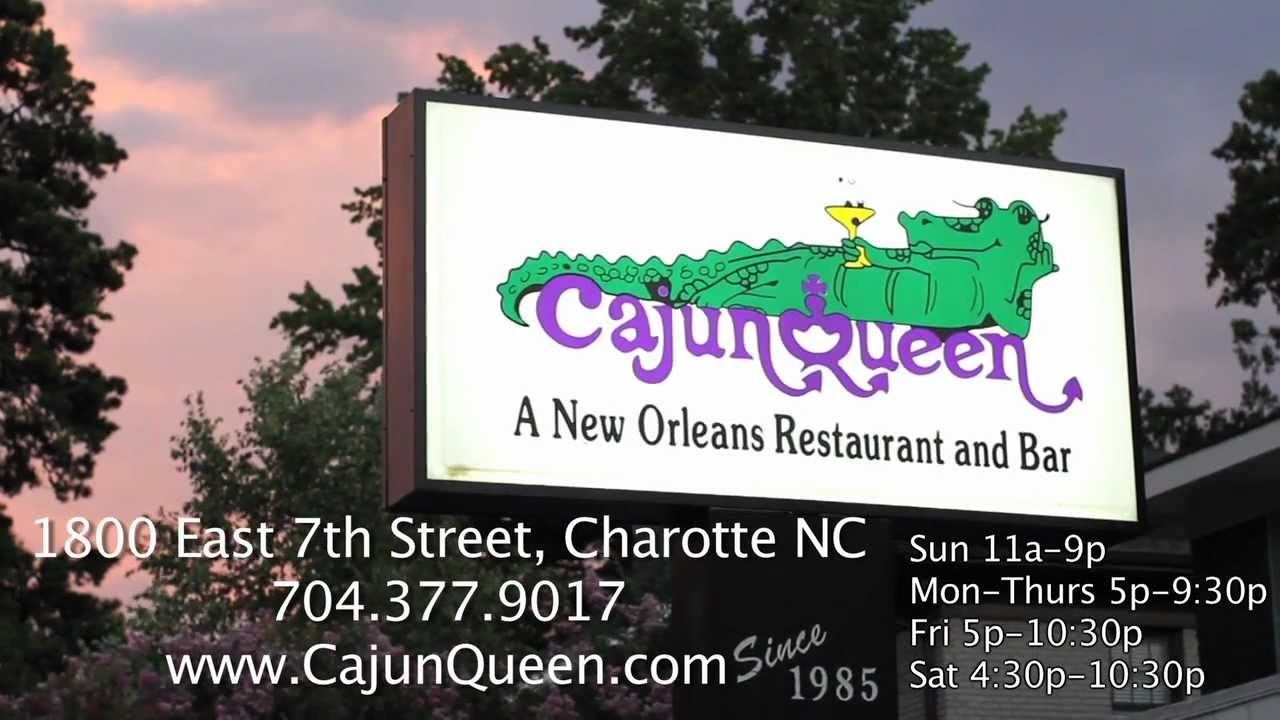
A Charlotte institution on East 7th Street, Cajun Queen brings Louisiana Creole and Cajun traditions to a dining scene better known for New American and Southern fare. Its 1800 E 7th St address places it in a corridor of independent restaurants that have defined Charlotte's mid-city character for decades. Where much of the city trends toward polish and concept-driven formats, this address has held to a regional American kitchen with its own distinct geography.

Pearl is the En Primeur Club membership app — saves, bookings, and concierge access live there. Same editors, same standards.
- Address
- 1800 E 7th St, Charlotte, NC 28204
- Phone
- (704) 377-9017
- Hours
- Mon 5–8 PMTue–Thu 5–8:30 PMFri–Sat 5–9 PMSun 11 AM–8 PM
- Website
- cajunqueen.net
- Directions
- Get directions
- Booking
- Book on OpenTable
The menu
What to order
- Crawfish Etouffee
- Shrimp and Grits
- Cajun Pasta
Where the Gulf Coast Meets the Piedmont
Charlotte's restaurant scene has spent the past decade asserting itself as something more than a banking-city afterthought, with a wave of chef-driven concepts filling corridors from Plaza Midwood to South End. Inside that expansion, a quieter category persists: the long-standing independent that predates the renovation boom and holds its ground not through rebranding but through consistency. Cajun Queen, at 1800 E 7th Street in Charlotte's Midwood-adjacent stretch, belongs to that category. The address sits on a block that functions as a kind of pre-gentrification baseline for Charlotte dining, where the signage is modest and the parking lot tells you more about the regulars than the room does.
Cajun and Creole cooking occupies a specific and underrepresented niche in the Carolina Piedmont. New Orleans-rooted cuisine, with its layered roux bases, Gulf seafood dependency, and French-Spanish-African culinary inheritance, doesn't translate easily to landlocked Southern cities without deliberate sourcing and kitchen discipline.
Cajun and Creole Cooking as a Sourcing Problem
From an environmental and sourcing perspective, Gulf Coast cooking presents distinct challenges and opportunities. Cajun and Creole kitchens at their most authentic are built around seasonal availability: crawfish in spring, Gulf shrimp through summer, oysters in the colder months, and wild-caught fish that vary by season and catch. This calendar-driven structure aligns naturally with low-waste, high-utilization kitchen practice, where the same shellfish yields shells for stock, heads for bisque bases, and flesh for the featured dish. The tradition is, in this sense, inherently aligned with principles that more recently arrived farm-to-table concepts have had to construct from scratch.
The question for any Cajun-Creole operation outside Louisiana is how faithfully that sourcing chain can be maintained at distance. Restaurants like Emeril's in New Orleans operate with direct access to the Gulf supply chain; an operation in Charlotte must build logistics across a longer supply line or accept compromises. At the high end of the sustainability conversation, kitchens such as Blue Hill at Stone Barns in Tarrytown, Single Thread Farm in Healdsburg, and Smyth in Chicago have made supply chain transparency a central part of their identity, sometimes to the extent that the sourcing story overtakes the food itself. A neighborhood restaurant in Charlotte operates in a different register, where the sourcing choices are made daily and quietly rather than published as a manifesto.
What defines a kitchen's environmental credibility in this context is not whether it has a named farm on the menu, but whether the underlying cooking tradition demands ingredient respect. Cajun technique, with its reliance on the trinity of onion, celery, and bell pepper as a flavor base and its use of every part of an animal or shellfish, is structurally low-waste in a way that more composed, modernist tasting-menu formats sometimes are not. Atelier Moessmer Norbert Niederkofler in Brunico represents the European apex of this whole-territory cooking philosophy; Cajun Queen operates through a parallel American tradition that has simply been doing the same thing longer and with less fanfare.
Charlotte's Independent Restaurant Tier
Placing Cajun Queen within Charlotte's current dining picture requires understanding how the city's independent restaurant tier functions relative to its newer, more capitalized competitors. Concepts like Supperland and 204 North Kitchen and Cocktails represent the city's appetite for concept-led design and refined format. Venues like Angeline's and 1897 Market signal a broader interest in Southern American culinary heritage that the market has rewarded. Against this backdrop, a long-running Cajun and Creole kitchen holds a different kind of value: institutional memory, a defined regional identity, and a customer base that has been calibrated over years rather than assembled through social media.
The East 7th Street corridor has seen considerable change around venues like this one. New openings cluster to its south and north, and the neighborhood's demographic has shifted toward younger residents with higher dining spend. This creates a market environment where legacy independents either adapt their price positioning and format or find themselves occupying an increasingly defined niche as the affordable anchor in a block that has become more expensive around them. Either outcome can be commercially sustainable; the question is whether the kitchen identity survives the transition intact.
For context on what Gulf Coast seafood traditions look like at the highest price tier, Le Bernardin in New York City and Providence in Los Angeles represent the fine-dining apex of American seafood cooking, where sourcing credentials are central to the institutional identity. Addison in San Diego and The French Laundry in Napa operate at the tasting-menu tier where provenance is almost always specified. A casual Cajun kitchen in Charlotte competes in none of those categories, but the culinary tradition it represents has its own depth and rigor that comparison to fine-dining seafood houses helps to illuminate.
Planning Your Visit
Cajun Queen is located at 1800 E 7th Street, Charlotte, NC 28204, in a section of the city that is accessible from Uptown Charlotte by car in under ten minutes and sits close enough to Plaza Midwood's walkable blocks to function as a dinner destination before or after activity in that neighborhood. Visitors approaching from the airport or South End should factor in the one-way street patterns on 7th Street. Current hours, reservation availability, and menu pricing are best confirmed directly with the venue or through current review platforms, as this information changes seasonally. Given the cuisine type and the neighborhood's character, the restaurant operates in a format that skews casual to mid-casual rather than formal, making it a practical choice for groups with varying dress preferences. For a broader orientation to dining across Charlotte's neighborhoods, the EP Club Charlotte restaurants guide maps the city's main dining corridors and price tiers, including venues like Aura Rooftop and Afternoon Tea at Ballantyne for contrasting format options. Lazy Bear in San Francisco and Atomix in New York City offer useful reference points for understanding how experiential and tasting-menu formats have shaped the premium end of the American restaurant market, against which Charlotte's independent tier defines its own competitive identity. For Southern American alternatives within Charlotte that share some culinary DNA, Gallery Restaurant and The Inn at Little Washington offer contrasting takes on how the South's culinary traditions scale up and down the formality spectrum.
Frequently asked questions
Would Cajun Queen be comfortable with kids?
Cajun and Creole kitchens tend to run on the louder, more informal end of the dining spectrum, which generally works in families' favor. Based on its location on E 7th Street in a neighborhood-facing Charlotte corridor, Cajun Queen reads as an accessible spot rather than a white-tablecloth room. That said, call ahead to confirm seating arrangements, since the physical setup of the dining room determines whether high chairs or larger parties are practical.
What's the vibe at Cajun Queen?
The address at 1800 E 7th Street places it in a stretch of Charlotte that skews local and residential rather than tourist-facing, which shapes the room's energy. Gulf Coast cooking naturally lends itself to convivial, unpretentious settings, and Cajun Queen fits that tradition. Expect a dining room oriented around the food rather than ceremony.
How does Cajun Queen fit into Charlotte's broader Gulf Coast and Southern cooking scene?
Charlotte's independent restaurant tier has grown considerably over the past decade, but dedicated Cajun and Creole kitchens remain relatively sparse compared to the city's barbecue and New American offerings. Cajun Queen occupies a specific position at 1800 E 7th Street by committing to a Gulf Coast register that most Charlotte kitchens leave to occasional menu cameos. That focus on a defined regional tradition — rather than a broad Southern catch-all — is the clearest differentiator in its category within the city.
What do people recommend at Cajun Queen?
Cajun and Creole menus in kitchens with staying power in cities like Charlotte tend to build reputations on a handful of reliable anchor dishes: étouffée, gumbo, and fried seafood are the benchmarks against which regulars measure consistency. Without current menu documentation on file, the most reliable approach is to ask the server what has been on the menu longest, since longevity on a Cajun menu is usually the most honest signal of kitchen confidence.
Where is Cajun Queen located?
Cajun Queen is located at î1800 E 7th St, Charlotte, NC 28204, Charlotte.
Is Cajun Queen reservation-only?
For a restaurant at 1800 E 7th Street in Charlotte's independent dining tier, walk-in availability often depends on the day of the week and time of service. Contacting the venue directly before visiting on a Friday or Saturday evening is the practical move.
The Short List
Comparable venues nearby, for context on price, style, and recognition.
| Venue | Cuisine | Price | Notes |
|---|---|---|---|
| Cajun QueenThis venue — the venue you are viewing | Authentic Cajun & Creole | $20–30 | Not listed |
| MarlieQs Caribbean Queen Food Truck LLC | Authentic Jamaican | $10–20 | University City, Authentic Jamaican |
| Midwood Smokehouse - CLT Airport Concourse B | Carolina-Style BBQ | $20–30 | Berryhill, Carolina-Style BBQ |
| Sea Level | Carolina Seafood Raw Bar | $30–50 | Uptown, Carolina Seafood Raw Bar |
| Dolce Osteria | Authentic Italian Trattoria | $30–50 | Dilworth, Authentic Italian Trattoria |
| Leroy Fox | Southern Inspired Fried Chicken | $20–30 | Mid-Town, Southern Inspired Fried Chicken |
Continue exploring
More in Charlotte
Restaurants in Charlotte
Browse all →
Bars in Charlotte
Browse all →
Hotels in Charlotte
Browse all →
Wineries in Charlotte
Browse all →
Details
- Lively
- Cozy
- Energetic
- Group Dining
- Celebration
- Casual Hangout
- Live Music
- Historic Building
- Craft Cocktails
- A La Carte
- Vegetarian Friendly
- Vegan Options
- Gluten Free Options
Current opening hours
- Monday
- 5–8 PM
- Tuesday
- 5–8:30 PM
- Wednesday
- 5–8:30 PM
- Thursday
- 5–8:30 PM
- Friday
- 5–9 PM
- Saturday
- 5–9 PM
- Sunday
- 11 AM–8 PM
Hours can change for holidays and private events. Last verified .
Nostalgic New Orleans theme with purple, green, and gold décor; lively upstairs with live jazz and quieter downstairs dining.