Our verdict
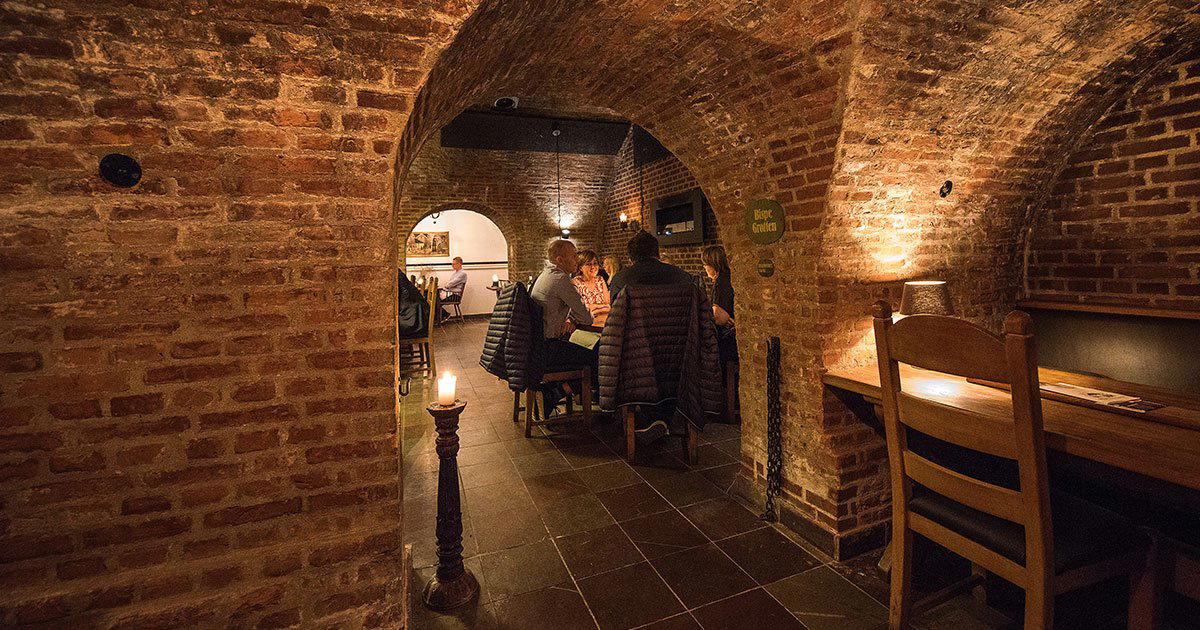
Brygger Bauers Grotter occupies a vaulted cellar space on Sct. Mathias Gade in central Viborg, placing it within Denmark's broader tradition of informal heritage dining rooms where stone walls and low ceilings shape the meal as much as the kitchen does. For visitors working through the Jutland interior, it represents a local anchor point in a city whose restaurant scene punches above its population size.

Pearl is the En Primeur Club membership app, where members save venues, book tables and use the concierge.
Stone, Cellars, and the Jutland Interior
Viborg sits at the geographic centre of Jutland, roughly equidistant from the west coast marshlands and the eastern fjords, and its dining scene reflects that position: less cosmopolitan than Aarhus, more rooted than the coastal resort towns, and shaped by a civic identity that goes back to the Viking Age. The city's medieval cathedral and surrounding historic quarter attract a steady stream of Danish domestic travellers rather than international tourist flows, which means its restaurants tend to serve a local-first audience with a secondary layer of culturally curious visitors. That audience rewards places that feel genuinely embedded rather than aspirationally imported.
Brygger Bauers Grotter addresses Sct. Mathias Gade 61, one of the main arteries through Viborg's historic core. The address alone signals something about the category: a cellar-format venue in a street-level heritage building, the kind of physical container that Danish brewers and merchants built in the 18th and 19th centuries and that now, repurposed across Scandinavia, defines a whole register of informal but atmospheric dining. The stone walls, low arched ceilings, and below-street geography create a sensory baseline before any food arrives, cooler air, a shift in acoustics, a visual compression that makes a room feel more intimate than its square footage would suggest above ground.
Where the Food Comes From in Central Jutland
The editorial angle on any Viborg restaurant worth serious attention is sourcing geography. Jutland's agricultural identity is distinct from Zealand's or Funen's: heathland, river valleys, and some of Denmark's most productive livestock farming sit within short distances of the city. The Karup River system and Lake Viborg are immediately proximate. That geography creates a sourcing logic, game from Jutland heathlands, freshwater fish from local lakes and rivers, root vegetables and dairy from nearby farms, that distinguishes interior Jutland cooking from the coastal seafood focus that dominates Denmark's more internationally recognised restaurant tier.
Denmark's celebrated fine-dining tier, which includes Geranium in Copenhagen and the broader New Nordic movement that Noma defined, built its international reputation on hyper-local sourcing as a philosophical and aesthetic commitment. At the opposite end of the formality scale, the same sourcing logic filters into informal regional dining rooms, not as a mission statement, but as a practical reality of cooking in a region where local supply chains are shorter and more direct than in capital cities. Brygger Bauers Grotter's cellar setting places it within this informal tier, where the ingredients speak to Jutland's land-based agriculture rather than Denmark's coastal identity.
For comparison within Jutland's more formal register, Frederikshøj in Aarhus operates at the premium end of the regional spectrum, and LYST in Vejle commands a waterfront setting with a kitchen oriented toward seasonal precision. Viborg's dining offer sits at a different register: less destination-restaurant, more civic institution, and all the more useful for travellers who want to understand how a mid-sized Danish city actually eats rather than how it performs for international guides.
Heritage Format Dining Across Denmark
The cellar-restaurant format has a specific cultural weight in Denmark and across Scandinavia. These spaces were originally functional, storage for barrels, grain, or ice, and their conversion into dining rooms preserves an architectural language that modern restaurant design rarely replicates convincingly. In Copenhagen, venues like this have been absorbed into the city's hospitality mainstream; in regional cities like Viborg, they retain a more direct civic connection, operating as gathering places for locals across decades rather than as designed experiences for visitors. That continuity matters. A room that has been used by the same community across generations accumulates a kind of social texture that purpose-built restaurants cannot manufacture.
Within Denmark's broader regional dining picture, the Jutland interior remains underrepresented in national food media relative to its actual quality. Places like Ti Trin Ned in Fredericia and Syttende in Sønderborg have begun to draw wider attention to the peninsula's dining depth, but Viborg specifically sits in the quieter zone of that emerging recognition. Our full Viborg restaurants guide maps the city's dining options across formats and price points, which is useful context for building an itinerary.
For Viborg visitors, Neo-Bistro Les Jeunes represents the city's more contemporary dining register, a useful counterpoint if you want to map the full range of what Viborg's kitchen scene currently covers. The two venues occupy different ends of the city's dining spectrum without directly competing.
Planning a Visit
Brygger Bauers Grotter sits on Sct. Mathias Gade, walkable from Viborg's central cathedral square and the main hotel belt around the historic core. For travellers arriving by train from Aarhus, the journey runs approximately 50 minutes, and the address is within comfortable walking distance of Viborg Station. The cellar format typically suits evening visits when the contrast between the busy street above and the quieter space below is most marked; midday visits lose some of that atmospheric differential.
For context on Denmark's wider premium regional dining offer, Henne Kirkeby Kro in Henne on the west Jutland coast and Dragsholm Slot Gourmet in Hørve on Zealand represent the country's rural destination-dining format at its most developed. Tri in Agger in the Limfjord area offers a coastal Jutland counterpoint that pairs well with a Viborg stop on a longer Jutland itinerary. Further afield, Jordnær in Gentofte and Frederiksminde in Præstø show what the Zealand side of the Danish regional dining picture looks like at its most refined. Internationally, the community-dining philosophy that shapes cellar-format rooms like this one finds a different but structurally comparable expression in venues like Lazy Bear in San Francisco and the ingredient-first rigour of Le Bernardin in New York City, though the register and price points diverge sharply. Elsewhere in Jutland, Pearl by Paul Proffitt in Kruså, Domæne in Herning, and ARO in Odense round out the peninsula's most discussed dining addresses, while Parsley Salon in Hellerup offers a Copenhagen-adjacent reference point for those building a Denmark-wide itinerary.
Frequently asked questions
Would Brygger Bauers Grotter be comfortable with kids?
Cellar-format venues like Brygger Bauers Grotter on Sct. Mathias Gade tend to run atmospheric rather than child-focused, low ceilings, stone interiors, and an adult dining tempo. Younger children may find the setting less accommodating than a conventional family restaurant.
Is Brygger Bauers Grotter formal or casual?
The cellar-restaurant format in Denmark historically occupies a middle register: more considered than a neighbourhood bistro, but without the ceremony of a tasting-menu counter. At Sct. Mathias Gade 61 in Viborg, the stone-and-vault setting does the atmospheric work, which generally means guests dress comfortably rather than formally. Neat, unfussy clothing fits the format.
What kind of setting does Brygger Bauers Grotter occupy, and how does it compare to other cellar restaurants in Denmark?
Brygger Bauers Grotter operates from a historic cellar space in Viborg, Jutland's geographic interior, placing it within a Scandinavian tradition of repurposed subterranean storage architecture now used for dining and drinking. This format is well-established across Denmark but relatively concentrated in coastal cities; finding it in a cathedral town like Viborg gives the venue a distinct regional character. The grotter, meaning grottos or vaulted cellars, format signals atmosphere-led dining rather than high-volume turnover.
What do regulars order at Brygger Bauers Grotter?
What the cellar-restaurant tradition in central Jutland typically centres on is regional produce, meat, root vegetables, and preserved goods that reflect the agricultural interior rather than coastal seafood. Contacting the venue directly will give you the current picture.
What part of town is Brygger Bauers Grotter in?
Brygger Bauers Grotter is located at Sct. Mathias Gade 61, 8800 Viborg, Denmark, Viborg.
Can I walk in to Brygger Bauers Grotter?
Brygger Bauers Grotter sits on Sct. Mathias Gade 61, walkable from Viborg's cathedral square, which puts it squarely in the city's pedestrian core. Whether walk-ins are accepted on any given evening depends on capacity and season, cellar venues with limited covers book tighter than larger restaurants. Checking ahead, particularly for weekends, is the practical approach.
Comparison Snapshot
| Venue | Cuisine | Price | Awards | Notes |
|---|---|---|---|---|
| Brygger Bauers GrotterThis venue (the venue you are viewing) | European Tapas in Historic Caves | Not listed | Not listed | Not listed |
| Geranium | Modern New Nordic Pescatarian | $500+ | 3 Michelin Stars · World's 50 Best #1 | New Nordic, Creative |
| Noma | New Nordic Fine Dining | $300–500 | 3 Michelin Stars · World's 50 Best #1 | Creative |
| Alchemist | Avant-Garde Molecular Gastronomy with Social Commentary | $500+ | 2 Michelin Stars · World's 50 Best #5 | Progressive, Creative |
| Koan | Modern Korean-Nordic Fine Dining | $300–500 | 2 Michelin Stars · World's 50 Best #91 | New Nordic, Kaiseki, Creative |
| a|o|c | Modern Scandinavian Fine Dining | $300–500 | 2 Michelin Stars · La Liste Top Restaurants | New Nordic, Mediterranean Small Plates, Creative |
Continue exploring
More in Viborg
Restaurants in Viborg
All restaurants in Viborg →
Wineries in Viborg
Browse all →

Details
- Cozy
- Historic
- Intimate
- Date Night
- Special Occasion
- Celebration
- Historic Building
- Extensive Wine List
- A La Carte
- Small Plates
- Vegan Options
Current opening hours
- Monday
- Closed
- Tuesday
- Closed
- Wednesday
- 5–9 PM
- Thursday
- 5–9 PM
- Friday
- 5–10 PM
- Saturday
- 11 AM–3 PM, 5–10 PM
- Sunday
- Closed
Hours can change for holidays and private events. Hours as of .
Cozy and atmospheric with historic brick-vaulted cellars, warm lighting, and an inviting, romantic underground setting praised for its distinctive charm.