
Michelin Plate
Our verdict
Inside the Marché International de Rungis, the largest fresh produce market in the world, Au Cœur du Marché translates the logic of that supply chain directly onto the plate. Chef Nicolas Sale, a familiar name to Michelin readers, runs a market-dictated menu that moves through updated French classics, from beef terrine with chanterelle pickles to mirabelle plum tart, served generously at varnished oak tables surrounding an open kitchen.

Pearl is the En Primeur Club membership app, where members save venues, book tables and use the concierge.
Where the Supply Chain Becomes the Menu
Most restaurants claim proximity to their ingredients. Au Cœur du Marché has no need for the claim: it operates inside the Marché International de Rungis, a 234-hectare wholesale complex south of Paris that supplies a significant portion of the fresh produce consumed across France and beyond. The market sets the terms here, not the other way around. What arrived at the loading bays that morning determines what appears on the table by midday. That inversion of the normal chef-to-market relationship is the defining characteristic of eating here, and it shapes everything from the architecture of the menu to the pace of the room.
Rungis as a dining destination sits outside the circuits tracked by most Paris-focused editorial coverage, which tends to concentrate on the arrondissements north of the Périphérique. That gap is worth noting for any reader comparing options across the region. For context on the broader French fine-dining spectrum, our full Rungis restaurants guide maps the local options, while properties like Alléno Paris au Pavillon Ledoyen and Mirazur in Menton represent what the top end of the Michelin-recognised French table looks like at the other end of the formality and price spectrum.
The Room and the Logic Behind It
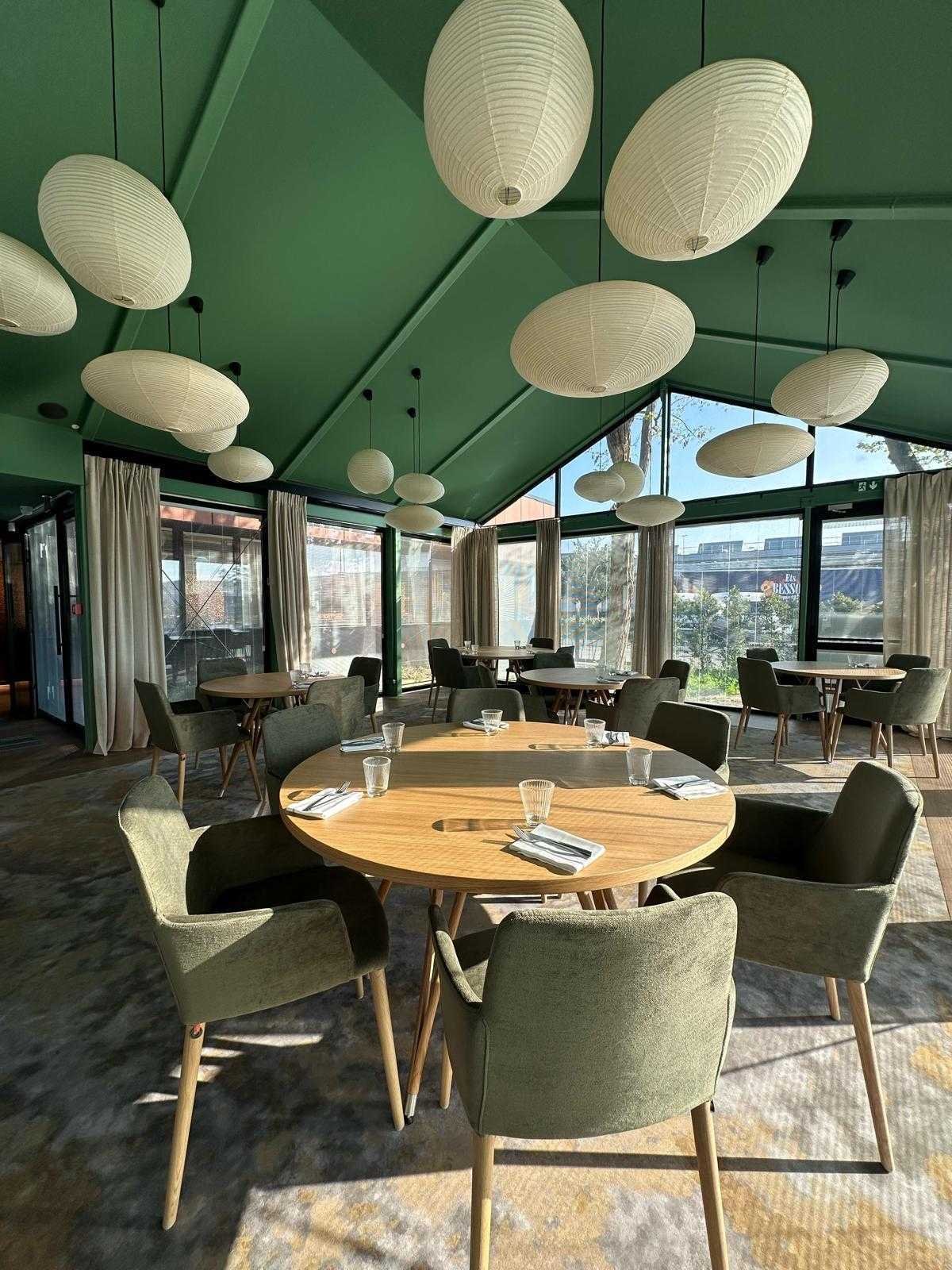
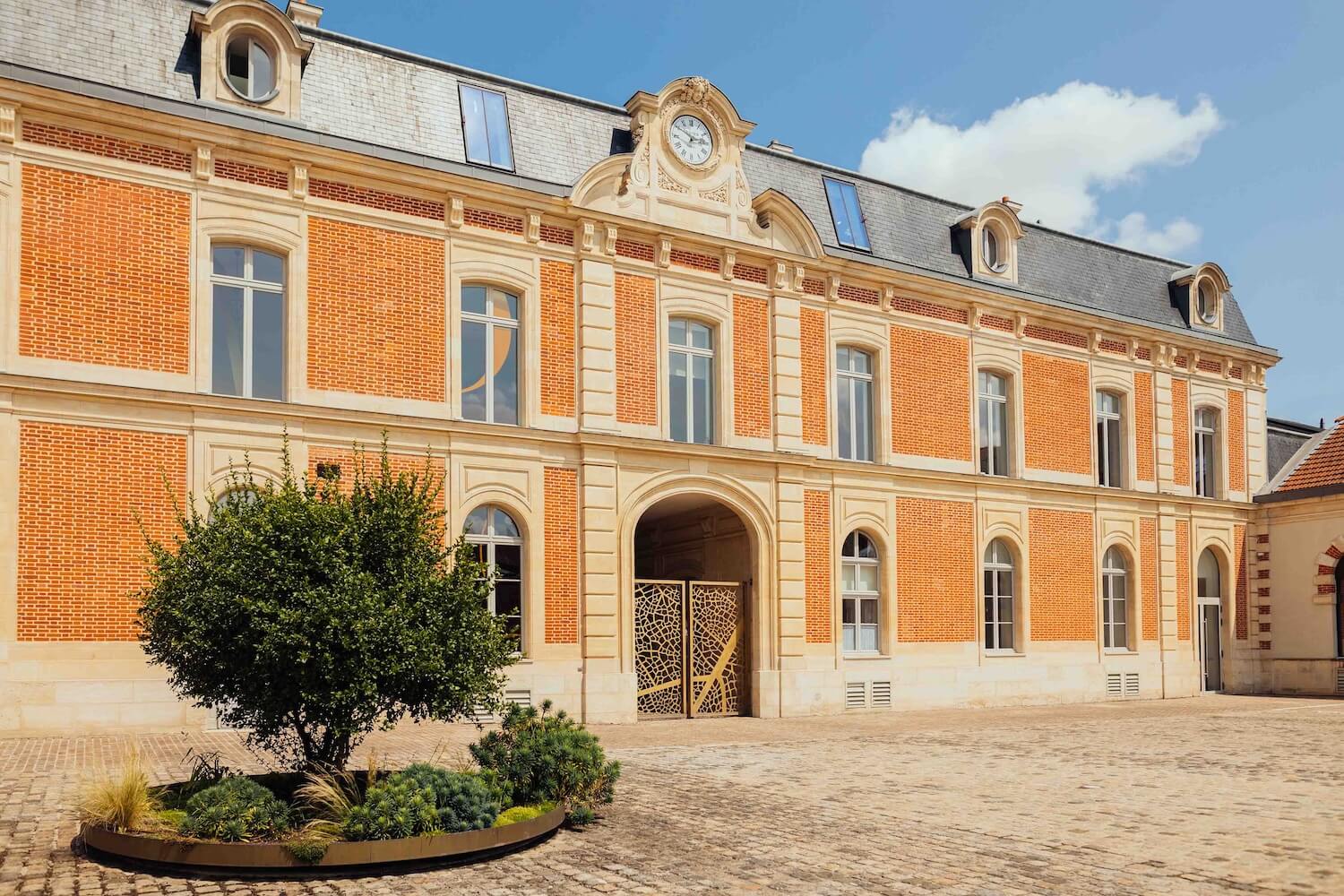
The building is contemporary rather than rustic, a deliberate design choice that positions the restaurant as something other than a canteen wedged between refrigerated warehouses. A large open kitchen occupies the centre of the space, surrounded by varnished oak tables and banquette seating finished in a way that registers as considered rather than industrial. The proximity of the kitchen to the dining room is not incidental theatre. In a place where the menu can shift depending on the day's consignment, the open format allows the kitchen to move with speed and transparency. You are not watching a performance; you are watching a logistical operation that happens to produce lunch.
The clientele at this hour, the market operates on wholesale hours, which means serious commercial activity begins well before dawn, skews toward buyers, traders, and industry professionals who know the supply chain from the other side. That professional context gives the room a particular register: direct, unhurried in the French midday sense, and largely free of the self-consciousness that can attach to destination dining. It is a working lunch environment that takes its food seriously without performing seriousness.
Ingredient Sourcing as Menu Architecture
Editorial point about sourcing here is structural, not atmospheric. At most restaurants, the sourcing narrative is applied after the menu is written: a supplier name added to a dish description, a provenance note on a printed card. At Au Cœur du Marché, sourcing precedes every other decision. The day's consignment arrives, the kitchen assesses it, and the menu follows. This is market cooking in the literal sense, not the phrase as it appears on menus in the 6th arrondissement.
Dishes Michelin references, beef terrine with chanterelle pickles, pollock with vegetable casserole and mashed potatoes, mirabelle plum tart with buckwheat ice cream, are recognisably French in their architecture, but they carry the particular detail of produce selected at the source rather than ordered from a distributor's catalogue. Chanterelles appear when chanterelles are available. Mirabelles appear in their season. The menu is, in effect, an index of what the market considers worth selling that week. For a reader who cares about ingredient quality, this is the most direct possible expression of that value.
Sharing format reinforces the logic. Generous portions made on-site and designed to move around the table suit an environment where the ingredient, not the plating, carries the argument. This is not the register of the multi-course tasting menu format operated by houses like Flocons de Sel or Bras. It sits closer to the tradition of the serious brasserie, where technique is applied in service of abundance rather than restraint.
Chef Credentials in Context
Chef Nicolas Sale's Michelin recognition places Au Cœur du Marché in a specific peer tier. Michelin's engagement with a market-embedded restaurant signals something about how the guide reads the category: this is not a footnote destination, and the format is being taken seriously on its own terms rather than measured against the conventions of urban fine dining. Sale's presence here, rather than in a more conventionally prestigious Paris address, reflects a broader pattern in French cooking where credentialled chefs have moved toward formats and settings that prioritise ingredient access and production logic over address prestige.
That pattern has precedents across the French regional scene. Houses like Troisgros in Ouches, Auberge de l'Ill in Illhaeusern, and Auberge du Vieux Puits in Fontjoncouse built their reputations precisely by embedding themselves in a specific place and its produce rather than positioning in a capital city market. Au Cœur du Marché operates from a different starting point, a commercial wholesale infrastructure rather than a rural terroir, but the underlying logic, that proximity to supply is itself a form of culinary argument, runs parallel.
Planning a Visit
Rungis is accessible from central Paris by road, south of the city near Orly airport, and the market address at 4 avenue de Bourgogne places the restaurant within the market's operational perimeter. Visits require some planning: access to the Marché International de Rungis is structured around professional credentials during wholesale hours, though the restaurant serves within a defined lunch window aligned with the market's operational rhythm. Readers considering a visit should confirm current access protocols directly, as the market's access rules govern the approach. For accommodation and supporting logistics, our Rungis hotels guide covers nearby options, and our guides to Rungis bars, wineries, and experiences round out the area picture.
For readers building a broader France itinerary around serious eating, the contrast with Paris addresses like Assiette Champenoise in Reims or Au Crocodile in Strasbourg, or with international benchmarks like Le Bernardin in New York and AM par Alexandre Mazzia in Marseille, underlines how distinct the Rungis proposition is. Those restaurants all operate within the conventional logic of destination dining. Au Cœur du Marché operates within the logic of a market, and that difference is the point. Readers who want to eat well while standing at the closest possible distance to the source of French produce in Europe will find few positions more direct than this one. Those seeking the tasting-menu formality of a Paul Bocuse or the creative intensity of Emeril's should look elsewhere. Au Cœur du Marché is not that kind of argument. Its argument is simpler and, in this specific context, harder to replicate anywhere else in the world.
Frequently asked questions
Would Au Cœur du Marché be comfortable with kids?
The sharing-plate format and contemporary room without strict dress formality make it manageable for older children. That said, the restaurant sits inside the Marché International de Rungis, a working professional wholesale market, so access logistics and the predominantly trade-hour clientele lean adult. Younger children would find the setting more logistically complicated than a conventional Paris bistro.
Is Au Cœur du Marché formal or casual?
The register is relaxed: varnished oak tables, contemporary banquettes, and an open kitchen set a canteen-adjacent tone that the restaurant consciously sidesteps through Chef Nicolas Sale's Michelin-level cooking. Sharing dishes and a menu driven by that day's market consignment signal a convivial, unpretentious atmosphere, closer to a high-calibre producers' lunch than a tasting-menu dining room.
Has Au Cœur du Marché won any awards?
Au Cœur du Marché has received recognition including: This restaurant is housed in a contemporary building in the heart of the Marché de Rungis – the largest fresh produce market in the world – and is run by chef Nicolas Sale, who is no stranger to MICHELIN. Occupying the middle of the space i….
What do regulars order at Au Cœur du Marché?
Michelin's own account of the menu points to the sharing dishes as the core: beef terrine with chanterelle pickles, pollock with vegetable casserole and mashed potatoes, and mirabelle plum tart with buckwheat ice cream have featured as representative plates. The menu changes with each day's market delivery, so specific dishes rotate, but the approach, classic French frameworks with a considered modern turn, stays consistent.
Comparable Venues
Comparable venues nearby, for context on price, style, and recognition.
| Venue | Cuisine | Price | Awards | Notes |
|---|---|---|---|---|
| Au Cœur du MarchéThis venue (the venue you are viewing) | Creative French-Japanese Fine Dining | $50–100 | Michelin Plate | Not listed |
| Néva Cuisine | Modern French Bistro | $50–100 | Michelin Plate | Quartier de l'Europe |
| Le Cotte Rôti | Modern French Bistro | $50–100 | Michelin Plate | Quinze-Vingts |
| Clutch | Modern French Bistro with Asian Influences | $50–100 | Michelin Plate | 11th arrondissement |
| Le Comptoir Boutary | Modern French Bistro | $50–100 | Michelin Plate | Pigalle |
| Le Clos Y | French-Japanese Fusion | $50–100 | Michelin Plate | 15th arrondissement |
Recognition history
Dated appearances from independent guides and award organizations, with the underlying list record or original source where available.
Michelin Plate
Michelin
Continue exploring
More in Rungis
Restaurants in Rungis
All restaurants in Rungis →
Bars in Rungis
Browse all →

Details
- Cozy
- Modern
- Elegant
- Special Occasion
- Business Dinner
- Open Kitchen
- Sommelier Led
- Local Sourcing
- A La Carte
Current opening hours
- Monday
- 7 AM–3 PM
- Tuesday
- 7 AM–10:30 PM
- Wednesday
- 7 AM–10:30 PM
- Thursday
- 7 AM–10:30 PM
- Friday
- 7 AM–10:30 PM
- Saturday
- Closed
- Sunday
- Closed
Hours can change for holidays and private events. Hours as of .
Modern decor with wood, copper, light tones in pink, gray, and ochre; cozy, luminous, and welcoming atmosphere praised by guests.