Atmos Dining sits in Osaka’s Nakanoshima district, a river-island setting that suits a dining room read through sourcing, seasonality, and the city’s appetite for both polished hotels and serious independent kitchens. With no public awards, chef, cuisine label, or price band attached, the useful reading is contextual: this is a planning choice for diners comparing central Osaka convenience with the city’s deeper food culture.
Pearl is the En Primeur Club membership app — saves, bookings, and concierge access live there. Same editors, same standards.
- Address
- 3 Chome-2-4 Nakanoshima, Kita Ward, Osaka, 530-0005, Japan
- Phone
- +81 6-6222-0111
- Website
- conradosaka.jp
- Directions
- Get directions
 Saves & bookings on Pearl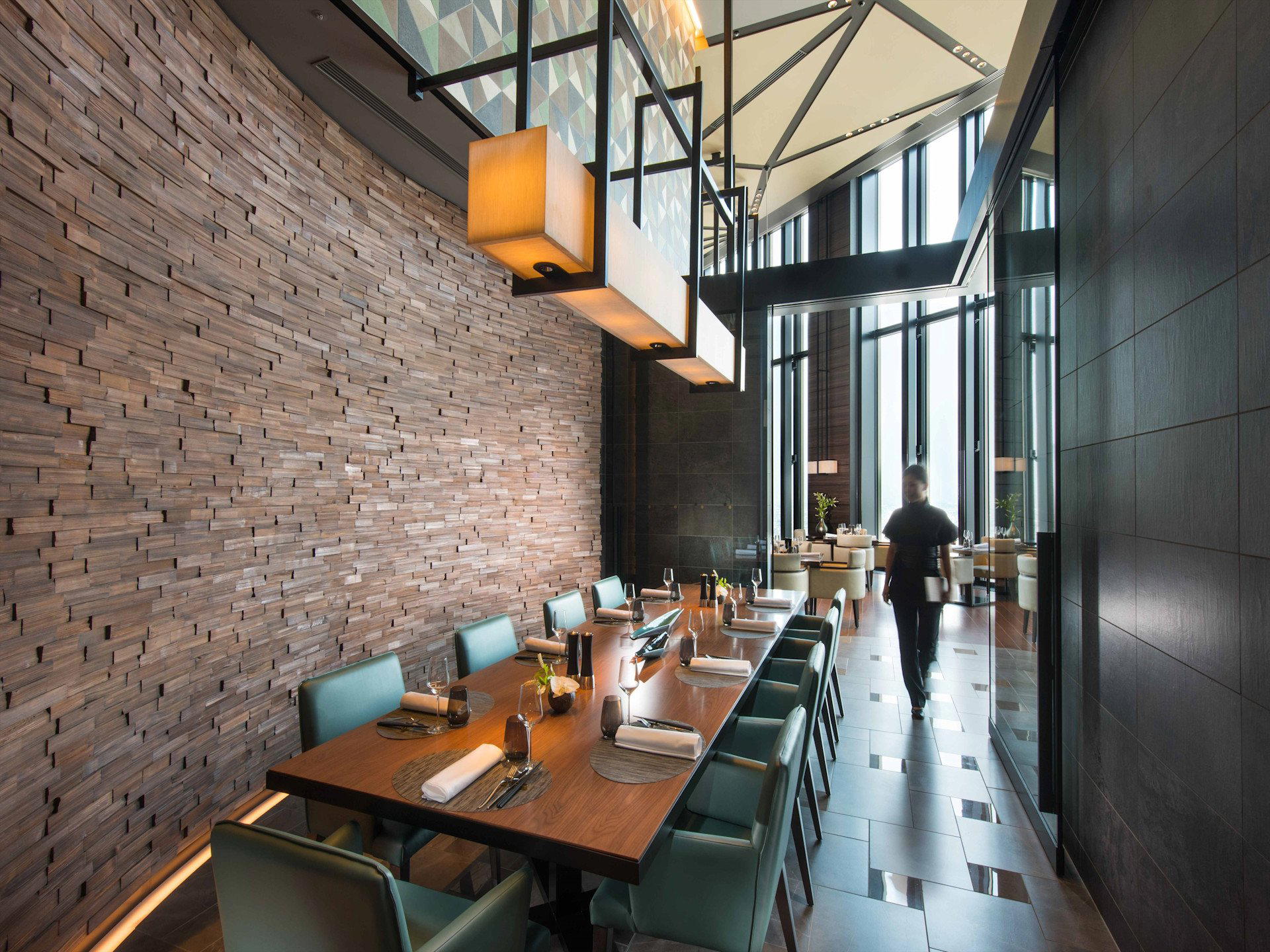
Osaka changes the tempo of dining before a menu appears. The city can feel fast, casual, and improvisational, but it also supports polished rooms where dinner is treated as a composed city decision. Atmos Dining belongs to that version of Osaka: urban, planned, and connected to the city’s broader dining rhythm rather than only to the louder eating circuits visitors often associate with the city.
That matters because Osaka’s dining identity is often flattened into street-food shorthand and the famous phrase kuidaore, eating until ruin. Those references explain the city’s appetite, but not its full range. Osaka also supports dining rooms where pacing, service, and setting matter, and where the question is less “what is the local specialty?” and more “what kind of evening does this room provide?” Atmos Dining should be read through that lens, not as a checklist stop.
Osaka dining favors setting over street-food shorthand
Setting is the sharper way to understand restaurants in this part of the city. Osaka has a wide dining range, from quick casual formats to more composed rooms for planned meals. A restaurant in Osaka can participate in that range without turning every visit into a regional statement. The stronger rooms in this category are usually judged by the total experience rather than by slogans.
Atmos Dining has no published cuisine type attached here, which makes a narrow dish-by-dish reading irresponsible. The safer editorial point is category-based: diners choosing a calmer Osaka dining room over a queue-driven stop are usually choosing quieter pacing, broader expectations, and a setting where service and atmosphere carry as much weight as spectacle. In Osaka, that is a meaningful distinction. The city’s casual food culture is loud, fast, and brilliant; its more composed dining rooms often ask for a different kind of attention.
Comparison also helps. La Fête Hiramatsu, Le progrès, C:GRILL, KURA - Teppanyaki & Sushi, Pasania, and other Osaka dining rooms can all form part of the same planning conversation for diners looking beyond local staples. Atmos Dining sits in that Osaka orbit, where the decision is shaped by setting, format, and confidence in the room rather than by a single headline dish.
Osaka context: when a city room makes sense
The right diner for this address is not necessarily the visitor trying to compress every Osaka cliché into one meal. It is the diner who has already accounted for the city’s casual canon and wants a calmer room within Osaka. That kind of setting works especially well when dinner needs to fit around a full day of city plans, rather than at the end of a night built only around noise and bar-hopping.
For a broader map of that choice, Our full Osaka restaurants guide is the useful anchor, especially when weighing Atmos Dining against other Osaka options. Pair it with Our full Osaka hotels guide if the meal needs to fit around a stay, or with Our full Osaka bars guide when dinner is only the first part of the evening. For wider trip planning, Our full Osaka experiences guide and Our full Osaka wineries guide help separate dining decisions from the rest of the itinerary.
Osaka’s range is easier to see when composed dining is placed beside humbler formats. Everyday takeaway counters, daytime cafes, casual bakeries, and restaurants built around familiar formats all sit alongside more polished dining rooms. That spread is the real Osaka story: not one cuisine, but a city unusually good at absorbing formats and judging them by execution.
How to place it in a Japan dining itinerary
For travelers moving across Japan, Atmos Dining belongs to the Osaka chapter rather than the destination-restaurant chapter. That is not a slight. A city itinerary needs different kinds of meals: some for local noise, some for speed, some for a more settled room, and some for a controlled evening after a day of transit or meetings. Osaka is well built for that mix.
Outside Osaka, the comparison shifts by city. Dining rooms in Kyoto, Tokyo, and other Japanese destinations can read through different local codes, service rhythms, and expectations. Restaurants elsewhere show how quickly the terms of judgment change once the trip leaves Osaka, which is why Atmos Dining is best assessed as part of an Osaka itinerary rather than forced into a national ranking.
Even Japanese-adjacent dining overseas underlines the same point: format travels, but local context changes. In Osaka, the advantage is a dining public accustomed to variety and a city that supports many different kinds of meals. Atmos Dining is best approached as part of that local equation.
How Atmos Dining Osaka compares with similar nearby venues.
| Venue | Cuisine | Price |
|---|---|---|
| La Fête Hiramatsu | Not listed | JPY 20,000 - JPY 29,999 JPY 8,000 - JPY 9,999 |
| Le progrès | French | ¥¥¥ |
Continue exploring
More in Osaka
Restaurants in Osaka
Browse all →




Bars in Osaka
Browse all →



Hotels in Osaka
Browse all →




Wineries in Osaka
Browse all →
At a Glance
- Modern
- Elegant
- Scenic
- Sophisticated
- Lively
- Family
- Group Dining
- Celebration
- Date Night
- Special Occasion
- Brunch
- Panoramic View
- Hotel Restaurant
- Open Kitchen
- Private Dining
- Skyline
Current opening hours
- Monday
- 11:30 AM–3 PM, 5:30–9 PM
- Tuesday
- 11:30 AM–3 PM, 5:30–9 PM
- Wednesday
- 11:30 AM–3 PM, 5:30–9 PM
- Thursday
- 11:30 AM–3 PM, 5:30–9 PM
- Friday
- 11:30 AM–5 PM, 6–9:30 PM
- Saturday
- 11:30 AM–4 PM, 5:30–9:30 PM
- Sunday
- 11:30 AM–4 PM, 5:30–9:30 PM
Hours can change for holidays and private events. Last verified .
Bright, contemporary hotel-brasserie space with floor-to-ceiling windows over Osaka’s skyline, an open kitchen and buffet counters creating an energetic yet polished atmosphere suitable for both families and special occasions.
Know Before You Go
- Reservations
- Recommended
- Dress code
- Smart casual
- Getting there
- 3 Chome-2-4 Nakanoshima, Kita Ward, Osaka, 530-0005, Japan