Asami Reizo Houdosandou ten

Tabelog 100 #34
Our verdict
Nagatoro’s shaved-ice culture is inseparable from mountain water, short daytime service and the Japanese sweets tradition. Asami Reizo Houdosandou ten belongs to the specialist kakigori tier, with Tabelog Sweets EAST 100 selections in 2018 and 2023 giving it a clear signal beyond casual café territory.

Pearl is the En Primeur Club membership app — saves, bookings, and concierge access live there. Same editors, same standards.
- Address
- 781-4 Nagatoro, 長瀞町 Nagatoro, Chichibu District, Saitama 369-1305, Japan
- Phone
- +81 494-66-1885
- Hours
- Mon–Wed 10 AM–4:30 PMThu ClosedFri–Sun 10 AM–4:30 PM
- Website
- asamireizo.web.fc2.com
- Directions
- Get directions
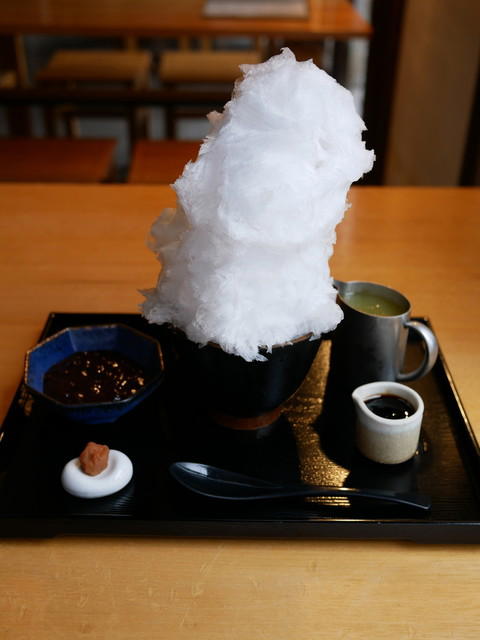
The menu
What to order
- Kakigori (shaved ice)
- Japanese traditional sweets
The approach to Nagatoro’s Hodosan side of town shifts the appetite before a spoon appears: low buildings, station-side foot traffic and the pace of a day-trip town built around river, shrine and mountain. In this setting, kakigori is not a throwaway summer dessert. It is a local format shaped by water, temperature and timing, closer to a regional craft than a café afterthought.
Asami Reizo Houdosandou ten sits inside that Nagatoro tradition, where shaved ice carries more weight than it would in a city sweets counter. The category matters because Japan’s stronger kakigori houses are judged less by novelty than by texture, melt rate and how carefully syrup and Japanese sweets elements are handled. Tabelog’s Sweets EAST 100 selections in 2018 and 2023 place the shop within a narrow, specialist group rather than the broader field of casual dessert stops.
Nagatoro kakigori is a water story before it is a dessert story
Japanese shaved ice has widened in the last decade, especially in urban cafés where elaborate toppings and pastry techniques draw attention. Nagatoro’s version starts from a different premise. The area’s reputation is tied to natural ice and mountain water culture, which gives the category a geographical anchor. That does not mean every bowl should be read as a rustic relic; it means the format rewards restraint, clarity and temperature control more than visual excess.
That sourcing frame explains why a specialist kakigori stop can justify a dedicated detour in Chichibu-gun. The difference between ordinary shaved ice and serious kakigori is often structural rather than decorative: how the ice is shaved, how quickly it softens, how syrup distributes through the mound and whether the final spoonful collapses into sweetness. Those are craft questions, not Instagram questions.
The Houdosandou branch is especially useful for understanding how Nagatoro’s sweets culture works for visitors. It is not a multi-course dining room, and it should not be evaluated like one. It belongs to the same local conversation as Asami Reizo Kanasaki honten, where the competitive set is shaped by kakigori credibility, Japanese sweets café discipline and the day-trip rhythm of Chichibu rather than by conventional restaurant luxury.
A specialist sweets counter in a town built for daytime eating
Chichibu-gun dining has a different tempo from Tokyo’s reservation economy. The stronger experiences often fit around trains, shrine visits, river walks and short daytime windows rather than late tasting-menu sittings. That makes sweets shops unusually important: they become part of the itinerary architecture, not merely a pause between meals.
Within that pattern, Asami Reizo Houdosandou ten is a focused kakigori and Japanese sweets café, with take-out also part of the service format. The room is described as a house-style restaurant with spacious seating, a useful distinction in a category where many high-demand sweets counters can feel compressed. Non-smoking operation and children-welcome status also push it toward the practical end of serious dessert culture: it is credible enough for kakigori followers, but not so formal that the format loses its everyday roots.
The price band sits in the low-thousands yen range, which is important context for Japan. At that level, the value question is not portion size alone; it is whether the shop delivers a specialist version of a deceptively simple craft. Compared with out-of-metro peers such as Takasago Horumon, Lapin Noir and Asobi, the point of difference is category rather than spend. This is not a meat, bakery or general café comparison. It is a narrowly defined sweets stop with award recognition in its own field.
For readers mapping a Chichibu-gun day, the wider editorial frame matters. Restaurants in the area sit beside rural hospitality, local bars, wineries and outdoor experiences rather than inside a dense metropolitan dining grid. Use Our full Chichibu-gun restaurants guide for the food route, then pair it with Our full Chichibu-gun hotels guide, Our full Chichibu-gun bars guide, Our full Chichibu-gun wineries guide and Our full Chichibu-gun experiences guide to understand how the region works beyond one bowl.
How to place it within Japan's sweets map
Tabelog Sweets EAST 100 is the clearest external signal here. It does not turn kakigori into fine dining, and that is precisely the point. Japan’s sweets hierarchy is unusually granular: a shaved-ice specialist, a wagashi counter, a pâtisserie and a dessert café may all compete for attention, but they are not interchangeable. Recognition in the Sweets EAST category says the shop belongs to a regional sweets conversation with defined craft standards.
For travellers building a broader Japan food route, this is the kind of place that sharpens the itinerary by contrast. A sukiyaki-focused stop such as -Grilled beef Sukiyaki- KAMAKURA TANUKIAN 鎌倉 たぬき庵 in Kamakura speaks to another tradition entirely, while Tokyo, Osaka and Kyoto entries such as . 鮪と炭火焼き うお炭 秋葉原店 in Tokyo, .cafe in Osaka and [ki:] in Kyoto show how urban density changes expectations. Nagatoro’s appeal is slower and more specific: a single category, attached to place, with enough recognition to merit attention.
The useful editorial stance is simple. Come for kakigori as a regional craft, not as a generic dessert. The shop’s selections for Tabelog Sweets EAST 100 in two separate years give it a credible reason to be on a Chichibu-gun food map, while the format keeps the experience grounded in daytime travel rather than ceremony.
For contrast across Japan and beyond, EP Club’s restaurant coverage also ranges from.know in Kumamoto, (Shoku) Vietnam in Kawasaki, [Curry Senmon Ten] Maruyama Kyoju. in Sapporo, #肉といえば松田 奈良本店 in Kashihara, 1/3 HAMBURGER FACTORY in Kanazawa and 1000 in Yokohama to Los Angeles and Pasadena references such as Jōdo Saké Bar in Los Angeles and Onigiri Time in Pasadena. Against that spread, Nagatoro’s kakigori scene reads as a reminder that Japan’s serious eating culture is not confined to dinner, counters or capital-city reservations.
Frequently asked questions
What price level is Asami Reizo Houdosandou ten?
Pricing at Asami Reizo Houdosandou ten is listed as JPY 1,000 - JPY 1,999 JPY 1,000 - JPY 1,999 View spending breakdown.
What time does Asami Reizo Houdosandou ten open and close?
Hours at Asami Reizo Houdosandou ten: Mon: 10 AM–4:30 PM; Tue: 10 AM–4:30 PM; Wed: 10 AM–4:30 PM; Thu: Closed; Fri: 10 AM–4:30 PM; Sat: 10 AM–4:30 PM; Sun: 10 AM–4:30 PM.
Where do I go for Asami Reizo Houdosandou ten?
Asami Reizo Houdosandou ten is located in Chichibu-gun.
What is Asami Reizo Houdosandou ten known for?
Asami Reizo Houdosandou ten is primarily known for its core concept and execution in Chichibu-gun.
How It Stacks Up
Comparable venues by cuisine and price in the same metro.
| Venue | Cuisine | Price | Awards | Notes |
|---|---|---|---|---|
| Asami Reizo Houdosandou tenThis venue — the venue you are viewing | Kakigori and Japanese traditional sweets café | $10–20 | Tabelog 100 #34 | Not listed |
| Asami Reizo Kanasaki honten | Japanese Kakigori Cafe | $10–20 | Tabelog 100 #49 | Kanasaki, Minano-machi |
| Chuka Soba Dokoro Konpiraso | Traditional Japanese ramen (chuka soba) | $1–10 | Tabelog 100 #12 | Sanze |
| Gyoza no Fukuho (餃子の福包) | Traditional Japanese Gyoza | $1–10 | Not listed | Shinjuku |
| Syokudoh TANUKI (食堂たぬき) | Traditional Japanese Canteen | Not listed | Not listed | Myoko City |
| 中華そば 速水 | 和歌山ラーメン | Not listed | Not listed | 緑ヶ丘 |
Recognition history
Dated appearances from independent guides and award organizations, with the underlying list record or original source where available.
Tabelog 100 #34 · No. 34
Tabelog · Tabelog 100 - Sweets - EAST - 2023
Continue exploring
More in Chichibu-gun
Restaurants in Chichibu-gun
Browse all →
Hotels in Chichibu-gun
Browse all →
Wineries in Chichibu-gun
Browse all →

Details
- Scenic
- Classic
- Cozy
- Rustic
- Casual Hangout
- Family
- Solo
- After Work
- Standalone
- Street Scene
- A La Carte
- Coffee
- Tea
- Soft Drinks
Current opening hours
- Monday
- 10 AM–4:30 PM
- Tuesday
- 10 AM–4:30 PM
- Wednesday
- 10 AM–4:30 PM
- Thursday
- Closed
- Friday
- 10 AM–4:30 PM
- Saturday
- 10 AM–4:30 PM
- Sunday
- 10 AM–4:30 PM
Hours can change for holidays and private events. Last verified .
Casual and relaxed, with spacious, non-smoking seating and some outdoor tables that let guests enjoy kakigori and traditional sweets in a laid‑back small‑town setting near Mt. Hodo.