.png)
Argan holds back-to-back Michelin Bib Gourmand recognition (2024 and 2025) for its Moroccan menu on the pedestrianised fringe of Souq Waqif. Tagine and couscous anchor the kitchen, with careful spicing carrying the cooking from lunch through the evening. The setting inside Al Jasra Boutique Hotel adds a plush finish to a meal that prices well below Doha's hotel dining norm.
 Discover on Pearl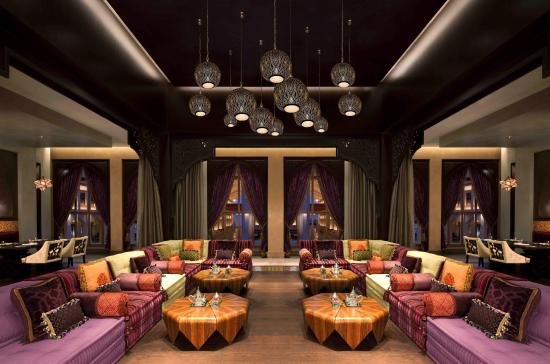
Where Souq Waqif Meets North Africa
The pedestrianised stretch of Al Jasra Street that skirts the edge of Souq Waqif is one of Doha's more layered dining corridors. The souq itself draws tourists and residents alike for its traditional market atmosphere, but the restaurants operating on its fringes tend to offer sharper value and more specific culinary identities than the main thoroughfares inside. Argan occupies that pocket with a focused Moroccan menu, sitting within the Al Jasra Boutique Hotel at a price point that reads as deliberately accessible against the wider Doha dining spectrum.
For context, Doha's restaurant scene spans an unusually wide range in a compact geography. At one end, IDAM by Alain Ducasse operates at the leading of the luxury bracket with a Michelin star and pricing to match. Alba and comparable hotel-dining rooms sit in the ﷼﷼﷼﷼ tier. Argan, rated at a single ﷼ and recognised by Michelin as Bib Gourmand in both 2024 and 2025, represents a different proposition entirely: food that meets an editorial quality threshold at a price that requires no special occasion to justify.
The shortlist, unlocked.
Hard-to-book tables, cellar releases, and concierge-planned trips.
Get Exclusive Access →The Moroccan Grill Tradition in a Gulf Context
Moroccan cuisine travels well, in part because its structural logic, spiced braises, charcoal-grilled meats, and slow-cooked tagines, maps onto the Gulf's own appetite for aromatic cooking. The technique that distinguishes serious Moroccan kitchens from generic North African menus is the handling of spice: ras el hanout, preserved lemon, saffron, and cumin don't function as background notes but as the architecture of a dish. The same principle applies to grilled meats, where the marinade work done hours before the coal is lit determines whether the result tastes built or assembled.
In cities with established Moroccan dining scenes, such as Paris, where restaurants like Mansouria and Le Sirocco have defined benchmarks, or in San Francisco, where Aziza has operated within a fine-dining frame, the cuisine is read through its regional depth. In Doha, that depth is rarer. Most of the city's high-profile restaurants pull from European, Japanese, or pan-Asian traditions. Moroccan cooking occupies a smaller, more specialised tier, which is part of why Argan's Bib Gourmand recognition carries weight beyond its price point.
Tagine, Couscous, and the Case for Restraint
Argan's kitchen anchors itself around tagine and couscous, the two formats that most consistently reveal a Moroccan cook's priorities. A tagine is a slow-cooking vessel that concentrates liquid and fat around the main protein, and what separates a considered version from a routine one is patience and spice calibration. The sealed conical lid creates a self-basting environment; the cook's job is to build the right base before the lid goes on. Couscous, meanwhile, is often underestimated as a vehicle, but properly steamed and separated grain absorbs broth and sauce in a way that changes the dish's register entirely from couscous that has merely been rehydrated.
The Michelin Bib Gourmand designation, awarded for good cooking at a moderate price, signals that Argan's versions of these dishes pass a quality test that evaluators apply consistently across cities. The back-to-back awards in 2024 and 2025 suggest the kitchen has maintained that standard rather than delivering a single strong year. Chef Daniel Asher leads the kitchen, and while the Moroccan canon here is the story rather than any individual's biography, that consistency across two award cycles is a credible operational signal.
The menu extends into desserts, with jawhara among the options on offer. Jawhara is a Moroccan pastry preparation built around crisp layers, cream, and orange blossom or rose water aromatics, and its presence on a menu that also carries careful mocktail and mint tea options suggests the kitchen is thinking about the full arc of a meal rather than front-loading effort into the mains.
The Setting: Al Jasra Boutique Hotel
Boutique hotel restaurants in Doha occupy an interesting position. The city's larger hotel-dining operations, attached to international chains, tend to aim at a different scale of production and pricing. A smaller property like Al Jasra Boutique Hotel creates conditions where a restaurant can operate with more specificity and less pressure to satisfy a generic, globally-distributed palate. The plush lounge that anchors the hotel's ground floor, where guests can close a meal with mint tea, functions as an extension of the dining experience rather than a separate hospitality zone.
The address on Al Jasra Street, a pedestrianised stretch on the edge of Souq Waqif, places the restaurant in one of Doha's more characterful neighbourhoods. The souq area has developed as a hub for local retailers and food outlets, and while it draws significant tourist traffic, the streets on its margins retain a more everyday quality. Arriving on foot from the souq side gives a sense of transition: from the busier market environment into a quieter hospitality corridor.
For those building a broader Doha itinerary, the area connects naturally to other dining options across different cuisines and price points. Baron and Bayt Sharq cover Middle Eastern territory at different registers, and Dar Yema offers another reference point for North African cooking in the city. EP Club's full Doha restaurants guide maps the wider scene, with companion guides covering hotels, bars, wineries, and experiences.
For readers interested in how Moroccan kitchens perform at different price levels and in different diaspora contexts, Kous Kous in Valle de Guadalupe represents an interesting counterpoint, operating within a wine-country framework rather than an urban one. And for reference on what Michelin-level recognition looks like across other categories in different cities, Le Bernardin in New York and Atomix illustrate what sustained award recognition demands at the starred tier, while Lazy Bear in San Francisco and Emeril's in New Orleans show how strong culinary identities hold across different American contexts.
Planning Your Visit
Argan is located at Al Jasra Street, Doha, within the Al Jasra Boutique Hotel on the pedestrianised edge of Souq Waqif. The single ﷼ price tier makes it one of the more accessible entry points for Michelin-recognised cooking in Doha. The Google rating of 4.2 across 369 reviews provides a further consistency signal across a broad sample of visits. No phone or booking URL is listed in the current record; approaching via the hotel directly or arriving in person during service hours is the practical path. Mint tea in the hotel lounge at the end of a meal is noted in the Michelin description as a worthwhile finish to the visit.
What People Recommend at Argan
The Michelin guide and visitor consensus both point to tagine and couscous as the kitchen's strongest territory, with the careful spicing across both dishes cited as the differentiator. Jawhara and the mocktail selection are noted for dessert and drinks, and the mint tea service in the hotel lounge is frequently flagged as a way to extend the meal into a more relaxed register. Chef Daniel Asher's back-to-back Bib Gourmand recognition in 2024 and 2025 confirms the kitchen has maintained its standard across consecutive evaluation cycles rather than peaking in a single year.
Al Jasra St, Doha, Qatar
+974 7047 3687
A Pricing-First Comparison
A quick comparison pulled from similar venues we track in the same category.
Need a table?
Our members enjoy priority alerts and concierge-led booking support for the world's most difficult tables.
Get Exclusive AccessThe shortlist, unlocked.
Hard-to-book tables, cellar releases, and concierge-planned trips.
Get Exclusive Access →