Amorini
Our verdict
On Place Ducale, one of northern France's most architecturally coherent squares, Amorini occupies a setting that few restaurants in the Ardennes region can match. The address alone positions it within Charleville-Mézières' compact dining scene, where Italian-inflected cooking and local French traditions share the same menus and the same tables. For visitors exploring the region beyond Reims, it represents a calibrated stop.

Pearl is the En Primeur Club membership app, where members save venues, book tables and use the concierge.
The menu
What to order
- Pasta in cuttlefish ink with scallops and candied carrots
- Pistachio pie with figs
- Ravioli
- Agnoloni
- Spaghetti
Place Ducale and the Weight of a Square
There are piazzas in France that function as genuine civic centres rather than tourist backdrops, and Place Ducale in Charleville-Mézières is among them. Designed in the early seventeenth century by Clément Métezeau, the square predates Paris's Place des Vosges by only a few years and shares its architect's hand, giving it a compositional rigour that most provincial French towns never achieved. The arcaded galleries, the uniform roofline, the warm pink and cream stonework: together they create an enclosure that feels deliberate, protected from the surrounding streets. A table here is not simply a meal with a view. It is a meal inside a piece of urban history that the city has, largely, left intact.
Amorini sits at 46 Place Ducale, directly within that architectural frame. In a city of roughly 50,000 people that most international travellers know primarily as the birthplace of Arthur Rimbaud, a restaurant on this square carries a particular gravitational pull. The address functions as a signal before any dish arrives: this is the centre, the considered choice, the place where Charleville presents itself.
Italian Roots in a French Provincial Context
The name Amorini, drawn from the Italian for the small winged figures that populate Baroque decoration, places the restaurant in a tradition that has moved across European dining for centuries. Italian-inflected cooking in northern France occupies an interesting position. The Ardennes sits closer to Belgium and Luxembourg than to the Mediterranean, and the culinary default of the region leans toward hearty, produce-led French cooking: game from the forest, river fish, charcuterie from local producers. Italian influences here are not absorbed through geography the way they are in Nice or Lyon. They arrive as a deliberate curatorial decision.
That tension between Italian culinary vocabulary and northern French raw materials is where restaurants of this type find their most interesting work. Pasta made from local eggs, preparations that reference the simplicity of Italian regional cooking but land in a context shaped by Ardennes agriculture: these are the productive collisions that distinguish a thoughtful kitchen from one simply borrowing a foreign name. Across France, this kind of cross-referencing has become increasingly common at the mid-market and upper-casual tier, from brasseries in Lyon to bistros in Bordeaux. Whether Amorini executes at the higher end of that range is a question the kitchen answers service by service. The address sets reasonable expectations that the cooking should meet.
For broader reference points on what French regional dining can achieve when it commits fully to its place, the contrast with destination restaurants elsewhere in the country is instructive. Auberge de l'Ill in Illhaeusern in Alsace, or Bras in Laguiole in the Aubrac, represent the ceiling of what regional anchoring can produce over decades of consistency. Closer geographically, Assiette Champenoise in Reims and Au Crocodile in Strasbourg illustrate the northeastern French tradition at its most formally ambitious. Amorini operates in a different register, as a neighbourhood-scaled address rather than a destination project, but the regional context matters when calibrating expectations.
Charleville-Mézières as a Dining City
Charleville-Mézières does not appear on most short-lists of French culinary destinations, and that absence reflects a structural reality rather than a failure of quality. The city's dining scene is compact, driven largely by a local professional and residential clientele, and lacks the critical mass of tourism that sustains a stratified restaurant market in cities like Strasbourg or Lyon. What that produces, in practice, is a set of restaurants that need to work for their community first and for visitors second. That ordering tends to produce honest, consistent cooking rather than the occasionally overreaching ambition of tourist-dependent addresses.
Within that local scene, Amorini occupies a position on Charleville's most prominent public space, which implicitly places it in competition with the handful of other serious addresses the city supports. Carmen, La Table d'Arthur, and Le 10 form the core of the city's mid-to-upper dining tier. Each brings a different format and emphasis; our full Charleville Mézières restaurants guide maps the distinctions across the scene. Amorini's Italian identity differentiates it clearly within that small competitive set, offering a vocabulary that the others do not.
Visitors arriving from Paris, which sits roughly two and a half hours to the southwest by road, or from the major tables of the broader region, will find the pace and scale of Charleville's dining distinctly different from the capital's density. That is not a drawback. The city's restaurants operate without the institutional pressure of a heavily reviewed market, which can produce a quality of attention at the table that crowded urban dining rarely sustains. For those accustomed to the ambition of addresses like Alléno Paris au Pavillon Ledoyen in Paris or Mirazur in Menton, Amorini belongs to a fundamentally different category: the well-considered local address, not the destination project.
Planning Your Visit
Place Ducale is walkable from most points within the city centre and functions as a natural anchor for an evening in Charleville. The square itself is worth time before and after a meal, particularly in the late afternoon when the light catches the stone arcades at a low angle. Reservations for restaurants on or near the square tend to fill on weekends, and Charleville's dining options are limited enough that leaving a booking to chance is unnecessary risk. Contact details and current hours are best confirmed directly via a local search or through the address at 46 Place Ducale, as operational specifics can shift seasonally. The surrounding region rewards at least a day or two: the Ardennes forest, the Meuse valley, and the Rimbaud Museum are all within the city or a short drive from it.
Frequently asked questions
Is Amorini good for families?
Charleville-Mézières runs on a local clientele rather than a tourist trade, which tends to produce restaurants comfortable with mixed-age groups. Place Ducale itself, directly outside, gives children room to move between courses. The Italian-inflected name suggests a register that sits closer to trattoria than formal dining room, which typically means a relaxed approach to families.
Is Amorini formal or casual?
An address on Place Ducale carries more occasion than a back-street bistro, it is one of the most architecturally considered squares in northern France. That said, Charleville-Mézières does not operate with Parisian dress-code expectations, and a restaurant drawing its name from Italian Baroque decoration suggests a tone that is convivial rather than stiff. Dress for the occasion of the square, not for a starred room.
What makes dining at Amorini on Place Ducale different from other restaurants in the Ardennes?
Place Ducale is one of the most architecturally unified public squares in northern France, designed by the same hand responsible for Paris's Place des Vosges, eating here puts a meal inside a genuinely historic urban set-piece rather than a conventional high street. Few restaurants in the Ardennes region hold an address with that kind of spatial authority. Amorini's Italian-inflected name adds a cultural counterpoint to its thoroughly French provincial setting.
What's the signature dish at Amorini?
Contacting the restaurant directly before visiting is the practical approach.
Where is Amorini located?
Amorini is located at 46 Pl. Ducale, 08000 Charleville-Mézières, France, Charleville Mezieres.
How hard is it to get a table at Amorini?
Charleville-Mézières does not carry the booking pressure of Paris or Lyon, and the city's restaurants are not known for multi-month waitlists. Weekends in summer may require more lead time given that Place Ducale sees increased foot traffic during the city's festival calendar. A call ahead is sensible; months-in-advance planning is not.
What do critics highlight about Amorini?
Charleville-Mézières sits outside the circuits that generate regular food-press attention, which means restaurants here are evaluated primarily by a returning local clientele rather than by guidebook panels. That context is as much a structural fact about the Ardennes dining scene as it is a statement about any individual venue.
Pricing, Compared
Comparable venues nearby, for context on price, style, and recognition.
| Venue | Cuisine | Price | Awards | Notes |
|---|---|---|---|---|
| AmoriniThis venue (the venue you are viewing) | Traditional Italian Trattoria | $20–30 | Not listed | Not listed |
| Carmen | Contemporary Neapolitan Pizza | $20–30 | Not listed | Place De L’hotel De Ville, Contemporary Neapolitan Pizza |
| Le 10 | Traditional French Bistro | Not listed | Not listed | centre, Traditional French Bistro |
| La Table d'Arthur | French Bistronomy with Ardennes Terroir | $20–30 | Not listed | centre-ville, French Bistronomy with Ardennes Terroir |
| Fimmina - Pizzeria Paris 9 | Artisanal Italian Pizzeria & Wine Bar | $30–50 | 50 Top Pizza Europe #42 · Gambero Rosso 2 Spicchi | 9th arrondissement, Artisanal Italian Pizzeria & Wine Bar |
| Les Artistes Gourmands | Italian Pizza & Pasta | $20–30 | Not listed | 11e Arr. – Popincourt, Italian Pizza & Pasta |
Continue exploring
More in Charleville Mezieres
Restaurants in Charleville Mezieres
All restaurants in Charleville Mezieres →
Hotels in Charleville Mezieres
Browse all →
Wineries in Charleville Mezieres
Browse all →
Details
- Classic
- Cozy
- Intimate
- Family
- Casual Hangout
- Group Dining
- Standalone
- Local Sourcing
- Street Scene
- A La Carte
- Italian Wine
- Vegetarian Friendly
Current opening hours
- Monday
- Closed
- Tuesday
- 12–2 PM
- Wednesday
- 12–2 PM
- Thursday
- 12–2 PM
- Friday
- 12–2 PM
- Saturday
- 12–2 PM
- Sunday
- Closed
Hours can change for holidays and private events. Hours as of .
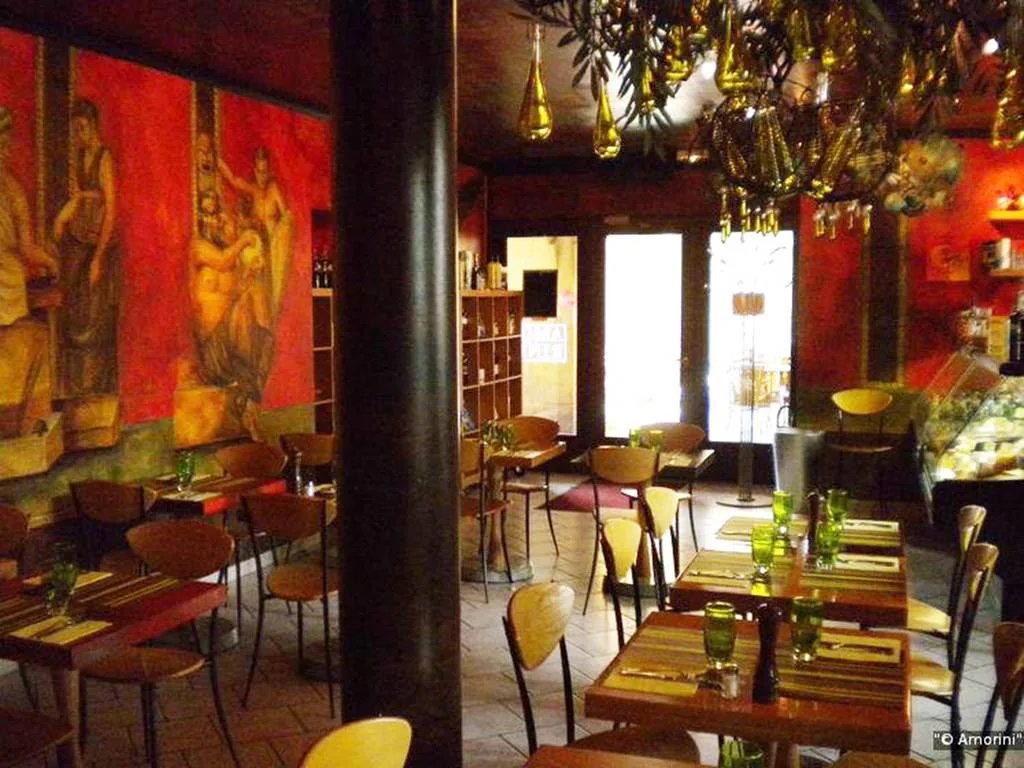
Warm and intimate dining room decorated with reproductions of frescoes from the Villa of the Mysteries in Pompeii, creating an authentic Italian aesthetic.