64 Goodge Street




Sister to Michelin-starred Portland and Clipstone, 64 Goodge Street is a French bistro operating in the compact, ingredient-led register that defines Fitzrovia's smarter dining rooms. British Racing Green walls, candlelit tables, and a semi-open kitchen set the tone for classical French cooking that leans on bold, gutsy combinations without losing its grip on technique. The wine list's 'Cellar List' tier is among the more carefully assembled in the neighbourhood.
Pearl is the En Primeur Club membership app — saves, bookings, and concierge access live there. Same editors, same standards.
- Address
- 64 Goodge St, London W1T 4NF, United Kingdom
- Phone
- +44 20 3747 6364
- Website
- 64goodgestreet.co.uk
- Directions
- Get directions
 Saves & bookings on Pearl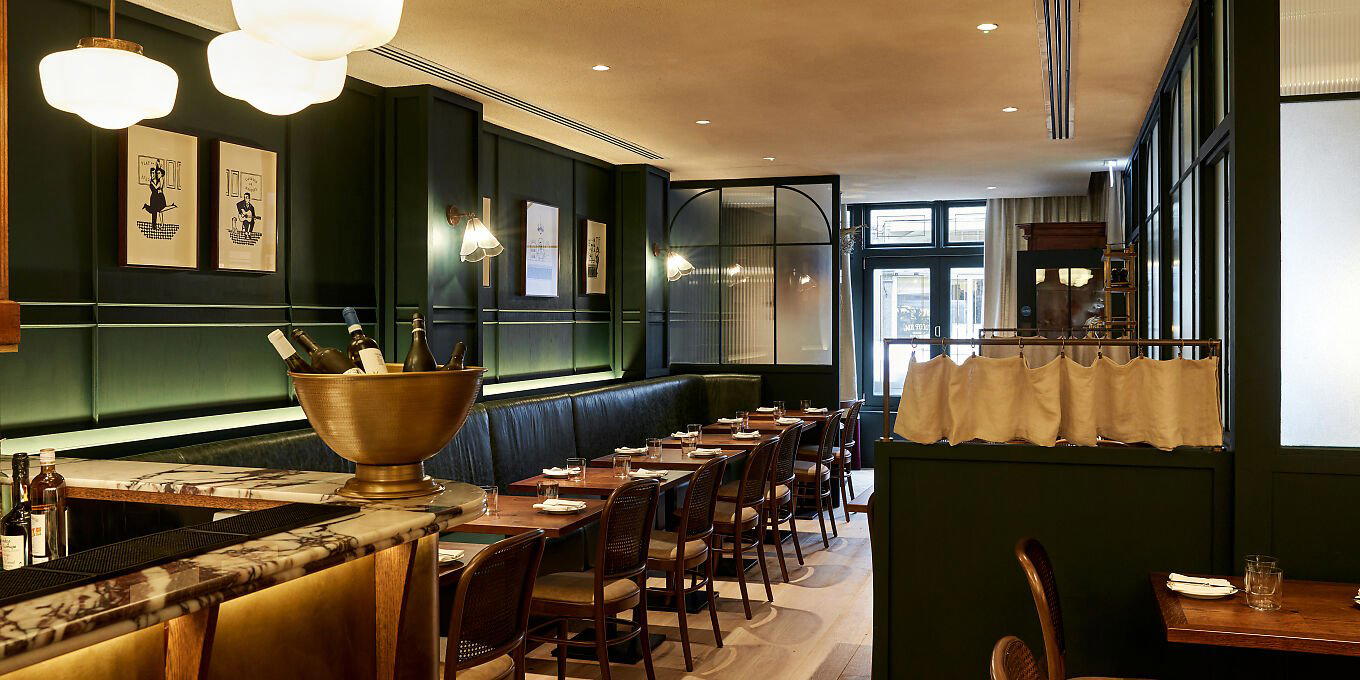
Fitzrovia's French Counter-Argument
Fitzrovia has accumulated a particular kind of smart, mid-range restaurant over the past decade: places with stripped-back interiors, good natural wine lists, and menus that signal seasonal awareness without necessarily delivering on it. Against that backdrop, the style of French cooking practised at 64 Goodge Street reads as a considered position. This is not the modernist reworking of French technique that you find at higher-ticket addresses like Pétrus by Gordon Ramsay or the theatrical formats of Galvin La Chapelle. It is classical French cooking applied with discipline and served without ceremony in a room that makes no attempt to intimidate.
The address sits in the same ownership group as Portland, a short walk away, and Clipstone, on the same street. That sibling relationship matters. The group has a clear point of view about ingredients and about how a dining room should feel, and 64 Goodge Street expresses both at a price point that brings Michelin-standard sourcing within range of a mid-week dinner rather than a special-occasion budget. The restaurant holds a Michelin star, which positions it inside a small cohort of London bistros where the food is serious but the format stays accessible.
The Room and What It Says
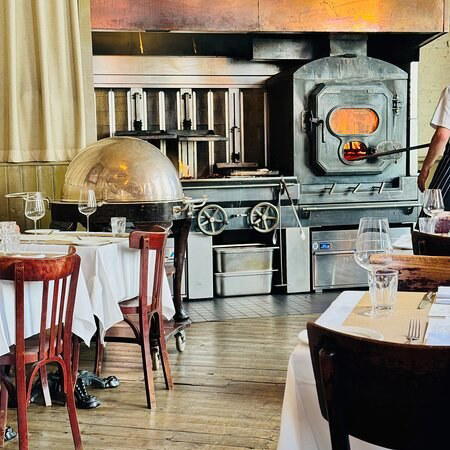
British Racing Green walls, polished wood surfaces, wicker chairs, and candle-lit tables produce an interior that references the classic Paris bistro without replicating it slavishly. The semi-open kitchen at one end of the room adds a degree of energy, the kind of low-level theatre that comes from watching a small brigade working at close range rather than from any designed spectacle. Tables are close-packed in the way that good French restaurants tend to be, which means the room fills quickly and the ambient noise rises to a working hum by mid-service.
That density is not accidental. The bistro format, as a category, depends on a specific ratio of covers to kitchen output: enough volume to keep the cooking moving, not so many that the sourcing philosophy gets diluted by volume pressure. At 64 Goodge Street, the room size enforces a discipline that keeps the menu focused. This is one reason why ingredient sourcing, rather than technical pyrotechnics, becomes the primary signal of quality here.
Ingredient Sourcing as the Editorial Logic
In French cooking at this level, the sourcing decisions are the argument. A soupe au pistou made with dried beans and stock powder and one made with poached fresh coco beans, tiny brunoise of carrot and courgette, bites of green bean, and super-fine noodles finished with intense basil pistou are technically the same dish. What separates them is the resolution of the sourcing: the freshness of the legumes, the cut of the vegetables, the concentration of the herb paste. The kitchen here appears to understand that distinction, producing versions of French standards where the ingredient quality is the point rather than a background assumption.
The same logic applies to fish. A fillet of sea bass on spinach with mussels in a saffron-scented sauce built from the mussel liquor is a dish that has appeared on French menus in some form for generations. Its quality depends almost entirely on the fish arriving at the right stage and the mussels carrying enough salinity and flavour to make the sauce worth building. When those conditions are met, it performs. When the game season arrives, roast partridge appears alongside boudin blanc, quince, and parsley roots, a combination that tracks classical French autumn cooking without straying into the over-complicated territory that can make game dishes feel laborious.
The truffade, ordered as a side, is worth noting separately. It functions as a baconed-up dauphinoise with a breadcrumb topping, the kind of dish that exists in peasant French cooking and rarely appears on London menus at any price point. Its presence suggests a kitchen that reads the French canon more widely than the standard bistro repertoire.
On the dessert end, a greengage Tatin and a Paris-Brest described in Michelin's notes as textbook both require sourcing decisions that precede technique. A Tatin depends on the fruit. A Paris-Brest depends on the praline and the quality of the choux. A tarte au citron with bergamot Chantilly adds an aromatic dimension to a classical format. These are not difficult dishes to understand; they are difficult dishes to execute consistently at the level where sourcing and technique align. That alignment is what the Michelin recognition reflects.
The Wine List and Its Architecture
The wine programme at 64 Goodge Street operates on a two-tier structure. The main list is selected with a clear eye on quality-to-price ratio, with glasses beginning at £8 and a range that covers French regions with appropriate depth given the kitchen's orientation. The 'Cellar List' is a separate tier of bottles assembled for the more committed wine drinker, carrying what the Michelin guide describes as real treasures. This kind of cellar-list structure appears at independent restaurants with genuine wine ambition, where the owner or buyer has been accumulating stock over time rather than ordering from a distributor's standard range. For a French bistro at the £££ price point, having a functioning cellar list is a differentiator worth taking seriously.
Compared to the wine-focused environments you find at Chez Bruce or at similarly credentialled regional addresses like Hand and Flowers in Marlow, the restaurant list operates in a more modest register overall, but the cellar tier closes that gap for diners who want to drink well against classical French food without paying for the room of a destination restaurant.
Where It Sits in the London French Dining Map
London's French restaurant category has split considerably over the past twenty years. At the leading end, addresses like Le Gavroche established a formal Franco-British fine dining register that younger chefs have largely moved away from. The current generation of French-influenced cooking in London tends to appear either at high price points with tasting menu formats, or at neighbourhood bistro level where the French label functions more as a marketing shorthand than a specific technical commitment.
The restaurant occupies a narrow middle position: a proper bistro format with a genuine technical commitment to classical French cooking, a Michelin star, and a price point that sits below the tasting-menu tier. That position is not crowded in London. For context, the comparison set in the city for French cooking at four-pound-sign price points includes places like Galvin La Chapelle and Pétrus by Gordon Ramsay, neither of which operates in the bistro register. Internationally, the classical French bistro tradition produces cooking at the level of Hotel de Ville Crissier in Switzerland and informs the approach of French-trained kitchens elsewhere, including Sézanne in Tokyo. At the restaurant, the same tradition is being applied in a format and at a price that makes it a practical rather than aspirational choice for a London dinner.
Planning Your Visit
The restaurant is located at 64 Goodge St, London W1T 4NF, in Fitzrovia, within walking distance of Goodge Street Underground station. The restaurant operates Tuesday through Saturday with lunch sittings from 12pm to 2:15pm and dinner from 6pm to 10pm, and adds a Monday service on the same schedule. It is closed on Sundays. The price range sits at £££, meaning a dinner with wine sits materially below what the formal French tier in London commands without making the kind of sourcing compromises that undercut the experience.
Reputation Context
Comparable venues nearby, for context on price, style, and recognition.
| Venue | Cuisine | Price | Awards | Notes |
|---|---|---|---|---|
| 64 Goodge StreetThis venue — the venue you are viewing | Classical French Bistro | $$$ | Michelin 1 Star | Not listed |
| Caractère | Modern French-Italian Fine Dining | $$$$ | Michelin 1 Star | Notting Hill |
| Pétrus by Gordon Ramsay | Modern French Fine Dining | $$$$ | Michelin 1 Star | Belgravia |
| Cornus | Modern French Fine Dining | $$$$ | Michelin 1 Star | Belgravia |
| Wild Honey St James | Brasserie | $$$ | Michelin 1 Star | St. James's |
| Chez Bruce | Modern French Brasserie | $$$$ | Michelin 1 Star | Balham |
Recognition history
Dated appearances from independent guides and award organizations, with the underlying list record or original source where available.
Michelin 1 Star
Michelin
Opinionated About Dining Top New Restaurants in Europe Ranked #24
Opinionated About Dining
Opinionated About Dining Top Restaurants in Europe Recommended
Opinionated About Dining
Opinionated About Dining Newly Added European Restaurants
Opinionated About Dining
Star Wine List
Star Wine List
Michelin 1 Star
Michelin
The Good Food Guide GFG Very Good
The Good Food Guide
Michelin 1 Star
Michelin
Continue exploring
More in London
Restaurants in London
Browse all →
Bars in London
Browse all →
Hotels in London
Browse all →

At a Glance
- Cozy
- Elegant
- Intimate
- Sophisticated
- Date Night
- Business Dinner
- Special Occasion
- Open Kitchen
- Private Dining
- Extensive Wine List
Current opening hours
- Monday
- 12–2:15 PM, 6–10 PM
- Tuesday
- 12–2:15 PM, 6–10 PM
- Wednesday
- 12–2:15 PM, 6–10 PM
- Thursday
- 12–2:15 PM, 6–10 PM
- Friday
- 12–2:15 PM, 6–10 PM
- Saturday
- 12–2:15 PM, 6–10 PM
- Sunday
- Closed
Hours can change for holidays and private events. Last verified .
Cozy and elegant with warm wood paneling, deep blue walls, minimalist aesthetic, mellow amber lamps, and a relaxed yet sophisticated atmosphere.