Volcano Village Estates
Volcano Village Estates sits on Hale Ohia Road in the rain-forest village of Volcano, Hawaii, where the surrounding Hawaii Volcanoes National Park sets the architectural and atmospheric terms for everything inside. The property occupies a distinct niche among Big Island accommodations: intimate, forest-embedded, and oriented toward guests who arrive specifically for the geological and ecological character of the place rather than coastal resort amenities.

Pearl is the En Primeur Club membership app, where members save venues, book tables and use the concierge.
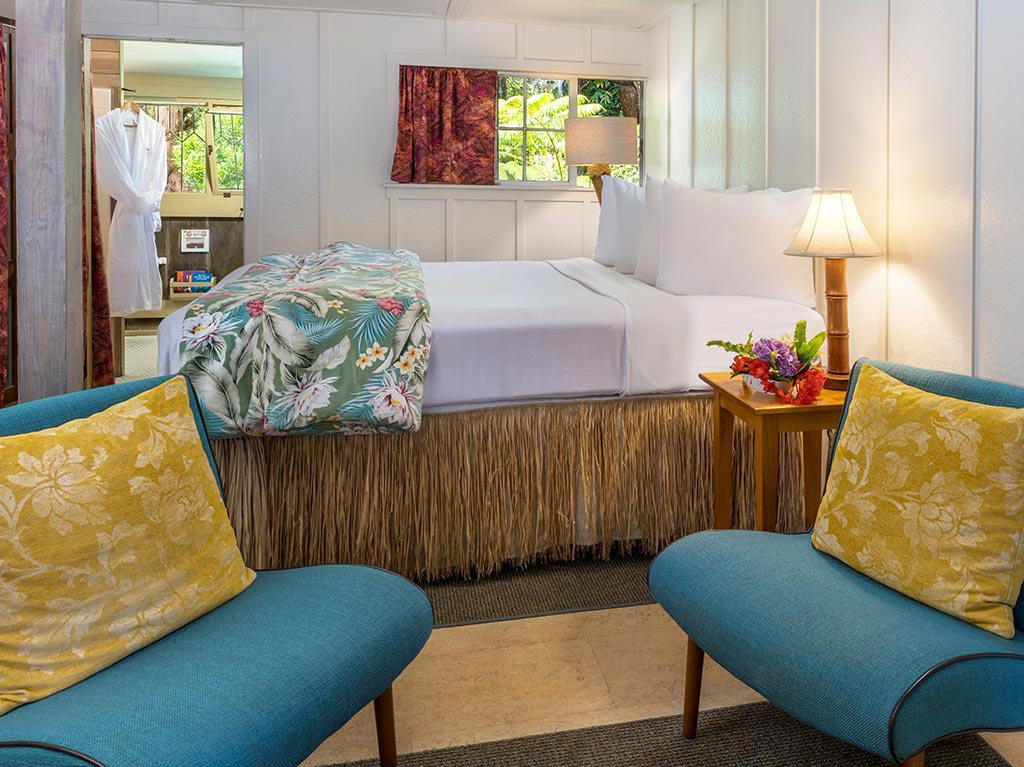
Where the Rain Forest Sets the Terms
There is a particular category of accommodation that only makes sense in a specific place, where the surrounding environment is so dominant that the building must answer to it rather than the other way around. The village of Volcano, Hawaii, sits at roughly 3,700 feet elevation on the slopes of Kilauea, wrapped in native ohia-lehua forest and subject to the cool, mist-heavy climate that distinguishes this part of the Big Island from the beach resorts forty minutes west. Properties in this micro-region do not compete with Kona Village, A Rosewood Resort in Kailua Kona or any coastal equivalent. They occupy a different category entirely, one where proximity to Hawaii Volcanoes National Park, forest density, and architectural integration with the land are the primary credentials.
Volcano Village Estates, addressed on Hale Ohia Road, sits inside that category. The address itself carries weight: Hale Ohia Road runs through one of the most botanically intact corridors of the village, where tree ferns reach overhead and the light arrives filtered and green. Arriving here is a physical adjustment. The air temperature drops, the sound changes, and the visual register shifts to something closer to a Pacific Northwest old-growth forest than the Hawaii most visitors picture.
Design in Dialogue with the Forest
Accommodation architecture in Volcano has historically followed one of two paths: properties that import continental resort conventions and apply them awkwardly to a rain-forest site, or properties that take their material and formal cues from the forest itself. The latter approach produces buildings that read as extensions of the landscape rather than impositions on it, using local timber, covered lanai structures that manage the frequent rain without enclosing the outdoor experience, and a scale that keeps individual structures small relative to the tree canopy.
This design discipline is not merely aesthetic. At this elevation and in this climate, a property that ignores the environment becomes functionally uncomfortable. Buildings that open toward the forest rather than sealing against it, that use covered outdoor space as primary living area rather than afterthought, and that situate guest quarters within the tree line rather than clearing it, are making practical architectural decisions as much as atmospheric ones. The result, when executed well, is a sense that the accommodation was grown rather than built, a quality that separates the stronger Volcano-area properties from the weaker ones regardless of price point.
For guests arriving from properties like Post Ranch Inn in Big Sur or Amangiri in Canyon Point, where landscape-responsive design is the central organizing principle, this approach will read as familiar, if expressed through a distinctly Hawaiian material vocabulary. For guests coming from more conventional hotel backgrounds, the forest-immersive experience requires a recalibration of expectations: privacy here is defined by vegetation rather than walls, and silence is punctuated by rain on broad leaves and the calls of native birds rather than managed ambient sound.
The Volcano Village Context
Understanding what Volcano Village Estates offers requires understanding what Volcano itself is. This is not a resort town. It is a small, working community of artists, scientists, and long-term residents drawn by the national park and the unusual ecology of the area. The dining and hospitality infrastructure reflects this: a handful of independent restaurants, a farmers market, and a small number of accommodation properties that serve a guest profile oriented toward the park rather than toward conventional leisure tourism.
Hawaii Volcanoes National Park, the reason most visitors come to this elevation at all, has no admission fee equivalent in the American park system for geological drama. Active volcanic features, lava tubes, and a caldera visible at night as a glow from the park's observation points represent a category of experience that coastal Hawaii cannot replicate. Properties in Volcano Village serve as base camps for that experience, and their value is largely a function of how well they position guests to access it. Driving to the park entrance from Hale Ohia Road takes minutes rather than the forty-plus minutes required from coastal hotels. That proximity is the core logistical argument for staying in the village rather than at a resort on the Kohala Coast, regardless of what those coastal resorts offer in terms of amenities. For comparison, travelers weighing resort amenities against park access might also consider how properties like Ambiente, A Landscape Hotel in Sedona solve a similar tension between landscape immersion and resort comfort in a different American context.
For guests who want both the national park experience and the full resort infrastructure of the Big Island, the standard approach is to split time between a coastal property, such as Kona Village, A Rosewood Resort in Kailua Kona, and a Volcano Village property for one or two nights specifically oriented around the park visit. This two-base itinerary has become a recognizable pattern among repeat Big Island visitors.
Across the American accommodation spectrum, a defined category of forest-embedded, low-key, landscape-first properties has grown in prominence over the past decade. Blackberry Farm in Walland positions itself against the Tennessee foothills. Troutbeck in Amenia sits within the Hudson Valley's rural accommodation tradition. Sage Lodge in Pray anchors to the Paradise Valley in Montana. What these properties share is an understanding that the surrounding natural environment is the primary amenity, and that architecture and programming should amplify rather than compete with it.
Volcano Village Estates operates in that same register, with the additional specificity of a geologically active landscape and a Pacific rain-forest ecology that has no mainland equivalent. The guest profile that responds to SingleThread Farm Inn in Healdsburg's precision or Alpine Falls Ranch in Superior's Montana scale will find a different but related sensibility here: intimate scale, environmental specificity, and an experience calibrated for guests who treat the natural surroundings as the destination rather than the backdrop.
Planning a Stay
Volcano Village sits approximately 30 miles from Hilo International Airport, the closest commercial airport, making the drive a manageable entry point for guests flying into the eastern side of the island. Rental cars are effectively required for a Volcano stay, as public transportation connections to the park and the village are limited. The village itself has a small restaurant scene concentrated on a short stretch of Old Volcano Road, and guests should arrive with meal plans that account for limited late-night options. The cooler, wetter climate at this elevation means packing for temperatures significantly below the 80-plus degrees of the coast, with layers and rain gear standard equipment even in summer months. Our full Volcano restaurants guide covers the dining options worth planning around.
Booking practices in the Volcano Village accommodation market tend toward direct contact or third-party platforms rather than the automated reservation systems of larger hotel groups. Lead times vary by season, with the driest months of summer and the winter holiday period seeing higher demand from both mainland visitors and inter-island travelers. Travelers comparing this type of property to urban luxury alternatives, such as The Fifth Avenue Hotel in New York City, Raffles Boston in Boston, or Aman New York in New York City, should approach the experience as a different category of travel altogether: the value proposition here is access to a specific landscape and its associated national park, not service infrastructure or urban programming.
Quick Comparison
| Venue | Price | Awards |
|---|---|---|
| Volcano Village EstatesThis venue (the venue you are viewing) | $200–300 | Not listed |
| Aman New York | Not listed | 3 Michelin Keys · World's 50 Best #87 |
| Amangiri | $1,000–1,500 | 3 Michelin Keys · World's 50 Best #45 |
| Hotel Bel-Air | $750–1,000 | 3 Michelin Keys · World's 50 Best #57 |
| The Beverly Hills Hotel | Not listed | 3 Michelin Keys · World's 50 Best #65 |
| The Carlyle, A Rosewood Hotel | $1,500–2,500 | 2 Michelin Keys · World's 50 Best #64 |
Continue exploring
More in Volcano
Hotels in Volcano
All hotels in Volcano →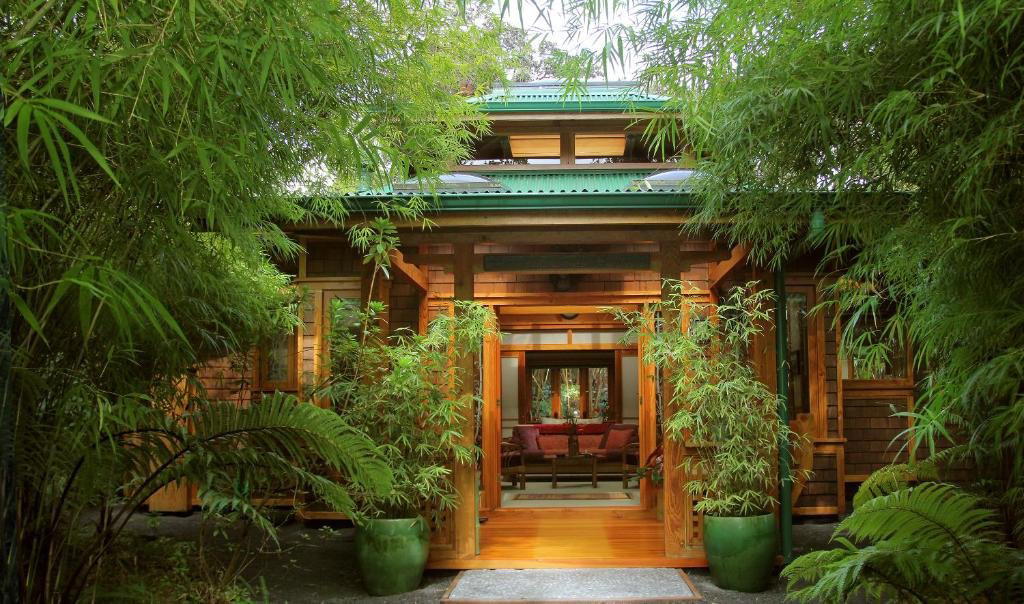
Bars in Volcano
Browse all →
Details
- Romantic
- Quiet
- Scenic
- Intimate
- Cozy
- Classic
- Romantic Getaway
- Honeymoon
- Family Vacation
- Weekend Escape
- Historic Building
- Garden
- Terrace
- Wi Fi
- Spa
- Garden
- Garden
- Mountain
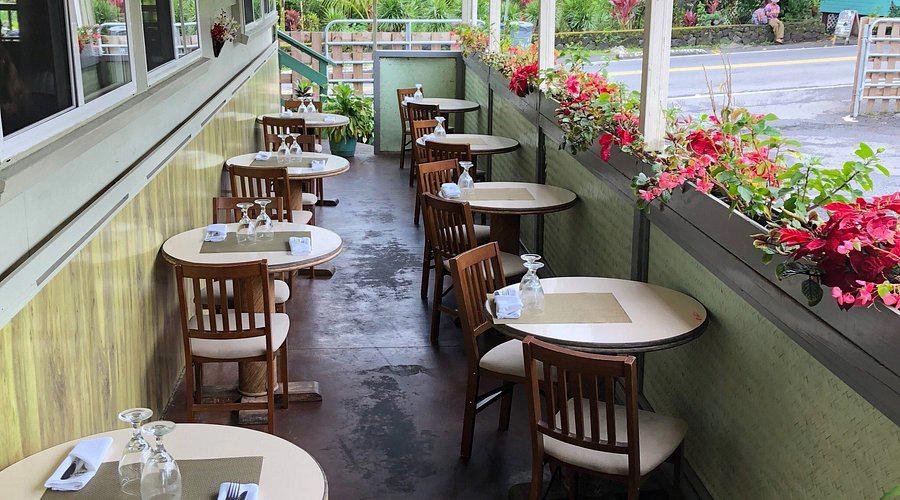
Serene rainforest setting with manicured grounds, warm hospitality, and a blend of historic charm and contemporary comfort; guests praise the helpful staff and tranquil garden atmosphere.