Volcano Rainforest Retreat
Volcano Rainforest Retreat sits at the edge of Hawaii Volcanoes National Park on the Big Island, where the architecture works with the surrounding ohia forest rather than against it. Cottages built into the fern-covered terrain offer a quieter counterpoint to the coast-facing resorts that dominate Hawaiian hospitality. For travelers willing to trade ocean views for volcanic silence, this is a distinct proposition.

Pearl is the En Primeur Club membership app, where members save venues, book tables and use the concierge.
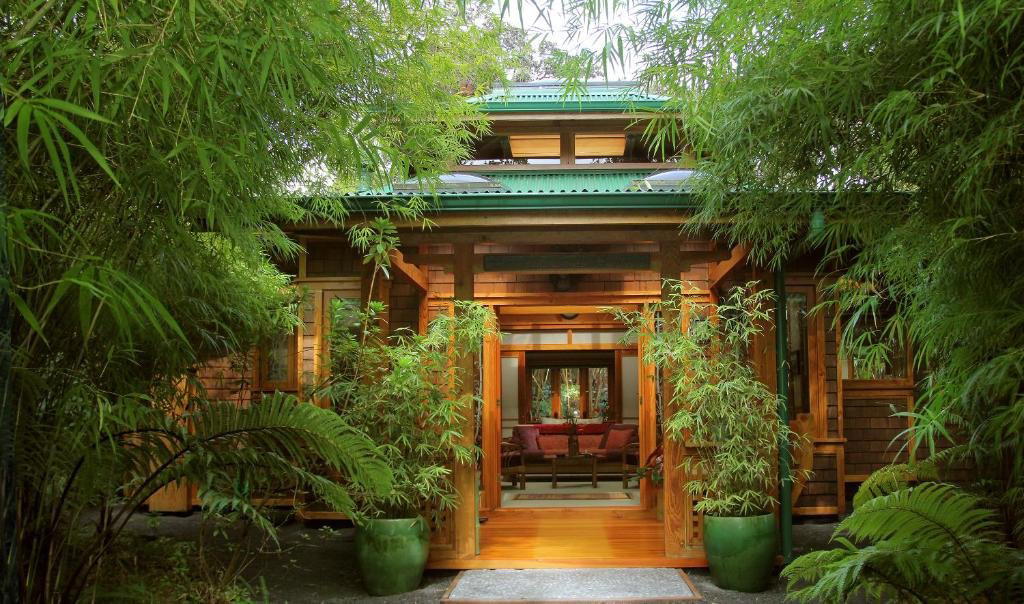
Where the Forest Floor Becomes the Floor Plan
Hawaii's hospitality conversation has long been dominated by oceanfront geometry: infinity pools angled toward the Pacific, open-air lobbies framing reef breaks, suites positioned to capture the exact moment of sunset. The Volcano district on the Big Island operates from a different premise entirely. Here, the defining natural force is not water but land in active transformation, and the accommodations that work leading in this environment are the ones that treat the rainforest as structure rather than scenery.
Volcano Rainforest Retreat, addressed at 11-3832 12th St in Volcano, HI 96785, sits within reach of Hawaii Volcanoes National Park, one of the few places on earth where new land is still being formed. The design logic of properties in this district follows from that fact. Structures are low-profile, set beneath the tree canopy rather than above it, and materials tend toward the weathered and organic. The operative aesthetic owes more to Pacific Rim vernacular architecture than to the resort modernism that defines Wailea or Ko Olina.
Design Embedded in Terrain
The architectural approach common to retreat-format accommodations in the Volcano district is one of deliberate understatement. Where coastal Hawaiian properties often assert themselves against the landscape through scale and material contrast, rainforest retreats like this one are legible primarily through what they omit: the grand entrance sequence, the atrium lobby, the pools that exist mainly to be photographed. What remains is a more direct relationship between the guest and the specific ecology of the saddle between Mauna Loa and Kilauea.
At elevation, the Big Island's climate is measurably different from the coast. Temperatures run cooler, mist moves through the ohia trees in the mornings, and the light has a quality that coastal Hawaiian photography rarely captures. Properties built into this terrain tend toward cottage formats, where individual structures are distributed across a site rather than stacked into a single building footprint. That distribution is both a design choice and a practical response to a forest environment where ferns, tree roots, and lava rock formations define the ground plane.
For travelers familiar with the design-led retreat model practiced at places like Amangiri in Canyon Point or Post Ranch Inn in Big Sur, the underlying logic is recognizable: the site's natural character is the primary design material, and the built structures exist to frame access to that character rather than replace it. The Volcano district takes that logic further than most American destinations because the landscape itself is geologically active, which gives even a quiet morning walk a dimension that more static environments cannot replicate.
The Big Island's Two Modes
The Big Island has historically attracted two distinct traveler profiles that rarely overlap much. The first gravitates toward the Kohala Coast's established resort corridor, where properties like the Fairmont Orchid and Kona Village, A Rosewood Resort in Kailua Kona offer the full-service, beach-anchored format that defines mainstream luxury Hawaii. The second is drawn specifically to Volcanoes National Park and the elemental experience of watching lava fields, steam vents, and calderas that have no equivalent elsewhere in the United States.
Retreat accommodations in the Volcano district serve the second group exclusively. The trade-offs are concrete: no beach access, no resort pool, limited dining options within immediate reach. The return is proximity to the park, which changes character significantly between day and night visits, and an environment where the forest itself is the primary amenity. Within this niche, the cottage-format retreat has become the dominant accommodation model because it matches the scale of the experience on offer.
This model has parallels in other American wilderness-adjacent accommodation categories. Sage Lodge in Pray, positioned near Yellowstone, and Alpine Falls Ranch in Superior operate from similar premises: the landscape is the product, and the accommodation's role is to reduce friction between the guest and that landscape rather than to compete with it as a destination in its own right.
Practical Orientation
The Volcano district sits at roughly 3,700 feet elevation on the Big Island's southeastern flank, approximately 30 miles from Hilo and about 95 miles from Kona's international airport, making Hilo Airport the more practical arrival point for visitors prioritizing the park. The drive from Hilo to Volcano takes under an hour and passes through agricultural land before ascending into the forest zone that characterizes the district.
Booking for retreat-format properties in this area typically runs through direct inquiry or third-party platforms rather than the reservation systems used by major hotel groups. Visitors planning park access around specific volcanic activity should monitor the USGS Hawaiian Volcano Observatory, whose updates directly affect which areas of the park are accessible on any given day. The park operates year-round, and the surrounding forest is at its most atmospheric during the wetter winter months when mist and low cloud are consistent presences.
For context on the broader island's dining and hospitality scene, our full Puako restaurants guide covers the Kohala Coast in detail. Travelers splitting time between the coast and the volcano district should plan for the driving distances, which are real: the two zones of the island offer genuinely different experiences rather than variations on the same one.
Those drawn to the broader category of nature-embedded retreat architecture across the United States will find useful comparison points at Blackberry Farm in Walland, Ambiente, A Landscape Hotel in Sedona, and Canyon Ranch Tucson in Tucson, each of which uses terrain as its organizing design principle in ways that differ from the Hawaiian rainforest context but share its fundamental premise.
Comparison Snapshot
| Venue | Price | Awards |
|---|---|---|
| Volcano Rainforest RetreatThis venue (the venue you are viewing) | Not listed | Not listed |
| Aman New York | Not listed | 3 Michelin Keys · World's 50 Best #87 |
| Amangiri | $1,000–1,500 | 3 Michelin Keys · World's 50 Best #45 |
| Hotel Bel-Air | $750–1,000 | 3 Michelin Keys · World's 50 Best #57 |
| The Beverly Hills Hotel | Not listed | 3 Michelin Keys · World's 50 Best #65 |
| The Carlyle, A Rosewood Hotel | $1,500–2,500 | 2 Michelin Keys · World's 50 Best #64 |
Continue exploring
More in Puako
Bars in Puako
Browse all →
Details
- Quiet
- Romantic
- Rustic
- Intimate
- Scenic
- Romantic Getaway
- Honeymoon
- Wellness Retreat
- Private Villa
- Hot Tub
- Garden
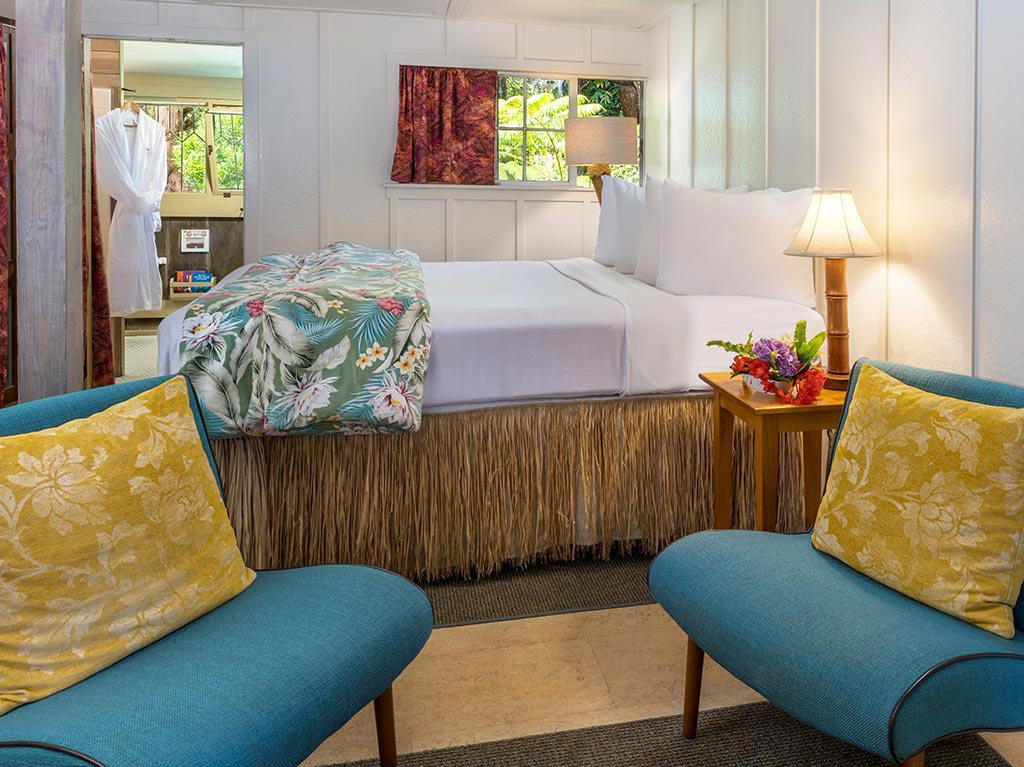
Serene and private rainforest atmosphere with misty, primal surroundings and cozy, intimate spaces.