Under Canvas North Yellowstone - Paradise Valley

Michelin Selected
A Michelin Selected glamping property in Montana's Paradise Valley, Under Canvas North Yellowstone puts canvas-walled tents within reach of Yellowstone's northern entrance. The format sits in a growing tier of high-comfort wilderness stays that trade hotel infrastructure for direct landscape access, with wood-burning stoves and en-suite bathrooms bridging the gap between backcountry and resort.

Pearl is the En Primeur Club membership app, where members save venues, book tables and use the concierge.
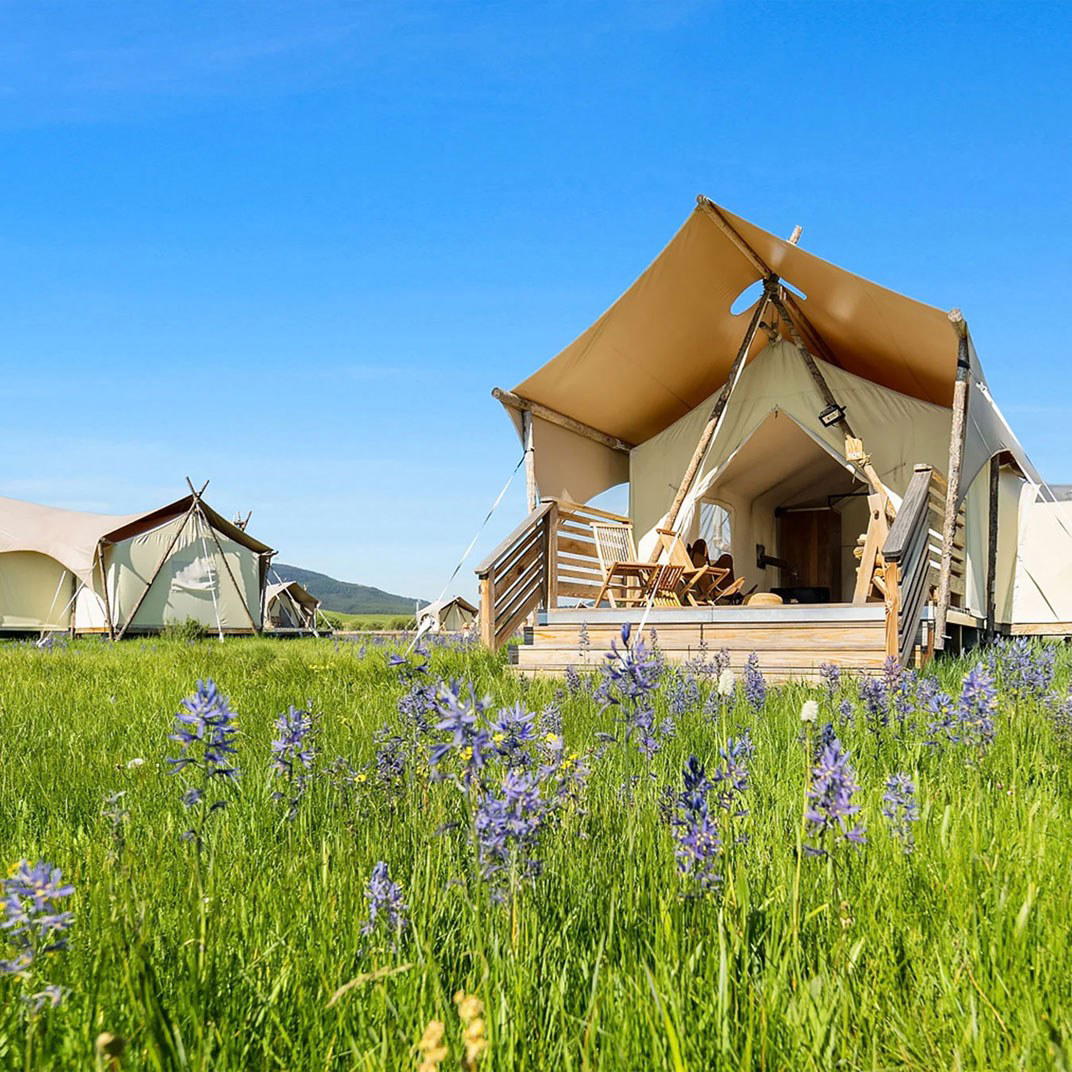
Where the Absaroka Range Sets the Scene
Paradise Valley runs south from Livingston, Montana, along the Yellowstone River, with the Absaroka Mountains rising steeply to the east and the Gallatin Range closing in from the west. The valley has long attracted a particular kind of traveler: people who want proximity to Yellowstone's northern reaches without the congestion of Gardiner or the cookie-cutter motel strips that line the approach. Under Canvas North Yellowstone, at 139 Pine Creek Rd, sits inside this corridor, positioned as a high-comfort camping format where the terrain itself is the primary amenity.
The glamping category has matured considerably over the past decade. What began as a premium novelty, canvas tents with proper beds, sold as an antidote to hotel sameness, has since split into tiers as predictable as those in conventional hospitality. At one end, pop-up festival glamping with minimal infrastructure; at the other, properties that hold their own against boutique hotel peers on design, dining, and service. Under Canvas operates in that upper tier, and its North Yellowstone property has earned a MICHELIN Selected designation in the 2025 guide to hotels and stays, placing it in a shortlist of Montana accommodations the guide considers worth a detour.
The Tent-as-Room Format and What It Implies
The structural logic of a glamping stay differs from a conventional hotel in ways that shape the entire experience. Walls are canvas. Sound travels. The ambient temperature at night in southern Montana, even in summer, can drop sharply. These are not bugs in the format; they are the point. Guests booking Under Canvas North Yellowstone are, by definition, choosing immediacy with the environment over the insulation of a solid-walled room. Wood-burning stoves and en-suite facilities bring comfort up to a standard that makes the choice feel intentional rather than merely rustic.
This positions the property alongside a small cohort of design-led wilderness stays in the American West that prioritize landscape access over hotel infrastructure. Amangiri in Canyon Point approaches the same premise from a different angle, desert terrain, architectural minimalism, a much higher price ceiling. Dunton Hot Springs in Dunton uses restored ghost-town cabins to achieve a comparable sense of place-specificity. Under Canvas competes on terrain access and format simplicity rather than on architecture or spa programming, which keeps it accessible to a broader range of travelers without sacrificing the core proposition.
Dining in the Wilderness Format
The dining program at wilderness-format properties like this one carries a burden that urban hotels largely sidestep. Guests cannot walk to a restaurant. Proximity to a town with a strong independent food scene is limited. The kitchen becomes, by default, the only serious option for most meals, and the quality of that offering shapes guest satisfaction in a way that has no parallel in city hotels where the room and the meal are separate decisions.
Under Canvas properties have generally positioned their on-site dining as casual and camp-appropriate rather than aspirational. That is a coherent editorial choice, there is a version of this where a glossy tasting menu would feel jarring against the canvas-wall context. The emphasis tends to sit on fire-adjacent cooking, communal formats, and ingredients that nod to regional sourcing. Across the broader glamping tier, the properties that execute food most credibly are those that commit to a specific regional identity rather than defaulting to generic comfort food at a premium markup. For a wilderness stay in Paradise Valley, that regional identity has clear anchors: Montana ranch culture, trout from the Yellowstone River system, summer produce from the agricultural corridor between Livingston and Bozeman.
Travelers for whom dining is a primary filter should cross-reference the food program with properties that lead on kitchen credentials. Sage Lodge in the same region has built a stronger culinary identity, and Sage Lodge in Pray places its restaurant program as a central feature. For those willing to benchmark against properties far outside the regional tier, SingleThread Farm Inn in Healdsburg and Meadowood Napa Valley in Napa represent the ceiling of what farm-to-table hotel dining looks like when the kitchen program is the lead offering rather than a support function.
Yellowstone Access and the Case for the Northern Entrance
The northern entrance to Yellowstone, via Gardiner, is one of only two year-round access points to the park. That operational detail matters. The West Entrance and South Entrance close seasonally, funneling winter and shoulder-season visitors toward the north corridor. The Lamar Valley, accessible from the north, holds some of the park's most concentrated wildlife viewing: bison herds, wolf packs reintroduced in the 1990s, and bear activity that draws serious wildlife photographers from late spring through fall.
Paradise Valley, which runs north from Gardiner, compresses the transition between park wilderness and working Montana ranch land into a single valley. Fly-fishing on the Yellowstone River is practical from late spring through autumn, with the stretch between Gardiner and Livingston among the more accessible float sections in the state. The timing of a visit aligns these factors: early summer for high water and active wildlife; late summer and early fall for lower river levels, clearer water, and the beginning of elk rut season, which brings its own spectacle to the valley floor.
How It Compares in the Broader Premium Outdoor Category
The premium outdoor stay category in the American West has expanded significantly, and the competitive set is now wide enough to require some editorial triangulation. Under Canvas North Yellowstone sits in the accessible end of the premium tier, more affordable than the structural architecture plays at properties like Post Ranch Inn in Big Sur or more wellness programs at Canyon Ranch Tucson or Canyon Ranch Lenox. The MICHELIN Selected designation signals a quality floor rather than a ceiling: the guide uses it for properties it considers reliably good within their category, not as a marker of luxury ranking.
For travelers calibrating the right level of comfort against the wilderness experience, the question is where on the spectrum between backcountry and resort they want to land. Under Canvas North Yellowstone sits closer to the backcountry end than properties like Kona Village, A Rosewood Resort in Kailua Kona or Little Palm Island Resort and Spa in Little Torch Key, both of which offer isolation alongside full-service resort programming. The Under Canvas model trades the service layer for format purity: the tent, the stove, the river, the park.
Planning Your Stay
The property operates seasonally, with summer the primary operating window and the shoulder months of May and September offering quieter conditions and more competitive rates than the July and August peak. Reservations for peak summer dates at wilderness properties in the Yellowstone corridor tend to move several months in advance, particularly since the pandemic-era surge in domestic outdoor travel reset booking timelines across the category. Anyone targeting a specific week in July or August should plan accordingly. Livingston, about 50 miles north via US-89, serves as the nearest town with reliable airport access via Bozeman Yellowstone International Airport, which has seen significant route expansion in recent years as the region has drawn more travel attention.
For context on the broader Yellowstone dining and accommodation picture, our full Yellowstone National Park restaurants guide maps the regional options across format and price tier. Those benchmarking this property against the wider universe of Michelin Selected hotels in the US can find instructive contrasts at Troutbeck in Amenia, Washington School House Hotel in Park City, or at the urban end of the selection, The Fifth Avenue Hotel in New York City and Raffles Boston.
Budget Reality Check
Comparable venues nearby, for context on price, style, and recognition.
| Venue | Cuisine | Price | Awards | Notes |
|---|---|---|---|---|
| Under Canvas North Yellowstone - Paradise ValleyThis venue (the venue you are viewing) | Not listed | $300–500 | Michelin Selected | Not listed |
| Sage Lodge | Not listed | Not listed | 3 Michelin Keys · Virtuoso Luxury Hotel Partner | Paradise Valley, Modern-rustic luxury resort blending contemporary design with authentic Montana heritage and natural landscape integration. |
| 320 Guest Ranch | Not listed | $200–300 | Not listed | Gallatin Canyon, Historic Western guest ranch with luxurious modern cabin accommodations |
| Under Canvas Glacier | Coram, upscale glamping resort | $300–500 | Michelin Selected | Not listed |
| Kimpton Armory Hotel Bozeman | Not listed | $300–500 | Michelin Selected | downtown, Historic armory building seamlessly blended with contemporary luxury. |
| MOUNTAIN SKY GUEST RANCH | Paradise Valley, rustic elegance | $2,500+ | Top 50 Ranches | Not listed |
Recognition history
Dated appearances from independent guides and award organizations, with the underlying list record or original source where available.
Michelin Selected
Michelin
Continue exploring
More in Yellowstone National Park
Hotels in Yellowstone National Park
All hotels in Yellowstone National Park →
Bars in Yellowstone National Park
Browse all →
Details
- Scenic
- Rustic
- Cozy
- Family Vacation
- Romantic Getaway
- Weekend Escape
- Panoramic View
- Waterfront
- Wi Fi
- Restaurant
- EV Charging
- Mountain
Refined riverfront rusticity with cozy wood-burning stoves in upscale safari tents, alfresco dining, communal fire pits, and stargazing under Big Sky Country.