Turtle Bay Resort

Turtle Bay Resort occupies a rare position on Oahu's North Shore, where the island's surf culture and open coastline shape the property's entire spatial logic. A MICHELIN Selected hotel for 2025, it sits well outside the resort density of Waikiki, trading tower-block geometry for low-rise structures that follow the natural topography of a peninsula jutting into the Pacific.
Pearl is the En Primeur Club membership app — saves, bookings, and concierge access live there. Same editors, same standards.
- Address
- 57-091 Kamehameha Highway, Rest of Island of Oahu, HI, USA
- Phone
- (808) 293-6000
- Website
- ritzcarlton.com
 Saves & bookings on Pearl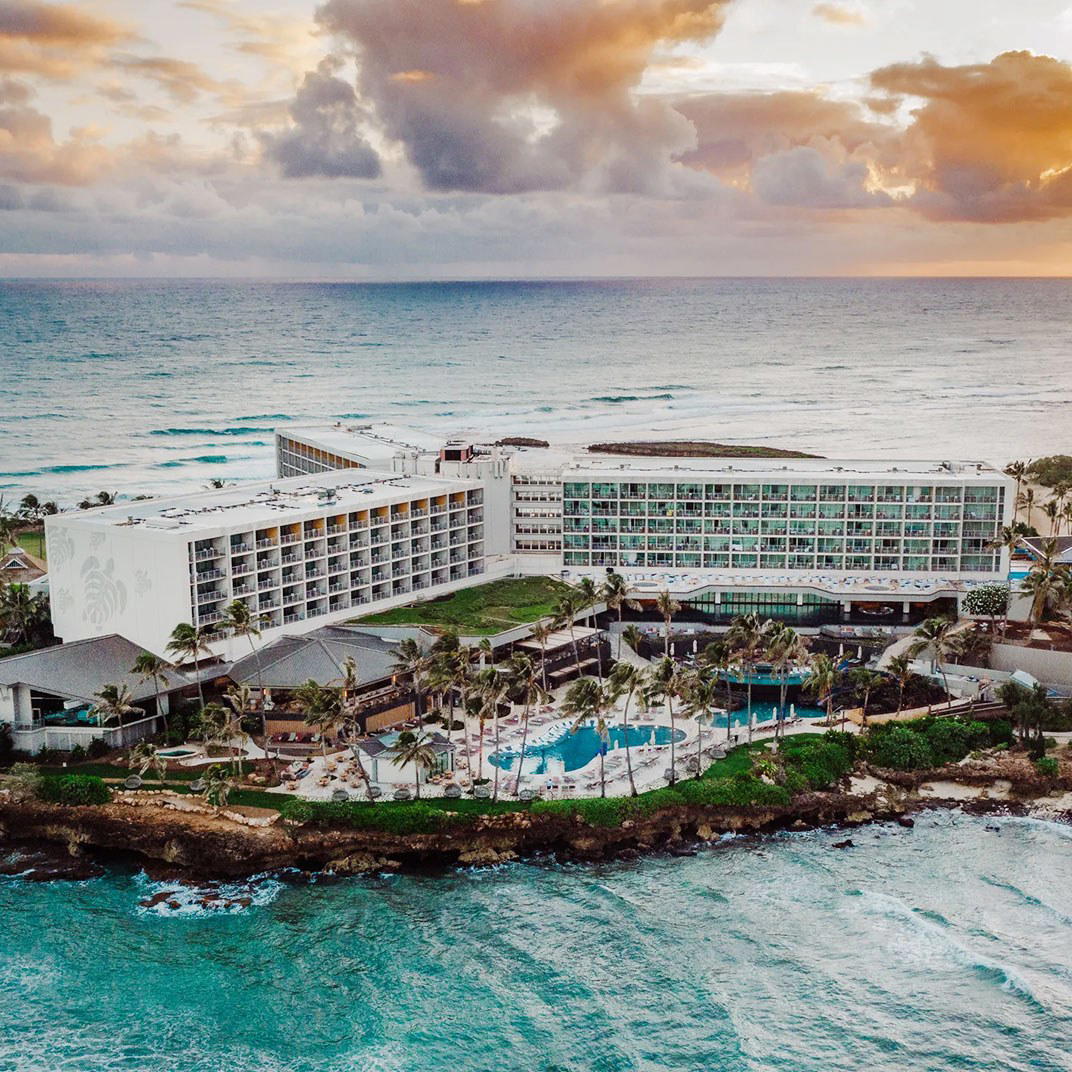
Where the North Shore Dictates the Architecture
Most of Oahu's resort development compressed itself into the Waikiki corridor long ago, stacking towers against a narrow beach and optimising for density. The North Shore took a different path. At Kamehameha Highway's northern reach, where the road narrows and the surf breaks grow more serious, the land itself refuses the high-rise logic. Turtle Bay Resort sits on a peninsula at the island's northeastern edge, and the site's geography, rather than any imposed design philosophy, defines what the property is. The Pacific borders the land on three sides. Accommodation spreads low and laterally across that headland rather than climbing upward, and the sightlines the layout creates, across open water on both the Kahuku and Sunset Beach orientations, are the primary spatial experience.
That positioning places Turtle Bay in a distinct tier among Hawaii's recognised properties. MICHELIN's 2025 hotel selection included it, and the resort's. The Michelin hotel programme does not operate on the same starred system as its restaurant guide; selection signals consistent quality and character rather than a numerical rank. Within Hawaii, that recognition clusters around properties where the relationship between built environment and natural setting carries genuine weight, as it does at Kona Village, A Rosewood Resort in Kailua Kona on the Big Island.
Low-Rise Logic on a Surf Peninsula
The design approach at properties like this one tends to be determined more by what the site prohibits than by what the architect proposes. A peninsula with consistent trade winds, salt exposure, and an identity built around professional surfing competitions does not accommodate grand atrium lobbies or urban-style tower footprints. Turtle Bay's built form stays close to the ground, which means pathways connecting accommodation to the water are short and the transition from interior to exterior happens quickly. That physical compactness between structure and coastline is the spatial quality that separates North Shore properties from their Waikiki counterparts regardless of category or price.
This typology, where the site's natural constraints become the design asset, appears across American resort development in locations where the setting has strong identity of its own. Post Ranch Inn in Big Sur operates on the same principle along California's coastal cliffs, and Amangiri in Canyon Point does the same in Utah's canyon country. In each case, architectural restraint and site-following design become the differentiator rather than interior grandeur. The logic at Turtle Bay belongs to that same tradition.
The North Shore Context
The stretch of Oahu's northern coastline between Haleiwa and Kahuku occupies a specific cultural position within surfing internationally. The Banzai Pipeline, Sunset Beach, and the surrounding breaks have hosted the sport's most scrutinised competitions for decades, and the community that developed around them carries a character meaningfully different from the resort hospitality of the south shore. A property sitting within that geography absorbs some of that identity by proximity. Guests do not arrive at Turtle Bay the way they arrive at a Waikiki hotel; the 40-minute drive from Honolulu International along the H-2 and Kamehameha Highway is itself a transition out of urban resort density and into a different register of the island.
That separation is part of the value proposition for the North Shore tier of Oahu accommodation, and it distinguishes stays here from properties in the Waikiki or Ko Olina corridors in ways that go beyond room type or amenity count. For comparison, resort properties that operate through geographic isolation as a feature include Little Palm Island Resort and Spa in Little Torch Key and Sage Lodge in Pray, Montana, both of which build their offer around the deliberateness the journey requires.
Accommodation Format and Peninsula Scale
The resort's footprint across the Kahuku peninsula allows for accommodation formats that a constrained urban or beachfront-corridor site cannot. Room configurations spread across multiple structures on the headland, and the scale of the property, consistent with the kind of peninsular site that was historically preserved from intensive development in Hawaii's post-statehood resort boom, gives individual accommodation units a spatial separation not available within Waikiki's tower stock.
For guests comparing the North Shore option against other MICHELIN-recognised properties in architecturally specific American settings, the comparable set includes Meadowood Napa Valley, which similarly distributes accommodation across a large natural site, and SingleThread Farm Inn in Healdsburg, which achieves a different kind of site-driven specificity in Sonoma County. The difference at Turtle Bay is the Pacific orientation and the surf-culture context that no inland American property replicates.
Planning a Stay
The address at 57-091 Kamehameha Highway places the resort at the northern apex of the highway that circles Oahu's perimeter, roughly 40 minutes from Honolulu International Airport under normal traffic conditions on the H-2 corridor. North Shore traffic can extend that drive on weekends and during competition season, when the area draws significant day-visitor volume from Honolulu. Winter months, from November through February, coincide with the largest North Shore swells and the period when the surf competition calendar is most active, which gives stays during that window a different ambient energy than the calmer summer months. Summer brings more consistent small-wave conditions suitable for water activity across a broader range of guests.
For those building a broader Hawaii itinerary that includes properties across the islands, the contrast between Turtle Bay's North Shore position and the Big Island's western coast character, as represented by Kona Village, is worth planning around rather than treating as interchangeable. Both carry Michelin recognition, but the site types, cultural contexts, and physical experiences they offer are substantially different.
Turtle Bay in a Wider American Resort Context
Properties that earn MICHELIN recognition outside major urban centres tend to share a quality: the setting does work that architecture alone cannot. Canyon Ranch Tucson in the Sonoran Desert, Dunton Hot Springs in Colorado, and Troutbeck in Amenia each occupy sites where the natural environment establishes the primary experience and the built structures support it rather than compete with it. Turtle Bay fits that pattern at the Pacific edge of American territory, where the peninsula site, the open-ocean exposure, and the cultural weight of the surrounding North Shore surfing community combine to produce something that cannot be relocated to a different coastline without losing its essential character.
Urban properties in the MICHELIN 2025 hotel selection, including The Fifth Avenue Hotel in New York City, Raffles Boston, and Chicago Athletic Association, operate through a different logic, one of urban positioning and architectural heritage rather than site isolation. The contrast is instructive: recognition in the Michelin hotel programme spans a wide range of typologies, and Turtle Bay's inclusion reflects the distinctiveness of its setting category as much as any specific design achievement. International comparisons in the same site-driven category would include Aman Venice or Hôtel de Paris Monte-Carlo, where geography and cultural context similarly anchor what the property is.
Quick Comparison
Comparable venues nearby, for context on price, style, and recognition.
| Venue | Cuisine | Price | Awards | Notes |
|---|---|---|---|---|
| Turtle Bay ResortThis venue — the venue you are viewing | Oceanfront resort with modern Hawaiian design honoring surf culture and natural splendor | $$$$ | 5-Star | Not listed |
| Grand Hyatt Kauai Resort and Spa | Eco-friendly luxury beachfront oasis with lush gardens and acres of pools | $$$$ | 4-Star | Poipu |
| The Ritz-Carlton Residences, Waikiki Beach | residential-style luxury resort blending hotel amenities with home conveniences | $$$$ | 5-Star | Waikiki |
| Mauna Lani, Auberge Collection | Modern Hawaiian elegance with profound cultural connection to sacred land. | $$$$ | 5-Star | Kohala Coast |
| Kona Village, A Rosewood Resort | Traditional Hawaiian hale in village-like clusters with modern sustainable upgrades | $$$$ | 5-Star | Kaʻūpūlehu |
| Alohilani Resort Waikiki Beach | Modern beachfront resort with signature oceanarium and lively pool deck | $$$$ | 4-Star | Diamond Head |
Recognition history
Dated appearances from independent guides and award organizations, with the underlying list record or original source where available.
Michelin Selected
Michelin
At a Glance
- Scenic
- Lively
- Cozy
- Family Vacation
- Romantic Getaway
- Weekend Escape
- Destination Wedding
- Beachfront
- Infinity Pool
- Golf Course
- Waterfront
- Pool
- Spa
- Fitness Center
- Beach Access
- Golf Course
- Tennis
- Waterfront
- Pool
- Spa
- Fitness Center
- Beach Access
- Golf Course
- Tennis
Light and airy rooms with natural materials like stone, rattan, and wood; laid-back North Shore vibe enhanced by ocean views, palm trees, and seamless indoor-outdoor flow.