The Mason Boutique Hotel

The Mason Boutique Hotel brings a design-led, intimate format to Louisville's competitive boutique accommodation tier, recognized by the World Travel Awards 2025. Its small-key approach positions it against the city's heritage independents rather than its larger full-service hotels. For travelers prioritizing character over scale, it occupies a distinct position in the Louisville market.
Pearl is the En Primeur Club membership app — saves, bookings, and concierge access live there. Same editors, same standards.
- Address
- 915 S Columbus Ave, Louisville, MS 39339, USA
- Website
- themasonhotel.com
- Directions
- Get directions
 Saves & bookings on Pearl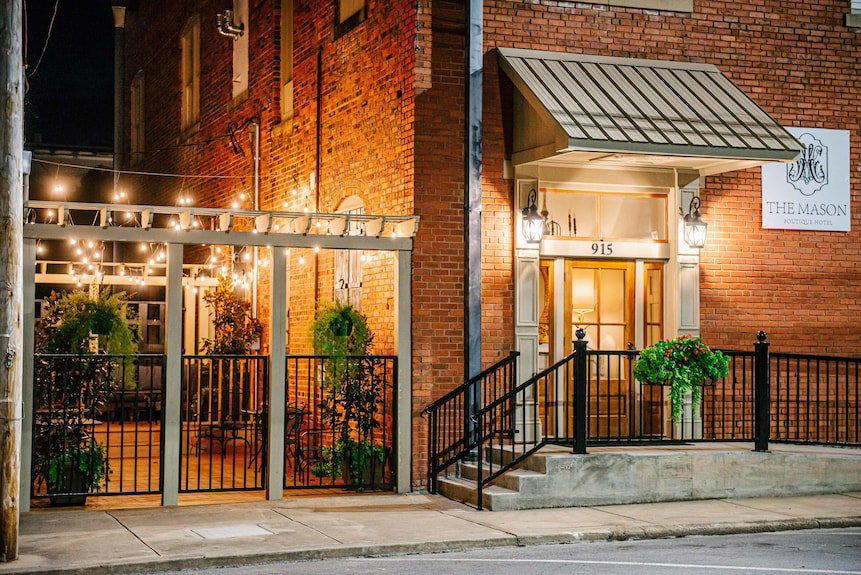
Where Louisville's Boutique Hotel Tradition Meets Architectural Intimacy
Louisville has developed one of the more textured independent hotel scenes in the American South and Midwest, a consequence of the city's bourbon tourism boom, its dense stock of late-nineteenth and early-twentieth century commercial buildings, and a visitor demographic that increasingly favors rooms with a sense of place over branded uniformity. The boutique tier here is genuinely competitive: The Brown Hotel anchors the historic prestige end, while properties like Hotel Genevieve, Proof On Main, and Gralehaus each occupy distinct design and price positions. The Mason Boutique Hotel enters this conversation as a smaller, more intimate option — the kind of property whose format signals that it is competing on character and curation rather than amenity volume.
The World Travel Awards recognized The Mason Boutique Hotel as Mississippi's Leading Boutique Hotel for 2025, a designation that places it within the regional recognition circuit for independent properties. That award category is meaningful because the World Travel Awards framework, while broad, specifically rewards boutique-format hotels that demonstrate differentiation from larger chain competitors — a useful signal about the property's positioning intent, if not a guarantee of any specific experience.
The Heritage Logic of Small-Key Hotels in American Cities
Across American mid-sized cities with significant nineteenth-century commercial cores, the boutique hotel format has followed a predictable architectural logic: adaptive reuse of period buildings, small key counts, interiors that reference local material culture, and programming that connects guests to neighborhood food and drink rather than insulating them from it. Louisville fits this pattern closely. The city's NuLu district, its Germantown neighborhoods, and its Whiskey Row corridor have all seen former warehouses, breweries, and commercial buildings converted into hotel stock over the past decade.
The appeal of this format is partly aesthetic and partly practical. A property with fewer rooms can maintain a level of service attentiveness that larger hotels can only approximate. It can also make design decisions, original flooring, preserved brick, period-specific millwork, that would be economically unworkable at scale. For the traveler arriving in Louisville for the Kentucky Derby in May, or for the bourbon trail in autumn, when the city's distillery culture draws its heaviest visitor numbers, a small boutique property in a period building offers a fundamentally different experience than a convention-adjacent tower. Booking lead times during Derby week extend months in advance across all of Louisville's better hotels, and the boutique tier fills earliest.
Travelers looking for comparable intimate-format properties in other American cities might consider Chicago Athletic Association in Chicago, where adaptive reuse of a landmark athletic club building created one of that city's more architecturally compelling hotel experiences, or Troutbeck in Amenia, which demonstrates how small-key rural properties use historic fabric as their primary design asset. At the urban end of the spectrum, The Fifth Avenue Hotel in New York City shows what the format looks like when applied to a landmark Manhattan address. The common thread across these properties is that history does structural work: the building itself carries meaning that no amount of contemporary FF&E can replicate.
Louisville's Competitive Boutique Set: Where The Mason Fits
Understanding where The Mason sits requires mapping the full Louisville boutique tier. The Brown Hotel, opened in 1923 and a fixture of downtown Louisville for a century, occupies the prestige-historic end: grand public rooms, a documented culinary legacy (the Hot Brown sandwich originated here), and a price position to match. Hotel Genevieve sits in the design-forward mid-tier, drawing on French Quarter aesthetics and a NuLu location. Gralehaus operates at the intimate, neighborhood-inn end of the spectrum, with a small room count and a coffee-culture orientation. The Grady and Proof On Main each offer distinct food and beverage programming as part of their identity proposition.
The Mason's World Travel Awards recognition positions it as a property that has cleared the threshold of regional notice within this competitive field. What that means practically is that it has differentiated itself sufficiently to earn external validation, the specific mechanism of that differentiation (design, service, building history, or programming) is a question leading answered by direct inquiry with the property, since granular detail on those dimensions is not available in current published records.
Planning Your Stay: Timing, Context, and Approach
Louisville's calendar creates distinct windows of demand that any traveler should factor into planning. The Kentucky Derby (first Saturday of May) and its associated week of events compress the city's hotel supply dramatically, rates across all tiers rise sharply, and availability at smaller boutique properties becomes genuinely scarce by early spring. The bourbon tourism season runs strongest from late spring through October, when distillery tours and the Kentucky Bourbon Trail draw steady visitor traffic. November through February represents the city's quieter period, when rates soften and the city's dining and bar scene, which operates year-round, is accessible without the overlay of festival crowds.
For travelers comparing Louisville boutique options against broader American boutique experiences, the city's price tier generally sits below comparable properties in gateway cities. Properties like Raffles Boston, Hotel Bel-Air in Los Angeles, or Aman New York operate at a different price altitude entirely. Louisville's boutique tier offers meaningful architectural and service quality at a price point that remains accessible relative to coastal equivalents, a structural feature of the city's hospitality market rather than a reflection of any individual property's positioning. See our full Louisville restaurants and hotels guide for broader context on the city's hospitality scene.
Direct contact with The Mason is the recommended approach for booking inquiries, rate questions, and room selection guidance. Published records do not currently include booking platform specifics, phone contact, or a confirmed website address for the property, so reaching out through the World Travel Awards directory or a Louisville tourism resource is a reasonable starting point for travelers who cannot locate the property through standard search.
Peers Worth Knowing
Comparable venues nearby, for context on price, style, and recognition.
| Venue | Cuisine | Price | Notes |
|---|---|---|---|
| The Mason Boutique HotelThis venue — the venue you are viewing | Historic boutique in restored downtown building | $$$ | Not listed |
| The Brown Hotel | Georgian Revival landmark blending historic grandeur with modern comfort | $$$$ | Fourth St. |
| The Grady | Historic boutique hotel blending traditional architectural elements with contemporary luxury amenities in a downtown cultural setting. | $$$ | West Main |
| Hotel Genevieve | Boutique rooted in Louisville history with French influence and local limestone architecture. | $$$ | Phoenix Hill |
| Hotel Bourré Bonne | lifestyle hotel | $$$$ | Downtown Louisville |
| Gralehaus | Victorian-style bed & beverage in early 1900s home | $$$ | The Highlands |
Recognition history
Dated appearances from independent guides and award organizations, with the underlying list record or original source where available.
World Travel Awards
World Travel Awards
Continue exploring
More in Louisville
Restaurants in Louisville
Browse all →
At a Glance
- Historic
- Cozy
- Elegant
- Intimate
- Classic
- Romantic Getaway
- Weekend Escape
- Anniversary
- Historic Building
- Terrace
- Wi Fi
- Breakfast Included
- Housekeeping
- Street Scene
- Wi Fi
- Breakfast Included
- Housekeeping
Tastefully decorated with historical elements, high ceilings, spacious rooms, and a clean, elegant atmosphere praised in guest reviews.