
Michelin Selected for 2025, The Breeze occupies a quiet stretch of Ahlbeck on Germany's Baltic island of Usedom, a coastline where the architecture of the late imperial era still defines the built environment. The property sits within that tradition of grand seaside resort design, offering a counterpoint to the more anonymous resort hotels that have moved into the region since reunification.
Pearl is the En Primeur Club membership app — saves, bookings, and concierge access live there. Same editors, same standards.
- Address
- Rathenaustraße 3, Ahlbeck, Germany
- Phone
- +49 38378 6920
 Saves & bookings on Pearl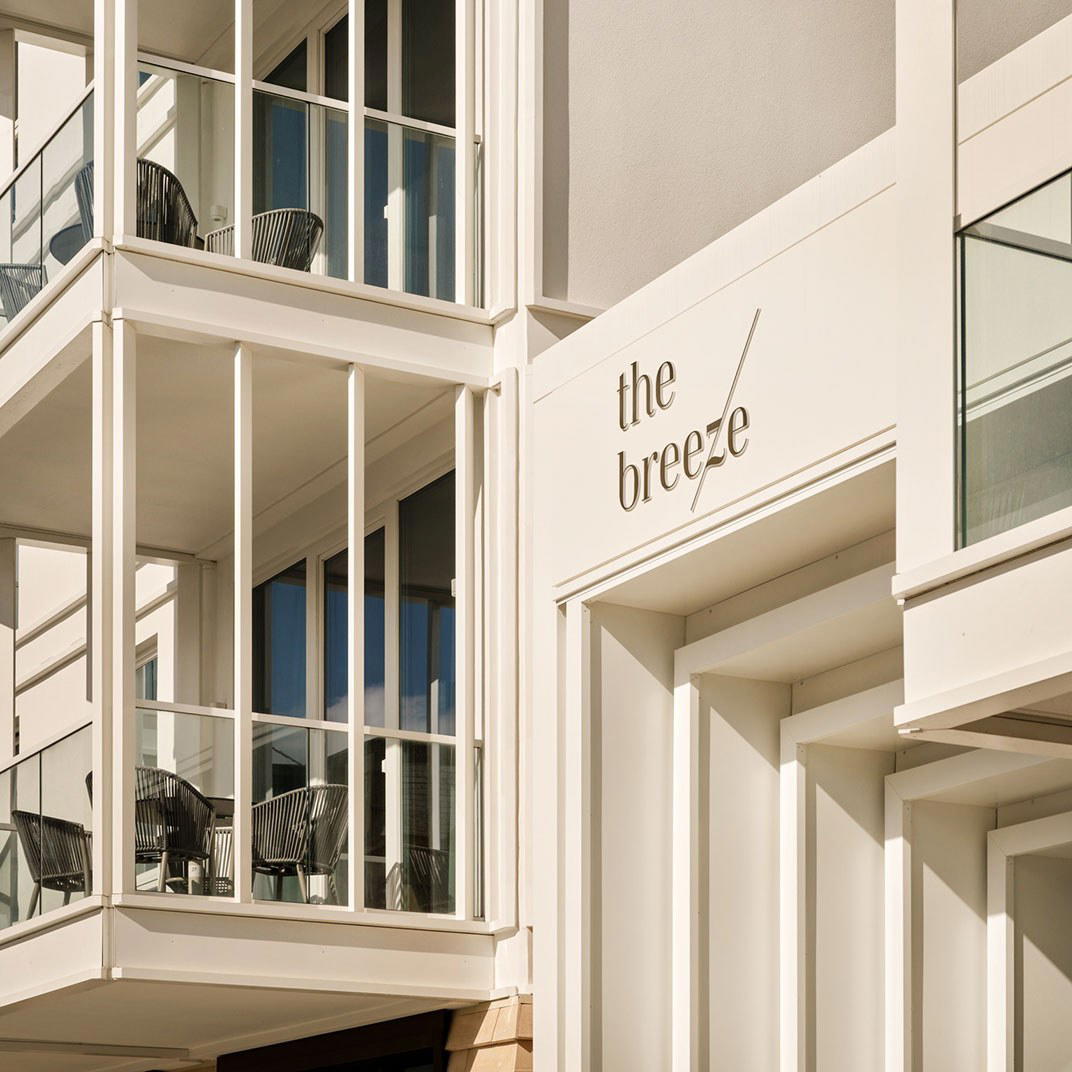
Where Baltic Architecture Meets Deliberate Restraint
Usedom's western shore has been pulling Central European leisure travellers since the 1870s, when the Wilhelmine resort towns of Bansin, Heringsdorf, and Ahlbeck were built out as seaside extensions of Berlin's upper bourgeoisie. The architectural inheritance of that era is the island's most distinctive asset: long promenades flanked by ornate villas, wedding-cake stucco, and the kind of cast-iron pier structures that have survived two political systems. Ahlbeck's broader dining scene maps the broader scene, but The Breeze is understood first as a building before it is understood as a hotel.
Ahlbeck's address on Rathenaustraße places The Breeze within walking range of the town's 1898 pier, the oldest surviving wooden pier on the German Baltic coast. That proximity matters architecturally: the seafront here sets an expectation of period weight and horizontal scale, and properties that ignore that context can feel out of place. The Breeze does not ignore it. The building's coastal position means that light, wind, and the particular grey-green palette of the Baltic inform the environment in ways that interior design alone cannot manufacture.
The Michelin Selection Signal and What It Implies
Michelin's hotel selection programme operates on different criteria than its restaurant stars, but selection in 2025 carries a specific meaning in the German Baltic context. The Michelin Selected designation for hotels focuses on character, quality of welcome, and a standard of comfort that the guide's editors consider noteworthy within a given geography. In a region where the accommodation offer runs heavily toward large spa-resort formats and self-catering apartments, a Michelin Selected property represents a smaller, more considered tier. The selection for the hotel in the 2025 guide places it in a comparable set defined more by editorial credibility than by room count or amenity volume.
For context on how that tier reads nationally: German Michelin Selected hotels span from converted country houses in the Black Forest to harbour-adjacent properties on the North Sea. Comparable coastal selections on the German Baltic and North Sea shores include properties like Seesteg Norderney in Norderney and BUDERSAND Hotel in Hörnum on Sylt, both of which operate in the design-led, lower-key end of German coastal hospitality. Söl'ring Hof in Sylt extends that comparison further into the Michelin restaurant tier. The hotel belongs to this coastal, character-property cohort rather than to the large international-brand format represented by properties like the Fairmont Hotel Vier Jahreszeiten in Hamburg or the Sofitel Frankfurt Opera.
Usedom's Positioning in German Coastal Travel
Germany's island coastline divides into two broad travel cultures. The North Sea islands, Sylt above all, carry stronger associations with high-spend leisure and a competitive design-hotel scene that has been running for two decades. The Baltic islands, Usedom and Rügen especially, have a different trajectory: a pre-war resort heritage interrupted by the GDR period, then a slow post-reunification recovery that has gradually restored the architectural stock and repositioned the islands for quality-conscious domestic and Central European travel. Usedom's proximity to Poland's Szczecin adds a cross-border dimension that is unusual in German island tourism.
Within that context, Ahlbeck occupies the island's southern tip, closest to the Polish border and historically especially compact among the three Kaiserbäder resort towns. The concentration of late-19th-century resort architecture here is dense enough that the built environment functions as a kind of open-air catalogue of Wilhelmine seaside design. Staying in that environment is not incidental to the experience; it is the experience, particularly for travellers whose interest in German travel runs toward architectural and cultural depth rather than spa facilities alone.
For comparison on the broader German quality-hotel spectrum, Weissenhaus Private Nature Luxury Resort in Weissenhaus represents the Baltic coast's larger-scale, estate-format offer, while Villa Contessa in Bad Saarow offers a parallel in lakeside northeastern Germany. Further afield, Althoff Seehotel Überfahrt in Rottach-Egern and Schloss Elmau Luxury Spa Retreat & Cultural Hideaway in Elmau define what the German premium resort format looks like at greater resource depth. The hotel operates at a different register: smaller, more specific to place, and more dependent on the quality of the location itself than on programmatic amenity stacking.
Planning a Stay
Usedom is accessible by train from Berlin via the regional rail connection to Swinemünde, with the journey running approximately two and a half to three hours depending on service. Ahlbeck is the first German stop from the Polish border, which means the train from Berlin effectively terminates at the heart of the Kaiserbäder zone. For those arriving by car, the island connects via the B110 route through the mainland and across the Zecheriner Brücke. Ahlbeck itself is walkable at the scale that matters: the pier, the promenade, and the central restaurant zone are all within a short radius of Rathenaustraße.
The Baltic season concentrates between late May and early September, when water temperatures climb enough for beach use and the promenade operates at full capacity. Shoulder season in April-May and September-October delivers quieter conditions and the kind of flat, atmospheric Baltic light that photographers and painters have been recording from this coastline for well over a century. Winter visits are viable for those drawn to the off-season character of Northern European resort towns, a particular aesthetic that properties with architectural substance carry better than resort-format hotels designed for summer-only activation. Booking is recommended in advance.
Travellers building a wider German itinerary around quality-hotel stays will find useful comparisons in properties like Hotel Traube Tonbach in Baiersbronn, Luisenhöhe in Horben, and Gut Steinbach Hotel Chalets Spa in Reit im Winkl for the southern character-property tier, or Telegraphenamt in Berlin and Breidenbacher Hof Düsseldorf for the urban end of the spectrum. For those whose itinerary extends internationally, Badrutt's Palace Hotel in St. Moritz and Hôtel de Paris Monte-Carlo represent the grander European resort-hotel tradition within which Germany's own coastal properties have always positioned themselves as quieter, more historically textured alternatives.
Fast Comparison
Comparable venues nearby, for context on price, style, and recognition.
| Venue | Cuisine | Price | Notes |
|---|---|---|---|
| The BreezeThis venue — the venue you are viewing | Modern spa architecture with luxury apartment residences | $$$ | Not listed |
| Soho House | Members-only creative club in historic Bauhaus building | $$$$ | Prenzlauer Berg |
| Romantik Hotel Landhaus Bärenmühle | Romantik country house in a historic mill with spacious suites featuring panoramic views and rustic elegance. | $$$ | Frankenau-Ellershausen |
| freistil Boutiquehotel | cozy Alpine Purist style boutique hotel | $$$ | Ofterschwang |
| Prize by Radisson, Berlin | Affordable high‑design, midscale lifestyle hotel integrated into a mixed‑use urban development in Prenzlauer Berg. | $$ | Prenzlauer Berg |
| 25hours Hotel The Trip | Trendy design hotel blending travel themes with urban creativity | $$$ | Goethehaus |
Recognition history
Dated appearances from independent guides and award organizations, with the underlying list record or original source where available.
Michelin Selected
Michelin
Continue exploring
More in Ahlbeck
Restaurants in Ahlbeck
Browse all →
At a Glance
- Modern
- Scenic
- Cozy
- Romantic Getaway
- Family Vacation
- Weekend Escape
- Beachfront
- Panoramic View
- Wi Fi
- Pool
- Spa
- Fitness Center
- Sauna
- Restaurant
- Concierge
- Waterfront
- Wi Fi
- Pool
- Spa
- Fitness Center
- Sauna
- Restaurant
- Concierge
Modern and stylish atmosphere with a relaxed seaside vibe, praised for cleanliness and welcoming service.