

Small Luxury Hotels of the World Member · World Luxury Hotel Awards WLHA Regional Winner
Taru Villas Villu - Wilpattu sits on the edge of Sri Lanka's largest national park, earning continental recognition for its interior design alongside a regional award for its private pool villas. The property positions itself as a considered base for close encounters with leopard, elephant, sloth bear, whale, and dolphin, Sri Lanka's so-called 'big five', without sacrificing the kind of deliberate calm that defines the better end of Sri Lanka's wilderness lodge tier.

Pearl is the En Primeur Club membership app, where members save venues, book tables and use the concierge.
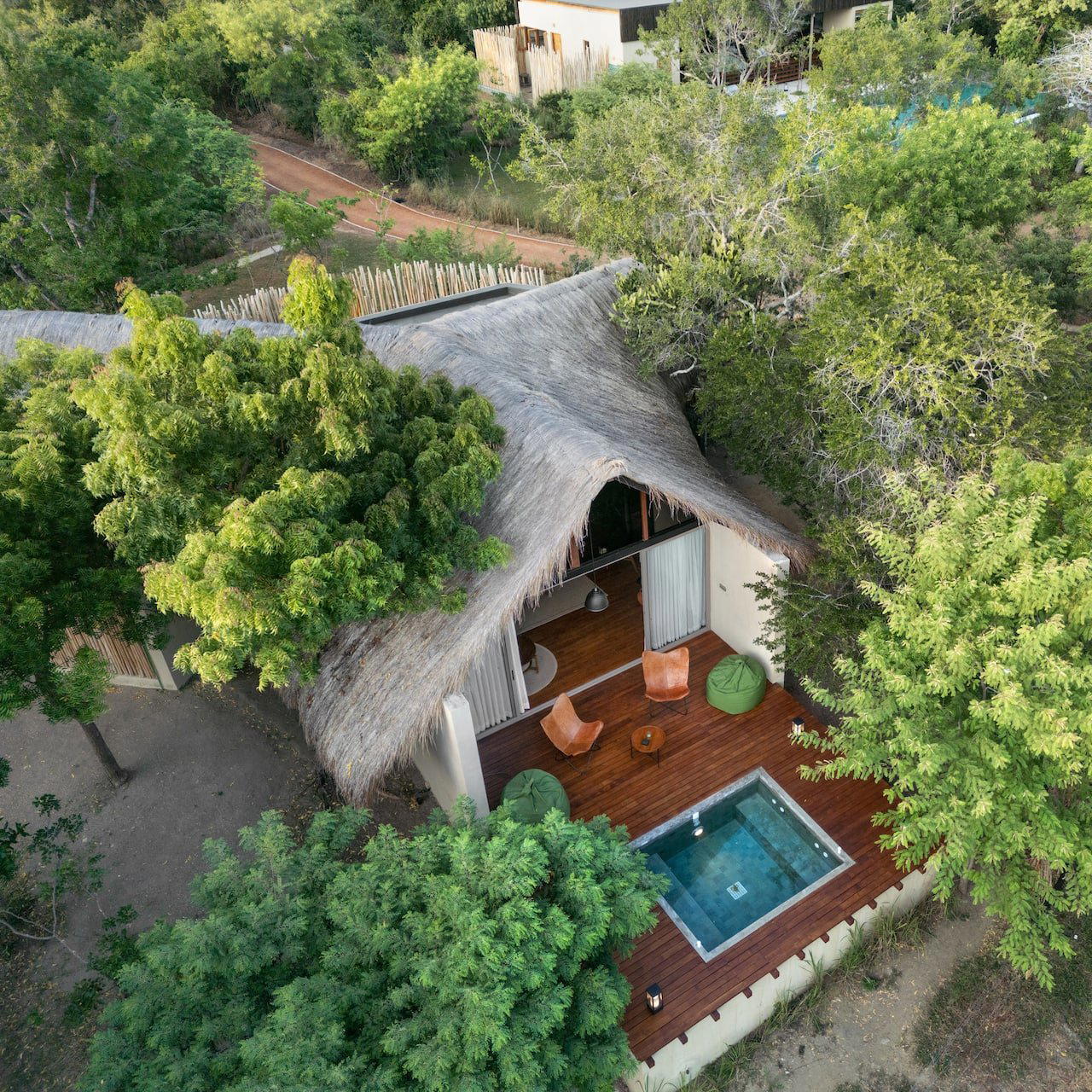
Where the Forest Starts at the Threshold
Sri Lanka's premium wildlife lodge category has split into two distinct camps over the past decade: large-format resort properties with safari add-ons, and smaller, architecturally intentional properties where the physical environment is itself the primary offering. Taru Villas Villu - Wilpattu belongs firmly to the second group. Situated at 635/1 Aluthroad, Eluwankulama, on the fringes of Wilpattu National Park, the property's address tells you something immediately useful: this is not a hotel that happens to be near a park. The park boundary is the context around which the entire spatial experience has been arranged.
Wilpattu is Sri Lanka's largest national park by area, and one of the least trafficked by the international safari circuit, which tends to concentrate on Yala in the south. That relative quiet shapes what a stay here feels like. Mornings carry a different texture than at Yala's busier lodge belt: fewer vehicles in convoy, longer silences between sightings, a stronger sense that you are moving through habitat rather than a managed spectator route.
The Design Award in Context
The property has received two awards with direct bearing on how it competes within the Sri Lankan luxury lodge tier: a Regional Winner designation for Luxury Private Pool Villa, and a Continent Winner for Leading Interior Design. The second of these is worth examining carefully, because continental-level design recognition in South and Southeast Asian hospitality is a genuinely competitive field, given how much serious design investment has gone into properties across Sri Lanka, the Maldives, and Bali over the past fifteen years.
What continental interior design recognition typically signals in this context is a resolved aesthetic approach: one where materiality, proportion, and the relationship between interior space and exterior environment are treated as a unified problem rather than a series of decorative decisions. The better Sri Lankan properties in this award tier tend to work with local materials, timber, stone, woven textiles, in ways that feel considered rather than folkloric. They also tend to prioritise sightlines, thermal comfort, and the management of natural light in ways that larger resort chains, constrained by brand standards and volume economics, rarely achieve. Whether Taru Villas Villu achieves all of this is something direct experience would need to confirm, but the award cluster suggests a property operating with that level of ambition.
For context, other properties in Sri Lanka's design-conscious lodge category include Wild Coast Tented Lodge in Yala and Gal Oya Lodge in Gal Oya National Park, both of which have built reputations for architecture that responds to landscape rather than ignoring it. Taru Villas Villu occupies the same conceptual space in the north-west, in a park that has seen far less development pressure.
The Private Pool Villa Format
The Regional Winner award for Luxury Private Pool Villa is a category signal as much as a quality signal. In the contemporary Sri Lankan luxury market, the private pool villa format has become the dominant accommodation typology at the premium tier, partly because the climate makes outdoor water genuinely useful across most of the year, and partly because the format allows properties to deliver privacy at a scale that suits couples and small families seeking distance from larger resort operations.
At a property positioned against the wilderness rather than a beach or town, the private pool functions differently than it does at a coastal property like Amanwella in Tangalle or Cape Weligama in Weligama. Here, the pool is less about sea-adjacency and more about creating a private perimeter within a dense natural setting, a decompression space between the intensity of a morning game drive and the quieter rhythms of the afternoon. That distinction matters when choosing between Sri Lanka's wilderness lodge options.
Wilpattu's Wildlife Proposition
Sri Lanka's so-called 'big five' framework, leopard, elephant, sloth bear, whale, and dolphin, is a marketing construction, but a useful one for understanding the island's wildlife geography. No single park delivers all five, and Wilpattu's particular contribution to that list is centred on leopard and elephant within its dryland forest and villus (natural lakes), with the coastal and marine species requiring separate excursions. Wilpattu is considered one of Sri Lanka's leading environments for leopard observation, with a habitat structure different from Yala's scrubland: denser, more forested, and consequently more atmospheric, even if individual sightings require more patience.
For travellers comparing this region to Sri Lanka's other wildlife destinations, the calculus involves trading the relative ease of sightings at more frequented parks for a more immersive environment and significantly fewer fellow visitors on the tracks. Properties in this category tend to attract a different traveller than Yala's larger lodges: less focused on the photographic checklist, more interested in the sustained environmental experience. Those seeking a more social wildlife circuit might compare with Hilton Yala Resort in Tissamaharama before committing to the quieter north-west.
Planning a Stay
Wilpattu is accessible from Colombo, typically a three-to-four hour drive north, making it a viable first or final stop on a broader Sri Lankan itinerary that might otherwise concentrate on the Cultural Triangle, the Hill Country, or the southern coast. Travellers combining regions often build a circuit that includes Water Garden Sigiriya or Ceylon Tea Trails in the interior before heading south to properties like Amangalla in Galle or Kahanda Kanda Galle.
The dry season for Wilpattu runs roughly from May through September, when the park's villus contract and wildlife concentrates around remaining water sources, improving sighting consistency. The park does operate year-round, unlike some Sri Lankan reserves that close during peak monsoon months. Booking lead times at smaller private villa properties in this region can be significant during peak season, particularly for single-villa properties where availability is structurally limited. Direct enquiry through the property's formal channels is the approach to use here. For broader itinerary context across Sri Lanka's hotel tier, see our full Wilpattu guide.
| Venue | Cuisine | Price | Awards |
|---|---|---|---|
| Taru Villas Villu - WilpattuThis venue (the venue you are viewing) | This venue | Not listed | Small Luxury Hotels of the World Member · World Luxury Hotel Awards WLHA Regional Winner |
| Amangalla | World's 50 Best | $300–500 | 1 Michelin Key · World's 50 Best #71 |
| Amanwella | Not listed | $500–750 | Michelin Selected · La Liste Top Hotels |
| Cape Weligama | Not listed | $750–1,000 | 1 Michelin Key · La Liste Top Hotels |
| Anantara Peace Haven Tangalle Resort | Not listed | Not listed | Michelin Guide New Hotels New Hotel · Michelin Selected |
| Angel Beach Resort | Not listed | Not listed | Small Luxury Hotels of the World Member |
Recognition history
Dated appearances from independent guides and award organizations, with the underlying list record or original source where available.
Small Luxury Hotels of the World Member
Small Luxury Hotels of the World
World Luxury Hotel Awards WLHA Regional Winner
World Luxury Hotel Awards
Full recognition history (3 entries)
World Luxury Hotel Awards WLHA Continent Winner
World Luxury Hotel Awards
Details
- Quiet
- Scenic
- Elegant
- Intimate
- Rustic
- Romantic Getaway
- Honeymoon
- Wellness Retreat
- Weekend Escape
- Private Villa
- Infinity Pool
- Panoramic View
- Garden
- Wi Fi
- Pool
- Spa
- Room Service
- Concierge
- Garden
- Garden
- Waterfront
Serene and tranquil jungle atmosphere with indoor-outdoor living, natural light, and peaceful wildlife sounds.