Built from kershef, the compressed salt rock and mud that defines Siwa's vernacular architecture, Shali Lodge sits at the foot of the ancient ruined citadel from which it takes its name. The property occupies a rare position in Egyptian desert hospitality: small-scale, materials-led, and rooted in a building tradition that predates modern tourism by centuries. For travellers making the 560-kilometre drive west from Cairo, it is one of the few places in the oasis where the architecture itself is the primary argument for staying.
Pearl is the En Primeur Club membership app — saves, bookings, and concierge access live there. Same editors, same standards.
- Address
- 6G2F+Q85, Siwa, Marsa Matrouh Governorate 5011402, Egypt
- Phone
- +20 46 4602399
- Website
- siwashaliresort.com
- Directions
- Get directions
 Saves & bookings on Pearl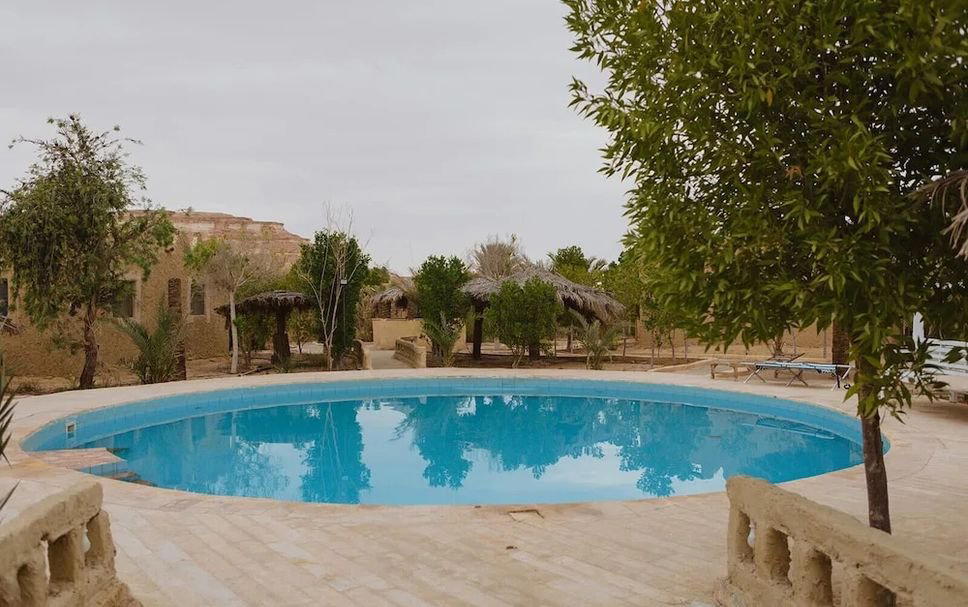
Salt Rock and Silence: How Siwa Builds
Shali Lodge is a hotel in Siwa, Egypt. There is a construction method in Siwa that exists almost nowhere else on earth. Kershef, a composite of salt rock quarried from the bed of the oasis lakes and sun-dried mud, has been the dominant building material here for at least a thousand years. It absorbs heat slowly, releases it at night, and weathers into surfaces that look less constructed than grown. The ruined citadel of Shali, the medieval town that collapsed in a three-day rainstorm in 1926, is especially dramatic demonstration of what kershef can become over centuries. Shali Lodge draws directly on that material tradition, placing it inside a contemporary hospitality context where the architecture does most of the editorial work.
This positions the property within a small but distinct tier of Egyptian accommodation: locally material-led, low-key in scale, and oriented around sense of place rather than international brand infrastructure. For context on where that sits in the wider Egyptian market, properties such as the Four Seasons Hotel Alexandria at San Stefano or the Sofitel Legend Old Cataract Aswan represent the international-brand, landmark-view tier. Shali Lodge operates in a different register entirely, closer in spirit to properties like Al Moudira Hotel on Luxor's West Bank, where the physical fabric of the building is the primary guest experience.
The Citadel as Backdrop, Not Decoration
Most hotels in historically significant locations treat their surroundings as scenery. The relationship between the hotel and the ruined citadel above it is more structural than that. The lodge sits at the base of the tell on which Shali was built, meaning the eroded salt-rock towers of the old town form the immediate skyline from terraces and upper floors. This is not a framed view from a distance; it is proximity to a ruin that is still, technically, dissolving. The citadel walls continue to erode with each rare rainfall, which means the backdrop shifts incrementally across seasons and years.
That relationship between built environment and geological process is specific to Siwa in a way that has no equivalent in Egypt's more trafficked destinations. The Giza Palace Hotel trades on pyramid adjacency; the Old Cataract in Aswan on Nile frontage. The hotel's version of landmark proximity is rawer and less managed, which is precisely what makes it architecturally interesting to a particular kind of traveller.
Desert Hospitality at Oasis Scale
Siwa sits in a depression in the Egyptian Western Desert, roughly 50 kilometres from the Libyan border and accessible by a single road from Marsa Matrouh on the Mediterranean coast. The drive from Cairo runs approximately 560 kilometres, and most visitors arrive by private vehicle or organised transfer. There is no rail connection. The oasis itself is small enough that most sites, including the Oracle Temple where Alexander the Great reportedly received his divine legitimacy in 331 BC, are reachable by bicycle or donkey cart from the town centre.
This scale shapes the accommodation logic. Siwa is not a destination that rewards large resort formats. Properties here work at lodge or guesthouse scale, where the guest-to-staff ratio allows for the kind of local orientation that the oasis actually requires. The nearest international-brand coastal properties, such as Cleopatra Sidi Heneish in Marsa Matrouh or Address Beach Resort Marassi in Sidi Abd El Rahman, are hours away on the coast road and serve a fundamentally different traveller profile.
For travellers who want the Egyptian Mediterranean coast rather than the interior desert, Address Marassi Golf Resort on the North Coast and Premier Le Rêve in Hurghada represent the larger-scale resort alternative. Siwa, and by extension the hotel, attracts a different traveller: one whose primary interest is the oasis ecosystem, the archaeological sites, and the Berber culture that has survived here in forms largely absent elsewhere in North Africa.
What the Architecture Demands of Its Guests
Kershef buildings are not climate-controlled environments in the conventional sense. The material's thermal mass does the work, which means rooms stay cooler than the exterior during the day and warmer at night, but the transition is gradual rather than switched. This is a feature of vernacular desert architecture that distinguishes it sharply from the sealed, air-conditioned environments of urban Egyptian hotels like the Dusit Thani LakeView Cairo or resort-tier properties such as Four Seasons Resort Sharm El Sheikh. Guests who arrive expecting the latter will find the former a recalibration.
The optimal season for Siwa runs from October through March, when daytime temperatures drop from summer extremes into a range that makes the desert landscape navigable on foot and by bicycle. Summer visits are possible but require adjustment to a different pace. The full Siwah guide covers the seasonal logic in more detail, including the date harvest in autumn, which draws visitors who want to see the oasis at agricultural rather than purely archaeological peak.
Planning a Stay
Siwa's tourism infrastructure remains thin relative to Egypt's more developed circuits. Booking for peak-season visits, particularly the October-November date harvest period and the spring weeks around March, should be arranged well in advance through whatever contact method the property makes available. Given the oasis's remoteness and limited accommodation stock, popular dates fill without the kind of last-minute availability that larger hotel markets sustain. Visitors combining Siwa with coastal Egypt might look at Good Days Boutique Hotel in Somabay or La Maison Bleue in El Gouna for contrast in the Red Sea resort tier.
At-a-Glance Comparison
Comparable venues nearby, for context on price, style, and recognition.
| Venue | Cuisine | Price | Awards | Notes |
|---|---|---|---|---|
| Shali LodgeThis venue — the venue you are viewing | Traditional Siwan architecture with palm-covered setting | $$$ | Not listed | Not listed |
| Good Days Boutique Hotel | Lifestyle-focused boutique retreat | $$$$ | Not listed | Somabay |
| Immobilia | Hotel | $ | Not listed | Cairo |
| Sofitel Cairo Downtown Nile | French luxury blended with Egyptian heritage in a modernist tower | $$$$ | 5-Star | Downtown |
| Nile Canopus | Intimate, high‑end dahabiya yacht offering slow‑travel Nile cruises between Luxor and Aswan, styled after Egypt’s golden age of travel. | $$$$ | Not listed | .nile_between_luxor_and_aswan |
| Sofitel Cairo Nile El Gezirah | Modern luxury with Art Deco heritage; a contemporary tower that blends French design elegance with authentic Egyptian and Moroccan influences. | $$$$ | 5-Star | Zamalek |
Continue exploring
More in Siwah
Hotels in Siwah
Browse all →
At a Glance
- Romantic
- Quiet
- Rustic
- Cozy
- Romantic Getaway
- Wellness Retreat
- Weekend Escape
- Garden
- Pool
- Restaurant
- Air Conditioning
- Garden
- Spa
- Garden
- Pool
- Restaurant
- Air Conditioning
- Garden
- Spa
Relaxed and informal atmosphere with natural comforts.