
Palácio Príncipe Real occupies a restored 19th-century palace on one of Lisbon's most culturally layered hillside neighbourhoods, earning 98 points from La Liste's 2026 Top Hotels ranking. It sits in the smaller, design-led tier of the city's premium accommodation market, where architectural heritage and neighbourhood character take precedence over international-brand scale. For travellers prioritising location and historic fabric, the address on Rua de São Marçal places it at the quiet edge of the Príncipe Real quarter.
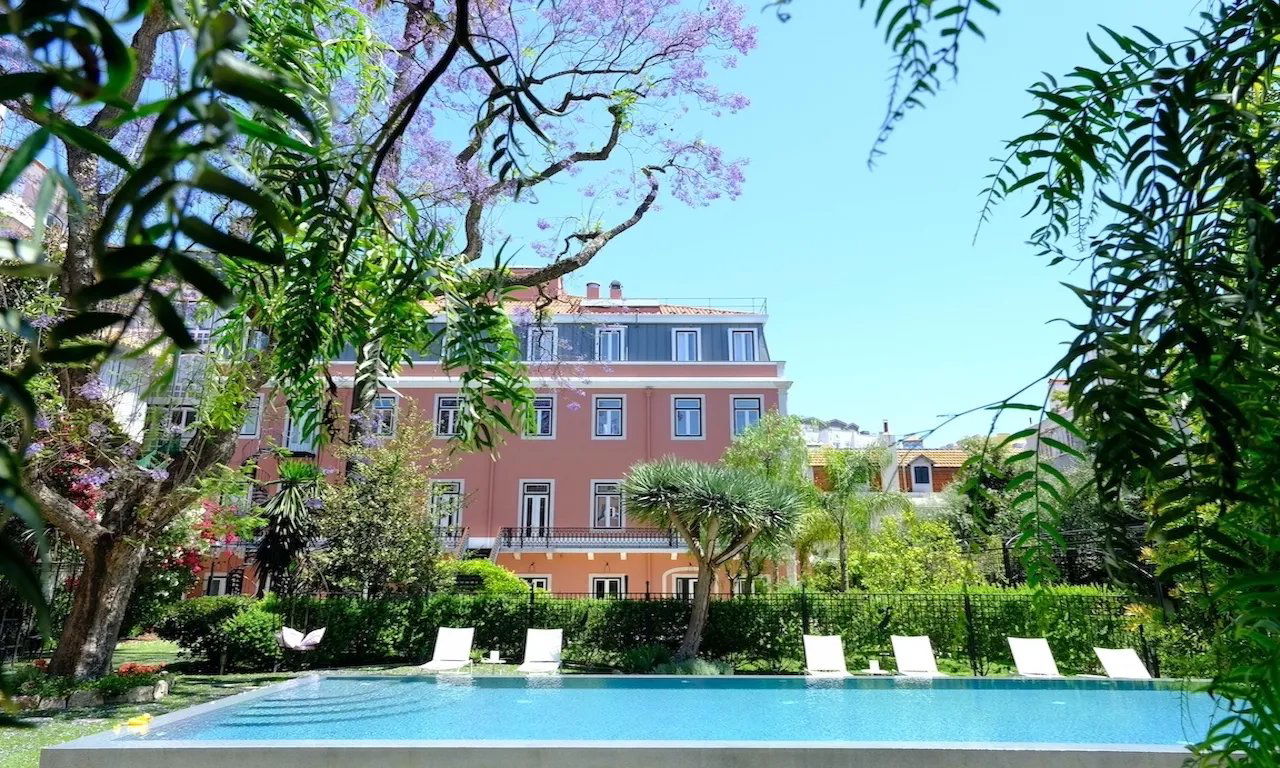
A Palace Address in Lisbon's Most Considered Neighbourhood
Príncipe Real is not the part of Lisbon that announces itself loudly. There are no grand viewpoint queues or tuk-tuk convoys working the streets around Rua de São Marçal. What the neighbourhood offers instead is something harder to manufacture: a residential grid of 19th-century palaces and townhouses, a weekend antiques market beneath the plane trees of the central garden, and a concentration of independent wine bars, natural wine importers, and design shops that reflect a particular, unhurried Lisbon sensibility. Palácio Príncipe Real sits squarely inside that context, at number 77 on the same street that has been central to the quarter's identity for well over a century.
Arriving on foot from Chiado or the Bairro Alto, you cross a threshold that the broader city's pace does not follow. The palace's 19th-century structure sets a physical register that large international-branded hotels in Lisbon, from the Corinthia Lisbon to the EPIC SANA Marques Hotel, cannot replicate regardless of renovation budget. The building's bones belong to an era when Príncipe Real was the preferred address of Lisbon's liberal aristocracy, and the current property trades on that inherited weight.
Where Palácio Príncipe Real Sits in the Lisbon Premium Market
Lisbon's upper-tier hotel market has undergone significant structural change over the past decade. International brands have expanded their footprint, particularly along Avenida da Liberdade and in the waterfront districts, while a separate cohort of smaller, palace-based and design-led properties has consolidated around historic Lisbon's hillside neighbourhoods. Palácio Príncipe Real belongs firmly to the second group. Its competitive set includes properties like the Bairro Alto Hotel, which occupies a similarly intimate historic building one neighbourhood over, and the Corpo Santo Lisbon Historical Hotel, which applies a comparable heritage-led approach in the Cais do Sodré district.
The distinction that separates this cohort from larger Lisbon properties, whether the Altis Avenida Hotel on the Praça dos Restauradores or the Altis Belém Hotel & Spa in the riverside district, is not simply scale. It is the way the building's history determines the product rather than decorating around it. A restored palace imposes its own logic on room configuration, circulation, and atmosphere. That constraint is also its strongest selling point to a specific kind of traveller.
La Liste's 2026 Leading Hotels ranking awarded Palácio Príncipe Real 98 points, placing it within a scoring bracket that in the La Liste methodology reflects consistent excellence at the upper tier. For context, La Liste aggregates assessments from across the global critical and travel intelligence community, and a score of 98 positions the property alongside a select group of European boutique palaces and design-led hotels rather than within the mass luxury segment. Among Lisbon's premium offerings reviewed by EP Club, that credential carries weight as a reference point for placing the property within its peer set. You can survey the full scope of where this property fits within the city's accommodation offer via our full Lisbon hotels guide.
The Cultural Weight of the Príncipe Real Quarter
Understanding Palácio Príncipe Real as a hotel requires understanding Príncipe Real as a neighbourhood, because the two are inseparable in any useful assessment. The quarter developed its character in the mid-to-late 19th century as Lisbon's bourgeoisie and liberal intellectual class built their townhouses on the ridge west of the Bairro Alto. Its garden, the Jardim do Príncipe Real, became one of the city's great social spaces, and the streets around it developed a density of cultural and commercial life that outlasted the original residents by a considerable margin.
Today, Príncipe Real occupies a specific position in Lisbon's internal geography. It is residential enough to feel unhurried but connected enough to reach Chiado in ten minutes on foot and the Mouraria district in twenty. The antiques market on Saturdays, the wine shops on Rua Dom Pedro V, and the Museu do Aljube nearby form a neighbourhood texture that has attracted both long-term local residents and a younger international creative community. For a hotel to be embedded here rather than along Avenida da Liberdade or in the modern waterfront development zones is a specific choice that shapes the entire guest experience, from the walk to dinner to the ambient noise level after midnight.
This neighbourhood positioning also puts the property within reach of some of Lisbon's more considered dining, drinking, and cultural options. EP Club covers those options across dedicated city guides: our full Lisbon restaurants guide, our full Lisbon bars guide, our full Lisbon wineries guide, and our full Lisbon experiences guide provide context for planning time in this part of the city.
Portugal Beyond Lisbon: Placing the Property in a Wider Network
For travellers building a broader Portugal itinerary, Lisbon palace hotels function as a natural basecamp before or after excursions to the Algarve, the Minho, or the Douro. EP Club covers properties across that full geographic range: the Anantara Vilamoura Algarve Resort in Quarteira represents the Algarve's resort tier, while the Bela Vista Hotel & Spa in Praia da Rocha occupies a smaller, more architecturally distinctive position on the same coastline. In the north, the Altis Porto Hotel in Porto, Casa da Calçada in Amarante, and Carmo's Boutique Hotel in Ponte de Lima each anchor different segments of the northern travel circuit. For the Serra da Estrela region, Casa das Penhas Douradas in Manteigas provides the mountain counterpoint, and in the south, Casa Mãe Hotel in Lagos and 3HB Faro in Faro cover the western Algarve and regional capital respectively. The Artsy in Cascais is the most direct day-trip-adjacent option for those based in central Lisbon.
At the international end of the spectrum, travellers for whom palace-hotel format is a consistent preference may find useful reference points in properties like Aman Venice in Venice, which applies a comparable historic-building logic in a different European context, or at the larger-footprint end, Aman New York in New York City and The Fifth Avenue Hotel in New York City. Those comparisons illuminate how the small-palace format in Lisbon differs from both large-brand luxury and the Aman micro-category in terms of service model and atmosphere.
Also in Lisbon's broader hotel field, the Art Legacy Hotel Baixa-Chiado and Brown's Avenue Hotel represent the contemporary and avenue-side alternatives for those who weight central Baixa access over neighbourhood character.
Practical Notes for Planning
Palácio Príncipe Real is located at Rua de São Marçal 77, 1200-419 Lisboa, in the Príncipe Real district. The address is walkable from both Chiado and the Rato metro station and sits within the wider historic hillside that also encompasses the Bairro Alto, Príncipe Real garden, and the antiques and wine-focused streets of Rua Dom Pedro V. Guests planning a Lisbon stay oriented around gastronomy, architecture, and the city's independent cultural scene will find this address more functional than a riverfront or Avenida da Liberdade placement. Price range, specific room categories, booking channels, and current availability are leading confirmed directly through the property, as those details are subject to change.
Frequently Asked Questions
Which room category should I book at Palácio Príncipe Real?
The database record for this property does not include room category or configuration detail, so a specific recommendation cannot be made here without risk of inaccuracy. What the La Liste 98-point score and the palace building format do imply is that the property operates in a tier where room count is limited and the historic structure shapes spatial variety more than a purpose-built hotel would. In properties of this type, higher categories often correspond to street-facing or garden-adjacent positioning rather than simply to square footage. Confirming room-type specifics directly with the property before booking is advisable, particularly for stays where light, noise exposure, or access to outdoor space matter.
What is Palácio Príncipe Real leading at?
Based on the available record, the property's clearest strength is the combination of a credentialed La Liste ranking (98 points, 2026) with a neighbourhood address that larger Lisbon hotels cannot replicate. Príncipe Real is one of the city's most architecturally coherent and culturally active historic quarters, and being based there rather than on a commercial avenue changes the texture of a Lisbon visit materially. Within Lisbon's premium segment, this property and its direct peers compete primarily on building character and location rather than on spa scale or meeting-facilities volume.
Do they take walk-ins at Palácio Príncipe Real?
No booking or walk-in policy information is available in the current database record for this property. Given its La Liste standing and the limited-key format typical of restored palace hotels in this district, availability without advance reservation should not be assumed. Direct contact with the property is the reliable route: the address is Rua de São Marçal 77, 1200-419 Lisboa. Phone and website details are not held in the current EP Club record and should be sourced directly from the property or a trusted booking platform.
Preferential Rates?
Our members enjoy concierge-led booking support and priority upgrades at the world's finest hotels.
Access the Concierge