Fairmont San Francisco

Michelin Guide New Hotels New Hotel · Michelin Selected
The Fairmont San Francisco has anchored the top of Nob Hill since 1907, its granite facade a fixed point in the city's skyline. The hotel operates across multiple dining venues and sits among San Francisco's most historically significant properties, drawing a mix of long-stay guests, business travelers, and locals who use its bars and restaurants as a regular meeting ground. Located at 950 Mason Street, it is walkable to Union Square and the Financial District.

Pearl is the En Primeur Club membership app — saves, bookings, and concierge access live there. Same editors, same standards.
- Address
- 950 Mason St, San Francisco, CA 94108
- Phone
- (415) 772-5000
- Website
- fairmont.com
- Directions
- Get directions
Nob Hill's Permanent Fixture
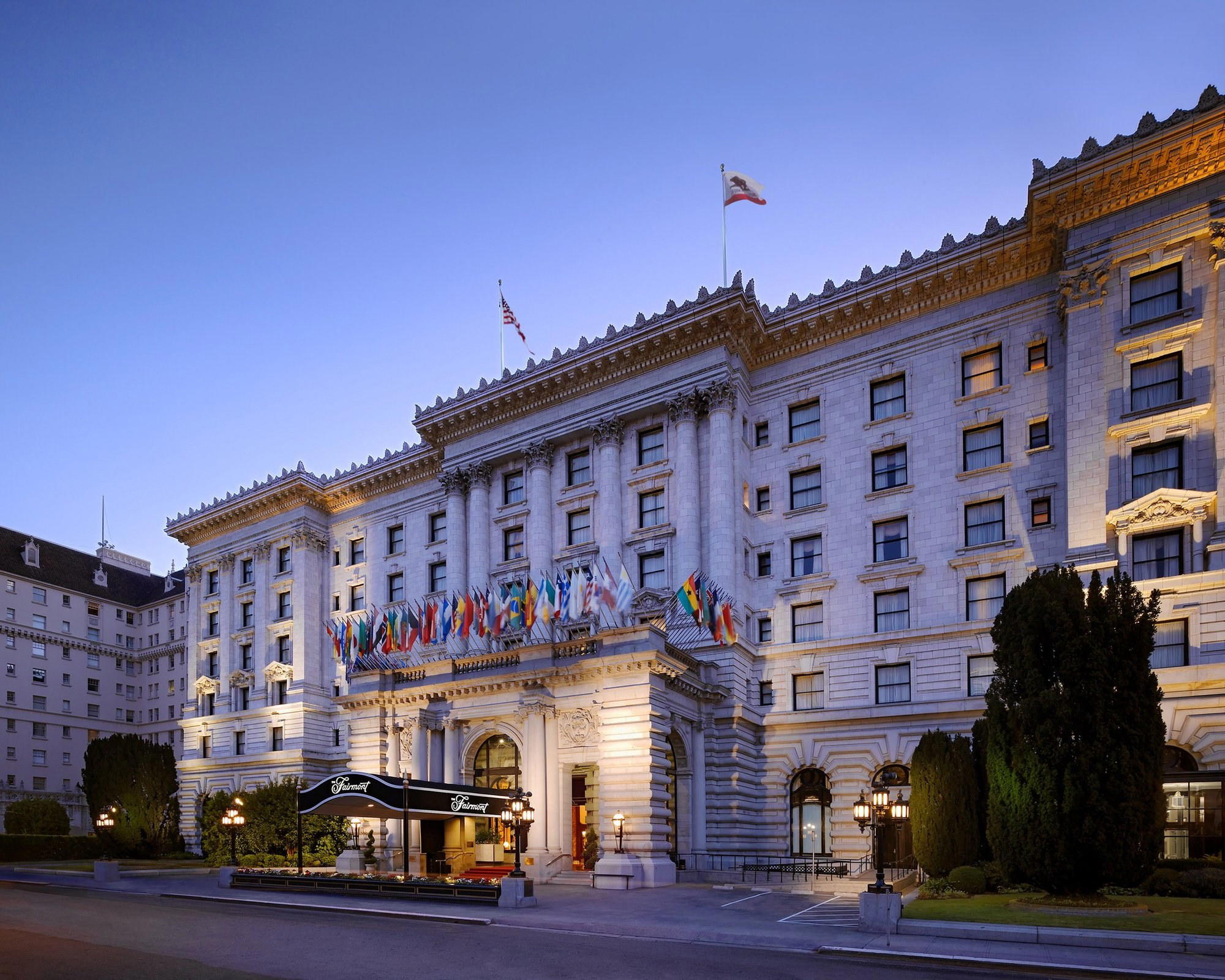
Arriving at 950 Mason Street, the approach does much of the work. The Fairmont San Francisco sits at the crown of Nob Hill, and the California Street cable car deposits guests at the base of a building that registers as civic architecture before it reads as hotel. The facade, completed in 1907 and opened just after the earthquake that leveled much of the city, is Beaux-Arts in scale and intention: rusticated granite base, arched windows stacked in pairs, a roofline that reads against the sky rather than disappearing into it. Inside the lobby, the proportions shift from grand to theatrical. Ionic columns run the length of the entry hall, the ceiling height discourages the kind of murmured conversation that fills smaller hotel lobbies, and the overall effect is less of arrival than of presentation.
That physical drama is the Fairmont's primary editorial argument. San Francisco's luxury hotel market has split over the past decade into two recognizable camps: the large-footprint legacy properties that trade on architectural weight and address, and the smaller, design-led hotels that position themselves on curation and restraint. The Fairmont belongs firmly to the first category, and makes no apology for it. Where a property like 1 Hotel San Francisco argues for a quieter, material-conscious aesthetic, or Hotel Drisco and its Pacific Heights counterpart Hotel Drisco Pacific Heights favor intimacy and neighborhood character, the Fairmont's competitive identity is built on scale, history, and the gravitational pull of a corner lot that has anchored Nob Hill for over a century.
The Architecture as Argument
The building's origin is inseparable from its meaning. Ground broke before the 1906 earthquake, and the structure survived the disaster largely intact while much of the surrounding city did not. That fact, documented in city records and architectural histories, gives the Fairmont a claim most hotels cannot manufacture: the building is a relic of San Francisco before its most defining trauma, and its survival is not incidental but structurally significant. The post-earthquake reopening in 1907 coincided with the city's broader effort to signal permanence and recovery, and the Fairmont's Nob Hill address placed it at the symbolic center of that effort.
The interior has been updated across ownership changes and renovation cycles, but the primary spaces retain their Edwardian scale. The columns, the mosaic floors, the central chandeliers: these elements are part of the building's load-bearing identity in a reputational sense, as much as the granite is in a structural one. Removing or softening them would produce a different hotel entirely, one without the particular authority that comes from space that was designed to impress on arrival. The Fairmont's design argument, in other words, is that the original brief was correct, and that the right response to an extraordinary room is to leave it largely as found.
That restraint, applied selectively, distinguishes the Fairmont from period hotels that have over-restored their interiors into something closer to theme park than architecture. The comparison is relevant across American luxury hotel history: properties like The Fifth Avenue Hotel in New York City or Raffles Boston demonstrate what happens when a landmark building gets a considered, modern intervention. The Fairmont's path has been more conservative, which in practice means the historic rooms carry more weight than the contemporary additions.
Position in the San Francisco Market
Nob Hill's concentration of legacy hotels creates a specific kind of comparison pressure. The Four Seasons Hotel San Francisco operates downtown at a modern price point with a contemporary format, and the Four Seasons Hotel San Francisco at Embarcadero anchors a different neighborhood with a different commercial logic. The The Battery positions itself as a private members club with rooms, serving a tech-adjacent professional audience.
The practical calculus for choosing the Fairmont over more contemporary options, including the Hotel Adagio, Autograph Collection or the Four Seasons Hotel Silicon Valley at East Palo Alto for Bay Area visitors, comes down to what you want the hotel itself to contribute. If the building is meant to be part of the experience rather than a comfortable container for it, the Fairmont's architecture does work that newer properties, however well-designed, cannot replicate. For guests whose frame of reference runs to properties like Badrutt's Palace Hotel in St. Moritz or Aman Venice, the category of historically significant, architecturally imposing hotel is immediately legible, and the Fairmont belongs in that conversation.
For guests coming from California's own luxury landscape, the Fairmont reads differently depending on direction. Travelers arriving from properties focused on landscape and natural material, such as Post Ranch Inn in Big Sur, Auberge du Soleil in Napa, or SingleThread Farm Inn in Healdsburg, will find the Fairmont's urban formality a deliberate counterpoint. The scale shifts from intimate to ceremonial, and the setting shifts from landscape to cityscape. Both modes are valid; they are simply making different arguments about what a luxury hotel stay should feel like.
Planning a Stay
The Fairmont San Francisco sits at the top of Nob Hill, accessible by the California Street cable car, which is the most direct connection to Union Square and the downtown retail corridor below. The neighborhood itself is quieter than the Embarcadero or SoMa districts, which positions the hotel as a retreat from the city's more active commercial zones while remaining within practical distance of them. Guests planning activity across the Bay Area, including excursions toward Silicon Valley via the Four Seasons Hotel Silicon Valley at East Palo Alto corridor or wine country to the north near properties like SingleThread Farm Inn, will find the Nob Hill address adds transit time in both directions but provides a base with stronger architectural returns than downtown alternatives.
Room categories at the Fairmont split between the original historic building and the Tower addition, with the Tower offering more contemporary finishes and views that extend across the bay on clear days. The historic building's rooms carry more architectural character and are the more consistent choice for guests booking primarily for the property's heritage identity. Advance booking is advisable for peak travel periods, particularly during the city's conference-heavy autumn calendar and the summer months when San Francisco draws international visitors at volume. For a broader view of how the Fairmont fits the city's dining and hotel scene, see our full San Francisco restaurants guide.
In Context: Similar Options
Comparable venues nearby, for context on price, style, and recognition.
| Venue | Cuisine | Price | Awards | Notes |
|---|---|---|---|---|
| Fairmont San FranciscoThis venue — the venue you are viewing | Well-known luxury atop Nob Hill with historic grandeur and modern comforts. | Not listed | Michelin Guide New Hotels New Hotel · Michelin Selected | Not listed |
| Palace Hotel, a Luxury Collection Hotel, San Francisco | Historic luxury landmark with modern updates | Not listed | Michelin Selected · Forbes Recommended | Financial District/South Beach |
| Hotel Vitale | Contemporary bohemian with nods to San Francisco's hippie heritage, infused with natural elements and modern luxury touches. | $300–500 | Not listed | Financial District/South Beach |
| W San Francisco | Modern luxury with lively, free-spirited design. | $300–500 | Michelin Selected | SoMa |
| Trimbri Hotel San Francisco | Lively boutique hotel blending vitality and comfort in central San Francisco. | $1–100 | Not listed | Tenderloin |
| Four Seasons Hotel San Francisco | Luxury urban hotel with Equinox fitness integration | Not listed | Michelin Selected · Star Wine List | Financial District/South Beach |
Recognition history
Dated appearances from independent guides and award organizations, with the underlying list record or original source where available.
Michelin Guide New Hotels New Hotel
Michelin Guide New Hotels
Michelin Selected
Michelin
Continue exploring
More in San Francisco
Hotels in San Francisco
Browse all →
Bars in San Francisco
Browse all →
Restaurants in San Francisco
Browse all →
Details
- Elegant
- Classic
- Sophisticated
- Well Known
- Ornate
- Business Trip
- Romantic Getaway
- Anniversary
- Celebration
- Historic Building
- Panoramic View
- Terrace
- Spa
- Pool
- Fitness Center
- Room Service
- Concierge
- Business Center
- Valet Parking
- EV Charging
- Skyline
- Wheelchair Accessible
- Elevator
- Step Free Entrance
- Accessible Parking
- Accessible Restroom
Elegant and ornate with lavish furnishings, premium bedding, and sweeping city views, creating a sophisticated classic atmosphere.