Monachyle Mhor

Michelin Selected
A Michelin Selected hotel set in the Balquhidder glen, Monachyle Mhor occupies a working farm on the edge of Loch Voil where the architecture speaks to place rather than period style. The property sits in a category of Scottish rural retreats that prioritise landscape integration over polish, placing it closer to Kilchoan Estate than to a conventional country house hotel.

Pearl is the En Primeur Club membership app — saves, bookings, and concierge access live there. Same editors, same standards.
- Address
- Balquhidder, Loch Lomond, UK
- Phone
- +44 1877 384622
Where the Glen Does the Work
The road into Balquhidder is a useful calibration. It leaves the A84 near Lochearnhead and narrows steadily over six miles of single track, past Rob Roy's grave and along the south shore of Loch Voil, before the farm buildings of Monachyle Mhor come into view against the hillside. By the time you arrive, the city logic that governs most hotel decisions — proximity, signage, convenience — has already dissolved. That gradual severance from the familiar is not incidental to what this place offers; it is the offer. See our full Loch Lomond restaurants and hotels guide for broader regional context.
Scottish rural hospitality has split into two broad categories over the past two decades. One track runs through the grand estate model, Gleneagles in Auchterarder being the clearest example, where scale, golf courses, and brand infrastructure carry the experience. The other track runs through smaller, family-operated properties where the physical environment and a strong sense of culinary identity do the heavy lifting.
Architecture That Reads as Landscape
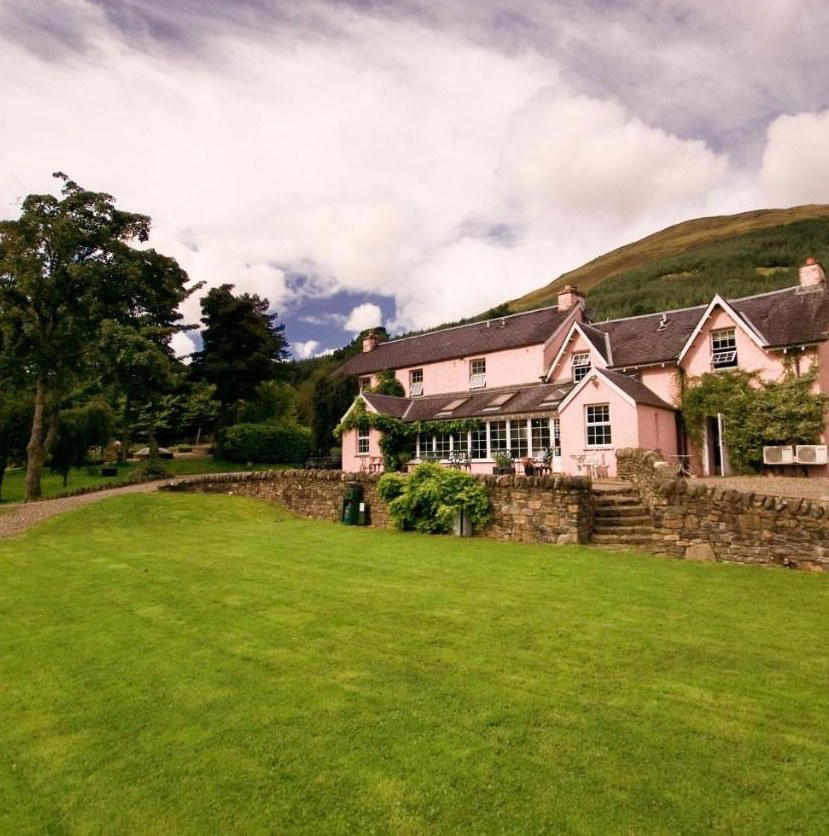
The physical language of Monachyle Mhor is worth attention. Rather than the baronial stone vocabulary that dominates Scottish country house hotels, towers, turrets, formal gardens, the property works with a looser, more pragmatic aesthetic. The original farmhouse and its outbuildings provide the core structure, and extensions and additions have been made in a way that references agricultural vernacular rather than attempting to compete with it. Pink-washed render on the main house reads as both playful and deliberate against the grey-green of the surrounding hillsides; it signals that the owners are comfortable with a certain irreverence toward heritage conventions.
This approach puts Monachyle Mhor in an interesting position within British rural hotel design. Properties like Estelle Manor in North Leigh and The Newt in Somerset have invested heavily in site transformation, new build, landscape engineering, controlled visitor journeys. Monachyle Mhor moves in a different direction, working with what the site offers rather than reordering it. The loch and the glen slopes are not backdrop; they frame every view from the property, and the architecture makes no attempt to compete with them.
For travellers accustomed to the design-hotel register of Hotel du Vin at One Devonshire Gardens in Glasgow or the urban polish of The Rutland in Edinburgh, Monachyle Mhor requires a different calibration. This is not a property that performs luxury through surface finish. It performs it through place, through the specific quality of light on Loch Voil on a November morning, through the silence between the hills, through the kind of stillness that no amount of thread count or marble can manufacture.
Michelin Selection and What It Signals
The Michelin Selected designation for 2025 locates Monachyle Mhor in a tier of British hotels that the guide's hotel inspectors consider worth the attention of a traveller who already knows what good looks like. The Michelin hotel selection differs from the restaurant star system in methodology, but the underlying logic is similar: properties are assessed against their category and context, not against a universal luxury template. For a remote farm-hotel in a Highland glen, Michelin Selected status signals that the property delivers on its own terms with enough consistency to warrant external validation. It places Monachyle Mhor in the same general recognition tier as properties such as Farlam Hall Hotel and Restaurant in The Lake District and Longueville Manor in Jersey, both Michelin Selected, both properties where the physical setting and dining are the primary currency.
It is worth contrasting this with the more internationally visible luxury tier. The Savoy in London, Badrutt's Palace Hotel in St. Moritz, and Hôtel de Paris Monte-Carlo operate in an entirely different register, one built on historical prestige, city positioning, and global brand recognition. Monachyle Mhor makes no argument in that direction. Its claim is narrower and more specific: that a farm on Loch Voil, run with real seriousness about food and place, can offer something that no city hotel can replicate regardless of budget.
Food, Farm, and the Kitchen's Supply Chain
Farm-to-table has become so widely deployed as a marketing phrase that it has largely lost descriptive value. At Monachyle Mhor, the relationship between the working farm and the kitchen is structural rather than cosmetic. The property sits within a farming operation, and that proximity to supply shapes what the kitchen is able to do in a way that properties without land simply cannot replicate. Scottish rural hotel dining has moved significantly over the past fifteen years; the reference point is no longer the silver-service country house dinner but a more produce-driven, seasonally constrained approach that reflects what is actually available in glen country at a given time of year. Properties like Crossbasket Castle in High Blantyre and Whisky Lodges Coleburn in Longmorn operate in adjacent territory, though without the same depth of agricultural integration.
Planning a Stay
Balquhidder sits roughly 65 kilometres north of Glasgow and around 85 kilometres from Edinburgh, making Monachyle Mhor accessible as a short-break destination from either city without requiring a full Highland expedition. The six-mile single-track road from the A84 is driveable year-round but demands appropriate vehicle confidence in winter conditions; the glen can accumulate snow from November through March, and arrival in low light on an unfamiliar track is an exercise leading planned in daylight. The property is within the Loch Lomond and The Trossachs National Park boundary, which means planning permissions have historically constrained development and kept the surrounding area in a relatively unaltered state. For travellers weighing the Monachyle Mhor experience against other British rural properties in a similar character bracket, Lime Wood in Lyndhurst and Oddfellows on the Park in Manchester represent the southern English equivalent in terms of design ethos, though neither operates within a working agricultural context. Dunluce Lodge in Portrush and Thornton Hall Hotel and Spa in Heswall offer comparable small-hotel character in the British Isles context. Booking well in advance is advisable for peak season periods, particularly summer weekends when demand for rural properties within national park boundaries consistently outpaces supply.
Side-by-Side Snapshot
Comparable venues nearby, for context on price, style, and recognition.
| Venue | Cuisine | Price | Awards | Notes |
|---|---|---|---|---|
| Monachyle MhorThis venue — the venue you are viewing | Restored 18th-century farmhouse with modern extensions and distinctive outbuildings | Not listed | Michelin Selected | Not listed |
| House of Gods Glasgow | Maximalist luxury with modern opulence and timeless decadence. | Not listed | Michelin Selected | Anderston/City/Yorkhill |
| Fowlescombe Farm | Victorian farmhouse and barns restored into a modern regenerative farm retreat | Not listed | Not listed | Ugborough |
| Charlotte Street Hotel | Hotel | Not listed | Not listed | Fitzrovia |
| Margate House | Artily dressed Georgian townhouse | $300–500 | Michelin Selected · Mr & Mrs Smith Seal of Approval | Cliftonville |
| Ned's Club | Historic landmark converted into lifestyle hotel and members' club | Not listed | Not listed | Cheapside |
Recognition history
Dated appearances from independent guides and award organizations, with the underlying list record or original source where available.
Michelin Selected
Michelin
Details
- Romantic
- Quiet
- Modern
- Rustic
- Scenic
- Cozy
- Whimsical
- Romantic Getaway
- Weekend Escape
- Destination Wedding
- Waterfront
- Panoramic View
- Historic Building
- Design Destination
- Private Dining
- Wi Fi
- Room Service
- Restaurant
- Sauna
- Garden
- Waterfront
- Mountain
- Step Free Entrance
Eclectic mix of urban style, rustic elements like antlers and stone walls, with a cool, sophisticated atmosphere in a secluded highland setting.