The Mercure Kakadu Crocodile Hotel in Jabiru is one of Australia's most architecturally singular accommodation choices, its building designed in the shape of a saltwater crocodile, a deliberate nod to the Mirarr people's connection to the land within Kakadu National Park. Positioned as the primary full-service hotel option inside the park boundary, it serves as a practical and culturally grounded base for exploring one of the world's largest tropical wilderness areas.
Pearl is the En Primeur Club membership app — saves, bookings, and concierge access live there. Same editors, same standards.
- Address
- Flinders St, Jabiru NT 0886, Australia
- Phone
- +61 8 8979 9000
- Website
- kakadutourism.com
- Directions
- Get directions
 Saves & bookings on Pearl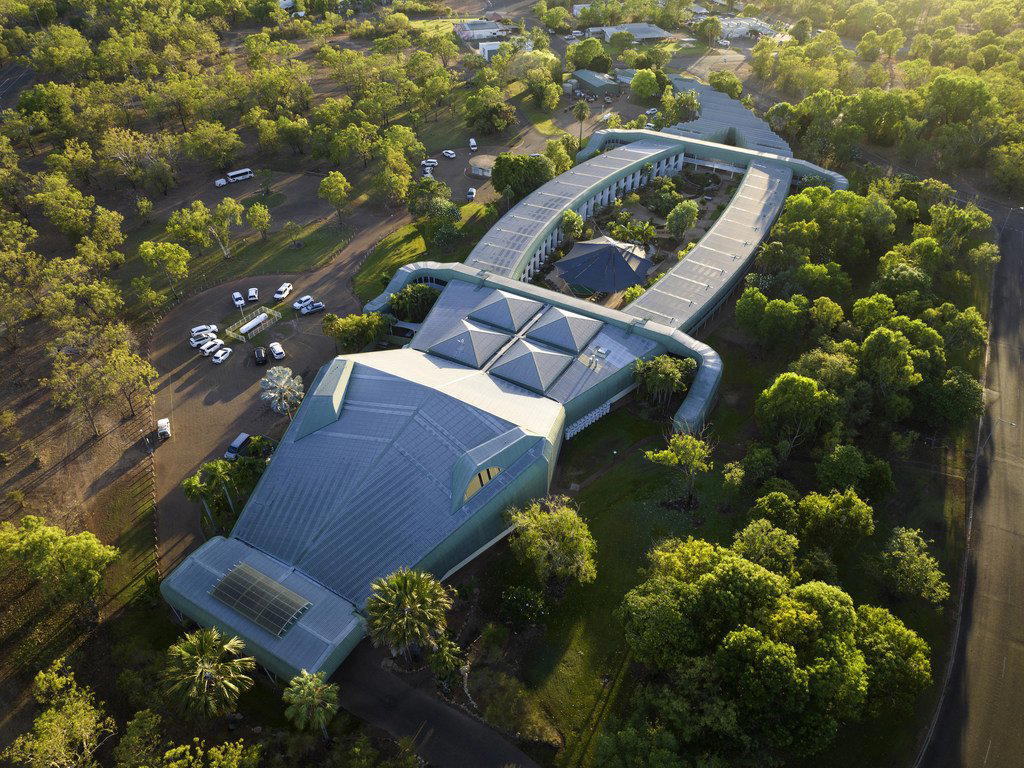
A Building That Earns Its Shape
There are few hotels anywhere whose floor plan functions as a statement of place. The Mercure Kakadu Crocodile Hotel in Jabiru is a 3-star hotel in Kakadu National Park, with rooms from about $120 a night. Viewed from above, the structure traces the silhouette of a saltwater crocodile, not as a novelty gimmick, but as an architectural acknowledgement of the Mirarr Traditional Owners whose country this building sits on. In a region where the saltwater crocodile holds deep cultural significance, the design reads as deliberate rather than decorative. That distinction matters here more than almost anywhere else in Australia.
Jabiru itself is a town unlike most. Built in the late 1970s to house workers from the nearby Ranger uranium mine, it sits entirely within Kakadu National Park, a dual World Heritage listed site covering nearly 20,000 square kilometres. The town's existence inside a protected area of that scale gives every building within it an unusual weight. The Crocodile Hotel, as it is known locally, is the settlement's primary full-service accommodation option, and that position shapes everything about how it operates and who stays there.
Design in Context: What the Architecture Actually Signals
Across Australia's premium accommodation spectrum, design-led properties have largely concentrated in coastal or urban settings. Think of the considered materiality at The Calile in Brisbane, or the heritage-adaptive approach at Capella Sydney. Remote Australia has its own design tradition, but it tends toward vernacular forms: refined platforms, corrugated iron, open-air breezeways that respond to heat rather than make a conceptual argument. The Crocodile Hotel sits in a different register entirely.
The crocodile-form building was constructed in 1987, designed by Queensland architect Alexis Petroff. The scale of the concept, and the logistical challenge of building anything to specification in a remote Northern Territory location during that era, gives the structure a weight that outlasts its novelty. What looks from the air like an architectural joke resolves on the ground into something more considered: a building that uses Indigenous iconography as structural vocabulary rather than surface decoration. Whether it fully succeeds as cultural architecture is a legitimate question, and one that the region's broader conversation about land, sovereignty, and tourism continues to frame.
For travellers arriving after the long drive from Darwin (roughly 250 kilometres on the Arnhem Highway), the building's silhouette from the car park is the first legible signal that Jabiru operates on different terms to most Australian towns. There is no comparable experience at, say, Southern Ocean Lodge in Kingscote or Wildman Wilderness Lodge in Marrakai, both of which use design to respond to landscape. Here, the building uses design to embody a specific animal that lives within it.
Positioning Within the Kakadu Accommodation Market
Kakadu's accommodation options range from campgrounds and caravan parks to the handful of established lodge and hotel properties distributed across the park's vast interior. The Mercure brand, part of Accor's mid-to-upper midscale tier, positions the Crocodile Hotel as one conventionally serviced option within Jabiru, with a pool, restaurant facilities, and a level of infrastructure that the park's more rustic alternatives do not offer.
That positioning matters practically. Kakadu's major sites, Ubirr rock art, Nourlangie, the Yellow Water Billabong, Jim Jim Falls, require either a full day's driving or multi-day planning. The Crocodile Hotel's location in Jabiru places it within reach of the park's northern and central zones, making it a viable operational base rather than simply a place to sleep. For travellers covering the park seriously over several days, the difference between a full-service hotel and a campsite at the end of a day in 35-degree heat is not trivial.
For those building a broader Northern Territory itinerary, the Crocodile Hotel pairs logically with properties that bookend the Leading End circuit. Wildman Wilderness Lodge in Marrakai sits closer to Darwin and covers a different ecosystem, the Mary River floodplains, while Jabiru anchors the Kakadu section of the journey. The two properties serve different purposes within the same broad landscape.
Timing and Access
Kakadu operates on a hard seasonal calendar. The wet season (roughly November through April) closes significant sections of the park, including many of particularly visited sites, due to flooding and road access. The dry season (May through October) is when the park is fully accessible and when the Crocodile Hotel operates at its most useful. Temperatures in the dry season are manageable, wildlife concentrates around remaining water sources, and the park's cultural sites are all open. Arriving in the shoulder months of May or October gives some flexibility on crowd density while retaining access.
Darwin Airport is the practical entry point for most international and domestic travellers. The drive to Jabiru takes between two and three hours depending on stops. There is no commercial air service into Jabiru itself. For those preferring not to self-drive, guided tour operators departing Darwin frequently include overnight stays in Jabiru as part of multi-day Kakadu itineraries.
Planning a Stay
The Crocodile Hotel's address is Flinders Street, Jabiru NT 0886. Travellers should confirm room availability and current facilities directly through the Mercure/Accor booking channels, as specific room categories and dining hours vary seasonally. The hotel's position as the area's primary full-service property means it is in demand during peak dry-season months; booking well in advance for July and August travel is advisable. For context on how remote-Australia stays compare across the country's broader premium accommodation market,
Travellers who have recently stayed at properties like Crystalbrook Riley in Cairns or Lake House in Daylesford will find the Crocodile Hotel operates in a different register, less focused on food and beverage programming, more focused on proximity to one of the country's most significant natural and cultural sites. That trade-off is the point. The building's architecture reminds you where you are. The park does the rest.
Quick Comparison
Comparable venues nearby, for context on price, style, and recognition.
| Venue | Cuisine | Price | Awards | Notes |
|---|---|---|---|---|
| Mercure Kakadu Crocodile HotelThis venue — the venue you are viewing | Indigenous-owned heritage hotel with distinctive crocodile-shaped architecture built in the 1980s as an interpretation of Gagudju cultural significance. | $$ | 3-Star | Not listed |
| Punthill Narrabundah | Contemporary apartment-style hotel with Art Deco architectural elements positioned as a relaxed, home-away-from-home base for extended stays. | $$ | 4-Star | Narrabundah |
| The Mitchelton Hotel Nagambie | contemporary luxury winery resort | $$$ | 4-Star | Nagambie |
| Little National Hotel Adelaide | Contemporary luxury boutique hotel designed for modern travellers. | $$$$ | 4-Star | North Terrace |
| QT Bondi | beachside apartment hotel | $$$$ | 4-Star | Bondi Beach |
| voco Brisbane City Centre | Contemporary boutique-style hotel with industrial and scholarly design influences reflecting the riverside setting and nearby universities. | $$$ | 4-Star | North Quay |
At a Glance
- Well Known
- Whimsical
- Scenic
- Rustic
- Family Vacation
- Weekend Escape
- Garden
- Historic Building
- Design Destination
- Panoramic View
- Wi Fi
- Pool
- Restaurant
- Bar
- Business Center
- Laundry Service
- Garden
- Wi Fi
- Pool
- Restaurant
- Bar
- Business Center
- Laundry Service
Air-conditioned comfort with natural light-filled modern bedrooms adorned with local Aboriginal artwork; outdoor seating available for evening drinks overlooking the landscaped courtyard and shaded swimming pool.