
Michelin Selected
Kameya Hotel sits in Yunohama, one of Yamagata Prefecture's oldest onsen resort districts, and holds a MICHELIN Selected distinction in the 2025 guide. The property occupies a position in Japan's traditional ryokan continuum where architecture, thermal bathing culture, and seasonal cuisine intersect. For travellers reaching Tsuruoka from Tokyo, it represents a measured alternative to the region's newer design-forward properties.

Pearl is the En Primeur Club membership app, where members save venues, book tables and use the concierge.
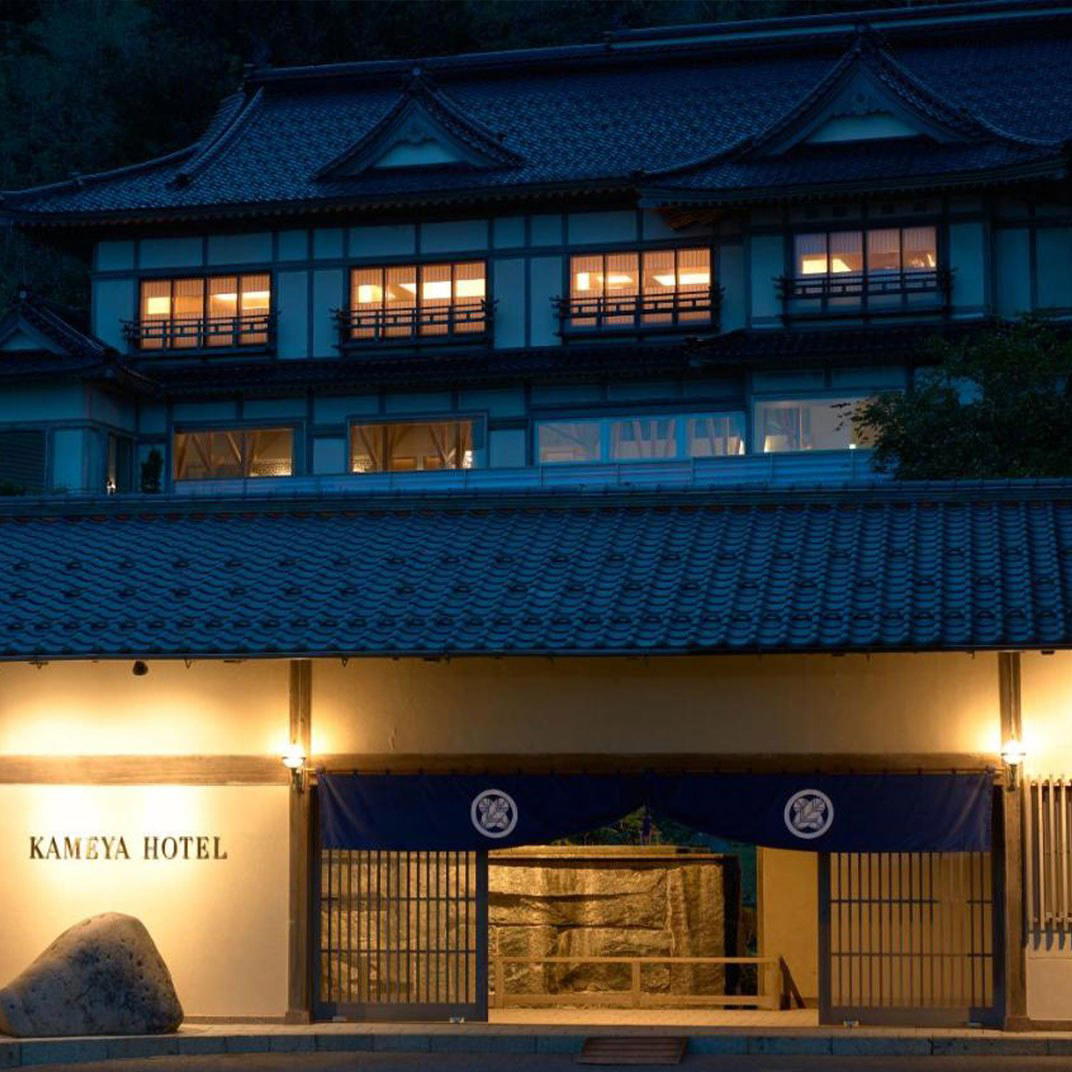
Where Yunohama's Thermal Tradition Takes Physical Form
Japan's onsen hotel tradition is deeply architectural. The best of these properties are not simply buildings with baths attached; they are spatial arguments about how hot-spring culture, regional materiality, and seasonal rhythm should be inhabited. Yunohama Onsen, a resort district on the Sea of Japan coast within Tsuruoka city, has anchored that tradition in Yamagata Prefecture for generations. Kameya Hotel, addressed at Yunohama 1-5-50, sits within that lineage and carries a MICHELIN Selected distinction in the 2025 guide, a credential that places it among a specific cohort of Japanese lodgings recognised for quality without necessarily reaching the star tier occupied by properties like Gora Kadan in Hakone or Amanemu in Mie.
Yunohama's position facing the Japan Sea gives it a particular atmospheric character that separates it from the inland mountain onsen towns more commonly featured in international travel media. The light here is oceanic and diffuse, especially in autumn and winter when the Shonai plain's skies close over with the seasonal weather patterns that have shaped the region's food culture as much as its architecture. Arriving at Kameya Hotel, you are entering a resort that has developed within that coastal onsen context rather than against it.
The Architectural Conversation Between Ryokan and Place
Japan's traditional inn format, the ryokan, is one of the most codified architectural typologies in world hospitality. The spatial grammar is consistent across properties: a sequence of threshold moments, from the genkan entry and the exchange of shoes, through corridors calibrated for a particular pace, to the tatami room that functions as sitting room, dining room, and bedroom in succession. Within that grammar, individual properties differentiate through the quality of materials, the handling of natural light, the relationship between interior space and garden, and the degree to which thermal bathing facilities are integrated into the guest experience rather than treated as an amenity add-on.
Yunohama Onsen properties, including Kameya Hotel, operate within a coastal variant of this typology where sea views carry significant spatial weight. This is a different design challenge from the mountain ryokan, where enclosure and the forested hillside provide the primary visual frame. The sea-facing ryokan must resolve the tension between the openness of the oceanic horizon and the introversion that traditional Japanese spatial design tends to favour. How individual properties handle that tension is often the most telling indicator of their architectural seriousness.
For regional comparison, the newer Shonai Hotel Suiden Terrasse in Tsuruoka takes an entirely different architectural approach, designed by Shigeru Ban around its relationship to rice paddy water. The two properties represent divergent positions on the question of what a high-quality Tsuruoka stay should look and feel like, and choosing between them is partly a question of whether you want the continuity of a thermal bathing tradition or the statement of contemporary Japanese architecture.
Tsuruoka's Place in Japan's Culinary Geography
No serious account of Tsuruoka accommodation should omit the food context. Tsuruoka holds UNESCO Creative City of Gastronomy status, a designation that reflects the depth of its agricultural and culinary heritage in the Shonai region. The area's mountain vegetables, known as sansai, its unique varieties of rice, and its Buddhist temple cuisine tradition at nearby Dewa Sanzan give it a culinary identity that is genuinely distinct within Japan rather than a provincial variation of national patterns. Ryokan dining in this context carries more specificity than in many other parts of the country, because the ingredient base is unusually localised and the kaiseki tradition connects directly to seasonal availability in ways that urban hotels cannot replicate.
For visitors building a Japan itinerary around food and accommodation quality, Tsuruoka sits on a different axis from the Kyoto-Osaka-Tokyo corridor. Properties like HOTEL THE MITSUI KYOTO in Kyoto or Bvlgari Hotel Tokyo in Tokyo offer urban luxury with access to dense culinary infrastructure. Tsuruoka offers the opposite proposition: relative isolation, a single-region ingredient story, and accommodation formats that have developed in direct response to that local specificity. See our full Tsuruoka restaurants guide for a wider picture of the dining scene.
Placing Kameya Within Japan's MICHELIN-Selected Ryokan Tier
The MICHELIN Selected designation, as applied to hotels and ryokan in Japan, indicates a property that the guide's inspectors consider worth recommending without placing it in the starred accommodation category occupied by a smaller group of properties. Within Japan's ryokan market, this tier includes a broad range of properties, from well-maintained traditional inns to carefully managed boutique operations. The designation is meaningful as a quality floor rather than a ceiling indicator.
Comparable MICHELIN-recognised ryokan elsewhere in Japan include Nishimuraya Honkan in Kinosaki-cho, which operates in a similarly traditional onsen-town context, and Kamenoi Besso in Yufu, which occupies a prestigious position in Kyushu's hot-spring belt. These properties share a commitment to the formal ryokan experience, distinguishing them from design-forward properties like Zaborin in Kutchan or Benesse House in Naoshima, which sit in a different peer group where contemporary art or architecture is the primary organising principle. Other regional properties worth considering in the traditional Japanese inn format include Asaba in Izu and Fufu Nikko in Nikko, both of which demonstrate how the ryokan typology adapts to different geographical settings across Honshu.
Planning the Visit
Tsuruoka is accessible from Tokyo via the JR Tsuruoka station, with shinkansen connections through Sakata or Niigata depending on route. The Yunohama Onsen district sits west of the city centre on the coast, requiring a short transfer from the station. Given that Yamagata Prefecture experiences heavy snowfall between December and February, winter arrivals should factor in potential disruptions to local road access, though onsen towns in that season carry their own atmospheric reward. Autumn, when Shonai's rice harvest coincides with the mountain vegetable season, represents the period when the regional food story is at its most coherent, and ryokan dining menus typically reflect that concentration of local produce most directly. Booking should be made well in advance for peak autumn and New Year periods, when coastal ryokan in the Yunohama area fill quickly with Japanese domestic travellers who know the region's seasonal calendar. For those building a broader Japan ryokan itinerary, properties such as Satoyama-Jujo in Niigata, Fufu Kawaguchiko in Fujikawaguchiko, or Fufu Kyu-Karuizawa Restful Forest in Karuizawa offer useful regional comparisons across Honshu's distinct landscape types. For a different register entirely, international properties like The Fifth Avenue Hotel in New York City, Badrutt's Palace Hotel in St. Moritz, or Hôtel de Paris Monte-Carlo in Monte Carlo illustrate how differently the luxury accommodation question resolves in urban European contexts compared to Japan's onsen tradition.
A Quick Peer Check
Comparable venues nearby, for context on price, style, and recognition.
| Venue | Cuisine | Price | Awards | Notes |
|---|---|---|---|---|
| Kameya HotelThis venue (the venue you are viewing) | Contemporary ryokan blending traditional Japanese hot spring culture with modern minimalist design; recently renovated to balance heritage (established 1813) with contemporary aesthetics. | Not listed | Michelin Selected | Not listed |
| Shonai Hotel Suiden Terrasse | Contemporary resort blending into rice paddy landscape with distributed low-rise structures. | Not listed | Michelin Selected | Kitakyoden |
| The Knot Yokohama | Boutique hotel inspired by cruise ship cabins with a nod to Yokohama's maritime heritage. | $100–200 | Michelin Selected | Nishi-ku |
| The Knot Sapporo | Lifestyle hotel blending natural Hokkaido warmth with sleek modern design | Not listed | Michelin Selected | Susukino |
| Wanoi Kakunodate | Luxury heritage conversion of three distinct historic kura storehouses scattered throughout a preserved samurai town, developed by JR East to preserve traditional architecture. | $200–300 | Michelin Selected | Kakunodate |
| Sierra Resort Hakuba | Western-style luxury mountain resort blending contemporary comfort with traditional Japanese architecture and natural hot spring heritage. | $300–500 | Michelin Selected | Hakuba Village |
Recognition history
Dated appearances from independent guides and award organizations, with the underlying list record or original source where available.
Michelin Selected
Michelin
Continue exploring
More in Tsuruoka
Details
- Modern
- Elegant
- Scenic
- Romantic
- Romantic Getaway
- Wellness Retreat
- Anniversary
- Beachfront
- Waterfront
- Panoramic View
- Destination Spa
- Sauna
- Massage
- Beach Access
- Free Parking
- Wi Fi
- 24 Hour Front Desk
- Spa
- Waterfront
Contemporary minimalist design blending modern Japanese and Western aesthetics with airy, open public bath areas overlooking the sea; serene and contemplative atmosphere enhanced by natural light and ocean vistas.