
A former wine-tank industrial complex on the Peloponnese coast, Dexamenes Seaside Hotel transforms the concrete geometry of 1920s winemaking infrastructure into spare, architecturally considered accommodation. The setting, on the Kourouta beachfront in Elis, positions it among a narrow tier of Greek properties where adaptive reuse and material honesty drive the design proposition rather than conventional resort polish. For travellers oriented toward design and place, the conversion itself is the experience.
 Discover on Pearl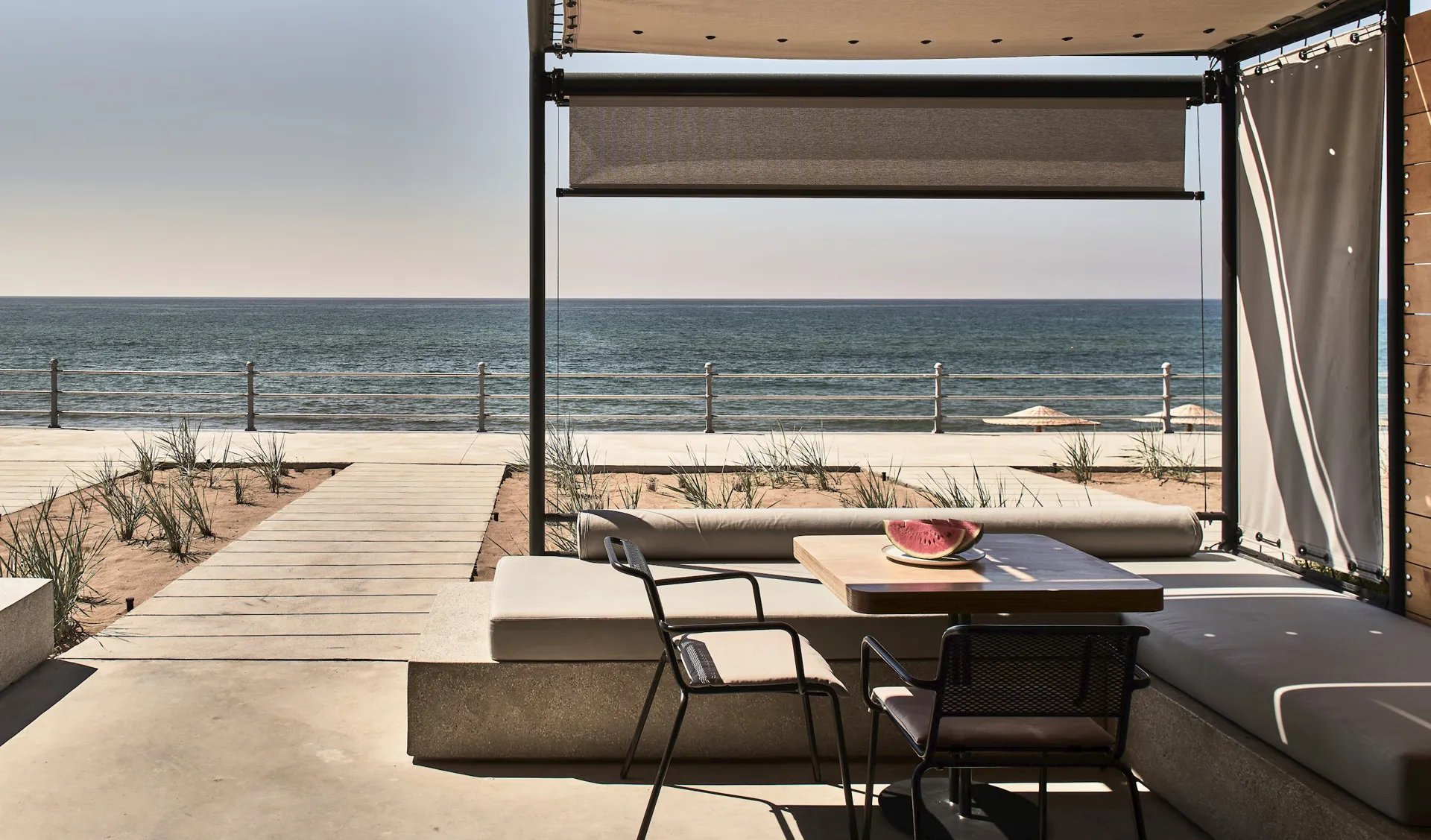
Concrete and the Ionian: How Dexamenes Rewrote the Greek Seaside Hotel
The Peloponnese coast between Patras and Pyrgos does not carry the postcard recognition of Santorini or Mykonos, and that gap in attention is part of what makes Kourouta interesting. The Ionian shore here is flat, wide, and relatively unbuilt, a different register of the Greek coastal experience than the cliff-perched architecture of the Cyclades. It is into this quieter geography that Dexamenes Seaside Hotel inserts itself, occupying a set of industrial wine storage tanks a matter of meters from the waterline. The choice of structure is the entire editorial argument: Greek adaptive reuse at its most committed, translating the rough geometry of early twentieth-century agricultural infrastructure into rooms that ask guests to reconsider what a hotel room needs to be.
The Architecture as the Proposition
Wine tanks are not, by training or instinct, what most hospitality designers reach for. Their walls are thick, their shapes cylindrical or rectangular and uncompromising, their interiors stripped of the softening curves that populate resort architecture. At Dexamenes, that rigidity is the point. The concrete forms have been retained rather than obscured, so the guest relationship with the building is one of confrontation with material honesty rather than retreat behind applied luxury finishes. This positions Dexamenes inside a wider movement in European design-led hospitality that has gained ground since roughly 2015: properties that derive prestige from restraint and structural authenticity rather than from imported materials or brand-name consultants.
The shortlist, unlocked.
Hard-to-book tables, cellar releases, and concierge-planned trips.
Get Exclusive Access →The approach shares a lineage with industrial conversion projects across Portugal, Slovenia, and Spain, where former factories, silos, and agricultural buildings have been reworked into accommodation that would be impossible to replicate from scratch. What distinguishes the wine tank format specifically is the thickness of the concrete walls, which provides a natural thermal buffer that most purpose-built resorts try to achieve through engineered systems. The result, in a region where summer temperatures on the Ionian coast regularly reach the mid-thirties Celsius, is a room environment that responds to climate through mass rather than mechanical intervention alone. This is a design argument with practical consequences, and at Dexamenes those two things are difficult to separate.
Among Greek hotel openings of the past decade, the design conversation has been dominated by whitewashed minimalism in the Cyclades, large-footprint resort complexes in Crete, and the renovation of Athenian neoclassical buildings. The concrete-industrial register that Dexamenes occupies is a distinct departure, placing it in a peer set that includes internationally recognised adaptive-reuse properties rather than Aegean resort comparators. For readers of this site who have also looked at Amanzoe in Porto Heli, the contrast is instructive: both properties pursue a design-forward position, but from opposite ends of the material spectrum, Amanzoe through refined classical reference, Dexamenes through industrial literalism.
Position on the Ionian, and What That Means in Practice
Kourouta sits on the western edge of the Peloponnese, facing the Ionian Sea rather than the Aegean, which produces a different quality of light and a calmer sea state for much of the season. The town itself is a low-key coastal settlement, not a developed resort hub, which means that staying at Dexamenes involves accepting a degree of self-containment. The surrounding area does not offer the restaurant density or nightlife infrastructure of larger Greek resort destinations, and that is broadly the correct expectation to hold. The property's position meters from the waterline means the sea is the primary amenity, a relationship that the architecture reinforces by orienting the structures toward the water.
For practical planning purposes, the nearest regional airport is in Araxos, approximately thirty kilometres north, while Patras, the main city of the western Peloponnese and a significant ferry hub, is around eighty kilometres by road. The property is accessible by car from Athens via the Rio-Antirrio bridge crossing, a drive of roughly three hours depending on traffic around Patras. Visitors arriving in Greece through Athens will find a longer but achievable transfer; those combining the Peloponnese with broader Greek itineraries should factor in the road distances that characterise this less-served part of the coast. For Athens-based hotel options before or after a Peloponnese trip, the Four Seasons Astir Palace Hotel Athens represents one reference point in the capital's upper tier.
Where Dexamenes Sits in the Broader Greek Hotel Picture
Greek hospitality at the premium end has historically clustered around two models: the large international-brand resort, where consistency and pooled resources produce a predictable experience, and the small Cycladic boutique, where whitewashed aesthetics and caldera or sea views carry the editorial weight. Dexamenes operates in neither category. Its positioning is closer to what the international design press would classify as a destination property: a place where the physical structure justifies the trip independently of the surrounding destination's existing draw.
This matters for how the property should be evaluated. Comparing Dexamenes to a Cretan beach resort, such as the Abaton Island Resort and Spa in Chersonisos or the Milatos Marriott Resort Crete, sets up a category error. The Cretan large-resort model competes on facilities breadth, food and beverage programming, and pooled amenities. Dexamenes competes on architectural specificity and the experience of inhabiting a converted industrial structure beside an uncrowded stretch of the Ionian coast. Readers drawn to properties like Eréma in Milos or Gundari in Petousis, where design and environmental position carry the primary argument, will find Dexamenes sitting in a recognisable register.
For Santorini-focused travellers who prioritise design specificity, properties such as Pegasus Suites in Fira or Amoudi Villas in Oia offer comparable emphasis on architectural character, though within the Cycladic vernacular rather than the industrial-conversion tradition. The comparison is useful precisely because it shows how design-led Greek hotels can diverge dramatically in material language while sharing a common premise: that the physical structure should generate its own reason to visit.
Other Ionian and western Greek coastal options for cross-referencing include Alkyna Lifestyle Beach Resort in Corfu and, further afield in the Aegean, Andronis Minois in Paros, both of which operate in a different architectural and resort-density context but share an audience that prioritises considered design over facilities volume. The full range of options across Greek coastal and island destinations is covered in our full Kourouta restaurants and venues guide.
The Honest Case For and Against
The honest editorial position on Dexamenes is that it suits a specific traveller rather than a broad one. The wine-tank structure is the draw, and if raw concrete and industrial materiality do not read as desirable to you, the surrounding area does not compensate with resort amenity density. Kourouta is not Halkidiki, where a property like Ajul Luxury Hotel and Spa Resort operates within a developed resort peninsula, and it is not the Heraklion coast, where properties such as Amirandes sit within a mature infrastructure of beaches and dining. What Kourouta offers is a lower-traffic, lower-infrastructure stretch of Greek coastline, and Dexamenes frames that quality rather than supplements it with imported programming.
For travellers who want an architecturally argued Greek hotel, access to a calm Ionian coast, and a property that places design honesty above finish polish, Dexamenes presents a clear and defensible choice. The wine tanks face the sea, the concrete holds the heat, and the argument the building makes is one that a whitewashed room on a Cycladic cliff cannot replicate.
The shortlist, unlocked.
Hard-to-book tables, cellar releases, and concierge-planned trips.
Get Exclusive Access →Frequently Asked Questions
At-a-Glance Comparison
These are the closest comparables we have in our database for quick context.
| Venue | Cuisine | Price | Awards | Notes |
|---|---|---|---|---|
| Dexamenes Seaside Hotel | This venue | |||
| Four Seasons Astir Palace Hotel Athens | World's 50 Best | |||
| Grace Hotel, Auberge Resorts Collection | ||||
| Hotel Grande Bretagne, a Luxury Collection Hotel, Athens | ||||
| King George, a Luxury Collection Hotel, Athens | ||||
| Amanzoe | Michelin 2 Key |
Preferential Rates?
Our members enjoy concierge-led booking support and priority upgrades at the world's finest hotels.
Get Exclusive AccessThe shortlist, unlocked.
Hard-to-book tables, cellar releases, and concierge-planned trips.
Get Exclusive Access →