Culloden Estate and Spa


A Gothic Revival mansion built in 1876 on the Holywood Hills above Belfast Lough, Culloden Estate and Spa sits within 12 acres of private woodland and gardens. Once the official residence of the Bishops of Down, it now operates as one of Northern Ireland's most architecturally significant country house hotels, combining period stonework and ecclesiastical heritage with contemporary spa facilities.
 Discover on Pearl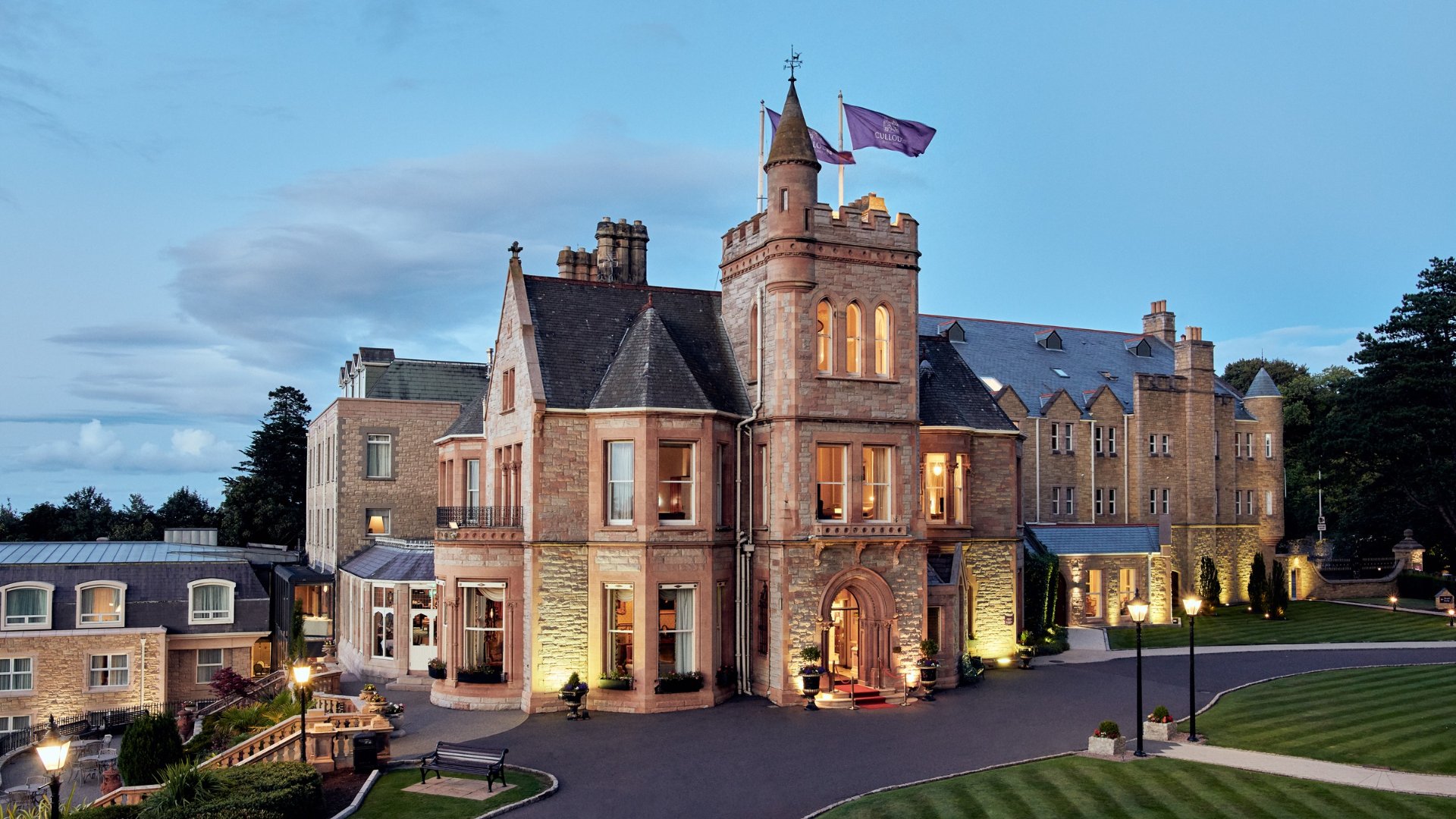
A Victorian Gothic Mansion Above Belfast Lough
Approaching Culloden Estate along the Bangor Road out of Holywood, the building announces itself before you reach the gates. The Gothic Revival stonework, steep pitched rooflines, and oriel windows are not affectations of a developer chasing period atmosphere — they are the original fabric of a mansion built in 1876 by architect William Robinson, and they have been here long enough to carry genuine weight. This is the architectural tradition of high Victorian Ulster: ecclesiastical in origin, confident in scale, and rooted in a moment when the province's merchant and professional classes were building to last. Culloden sits at the far end of that tradition, and the 12 acres of gardens and woodland that surround it absorb enough of the surrounding Holywood Hills to give the property genuine seclusion, even at its close proximity to central Belfast.
The views over Belfast Lough and the County Antrim coastline are a function of the site's elevation rather than any design intervention — the hills here provide natural amphitheatre framing, and on clear days the vista extends well beyond the city. That relationship between the house and its geography is one of the more compelling things about the property: the building reads as part of the landscape rather than imposed upon it.
From Episcopal Residence to Country House Hotel
The institutional history of this building shapes how you read it now. Culloden House was originally built as the official residence of the Bishops of Down, the Church of Ireland diocese that historically covered much of County Down. That ecclesiastical provenance explains several of the building's interior details , the soaring ceilings, the formal proportions of the principal reception rooms, the sense that the architecture was designed to project authority as much as provide comfort. In this respect, Culloden belongs to a recognisable category of British and Irish country house hotels: buildings whose original institutional function gave them a scale that purely domestic construction rarely achieved, and which now makes them compelling as hospitality properties.
Conversion from episcopal residence to hotel preserved rather than erased the building's original character. Across the wider UK and Ireland, the country house hotel category has split between properties that lean into their heritage , retaining original fittings, keeping formal room proportions, and treating patina as an asset , and those that use heritage architecture as a shell for contemporary interior design. Culloden sits closer to the former approach, where the Victorian Gothic bones of Robinson's building remain the primary experience. Comparable properties in this register include Amberley Castle in Station Road, Abbots Grange Manor House in Broadway, and Estelle Manor in North Leigh, all of which use the weight of their original architecture as the primary offer.
The Architecture in Detail
William Robinson's 1876 design draws on the Gothic Revival vocabulary that dominated institutional British architecture in the second half of the nineteenth century , pointed arches, buttress-style masonry detailing, and an asymmetrical roofline that gives the building a deliberately dramatic silhouette against the Holywood Hills. Inside, the reception rooms carry the proportions and detailing expected of a building conceived for ceremonial use: high corniced ceilings, substantial fireplaces, and the kind of spatial generosity that allows the rooms to function for events and gatherings without feeling crowded or compressed.
The 12-acre grounds operate in counterpoint to the formal architecture. The woodland and gardens absorb the house and prevent the property from feeling exposed or suburban despite its position above a commuter town. The relationship between formal garden structure near the house and the looser woodland further out is typical of Victorian country house design, where the cultivated garden acted as a transition between the built world and the natural landscape. For country house hotels in the British Isles, the grounds are often as important as the building itself , The Newt in Bruton and Lime Wood in Lyndhurst both demonstrate how extensively managed grounds can become primary amenities in their own right.
Position in the Belfast Hotel Market
Belfast's hotel market has deepened considerably over the past two decades. The city centre now carries a range of substantial properties, including The Merchant Hotel, which occupies a former bank building in the Cathedral Quarter, and The Fitzwilliam Hotel Belfast, which operates a contemporary format in the city centre. Regency House Belfast represents a different tier again. Culloden's position in this market is distinct: it is not a city centre property and makes no attempt to compete on that basis. Instead, it occupies the country house segment, offering a combination of architectural heritage, grounds, and spa facilities at a remove from the urban core that none of the city centre alternatives can replicate. The address in Holywood puts it approximately six miles from central Belfast, close enough for city access but sufficiently separate to function as a retreat.
That positioning aligns Culloden with the broader category of estate hotels that serve major UK and Irish cities from a short-drive distance , properties like Gleneagles in Auchterarder relative to Edinburgh and Glasgow, or Alexander House and Utopia Spa in Turners Hill relative to London. The calculation for guests is consistent across that category: you trade the convenience of a city centre location for scale, architecture, and grounds that urban sites cannot accommodate.
Planning Your Stay
Culloden sits at 142 Bangor Road, Holywood BT18 0EX, on the coastal road that runs between Belfast and Bangor along the southern shore of Belfast Lough. George Leading Belfast City Airport is the nearest airport, roughly four miles from the property, which makes Culloden one of the more accessibly positioned country house hotels in the British Isles relative to air access. For those arriving by train, Holywood station is served by the Belfast-Bangor line and within reasonable distance of the estate. The spa and grounds make the property viable as a base for multiple nights, though the Holywood and coastal location also positions it well for day excursions along the Antrim coast. For further context on the city's wider hospitality offer, the full Belfast hotels guide covers the complete range from urban to estate formats. The Belfast restaurants guide, Belfast bars guide, Belfast wineries guide, and Belfast experiences guide provide coverage of the broader city offer for guests using Culloden as a base.
Frequently Asked Questions
Comparable Spots, Quickly
A compact peer snapshot based on similar venues we track.
| Venue | Cuisine | Price | Awards | Notes |
|---|---|---|---|---|
| Culloden Estate and Spa | Residing high on the slopes of the Holywood Hills, overlooking Belfast Lough and… | This venue | ||
| Regency House Belfast | ||||
| The Fitzwilliam Hotel Belfast | ||||
| The Merchant Hotel |
Preferential Rates?
Our members enjoy concierge-led booking support and priority upgrades at the world's finest hotels.
Get Exclusive Access